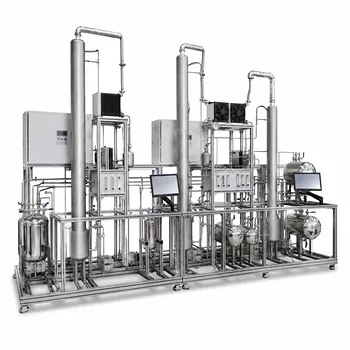
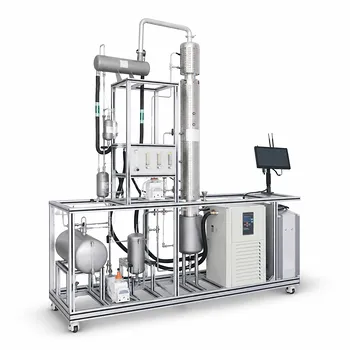
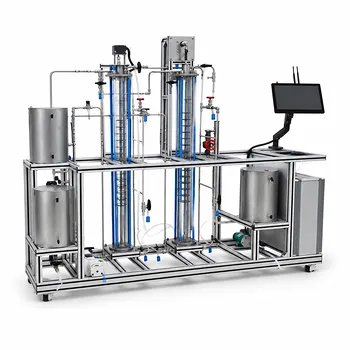
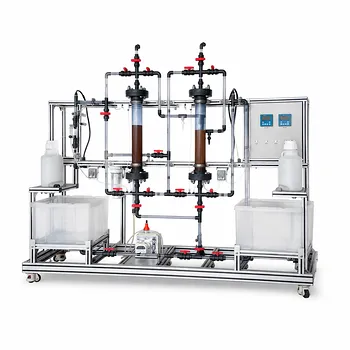
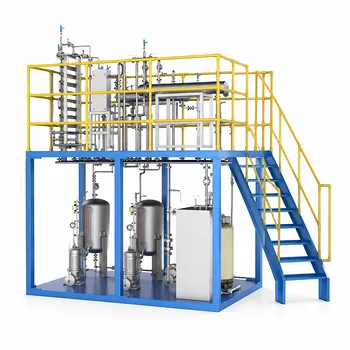
Pilot-scale distillation and extraction units are the critical bridge between small-scale chemistry and industrial reality—they give students and researchers a hands-on laboratory to systematically manipulate process conditions, directly measure separation performance, and understand the thermodynamic and transport limits that govern purity and yield. Without this physical intermediate step, the leap from textbook theory to a robust, cost-effective production process remains a dangerous guess.
Chemical engineering education and research truly come alive on the pilot plant floor. By operating physical columns and extractors, users move beyond simulation to confront real-world inefficiencies, validate theoretical models, and learn precisely how to tune parameters—from reflux ratios to solvent feeds—to minimize waste and maximize product purity, all while building the scale-up intuition that purely computational tools cannot provide.
How Physical Pilot Plant Experience Transforms Understanding
Bridging the Theory-Practice Gap
Pilot plants materialize the abstract concepts of vapor-liquid equilibrium and mass transfer. A textbook McCabe-Thiele diagram becomes tangible when you see the temperature profile along a fractionating column change in real-time. Operating the four fundamental steps—feeding, heating/stripping, vaporizing, and rectifying/condensing—helps students connect thermodynamic principles directly to physical cause and effect.
This visibility extends to extraction processes as well. Researchers can observe phase separation rates, entrainment, and the effect of agitation speed, moving from idealized ternary diagrams to the kinetic and hydrodynamic complexities of real liquid-liquid systems.
Physical Manipulation of Critical Process Parameters
A pilot plant’s true power lies in allowing deliberate, measurable changes to operating variables. You can systematically vary:
- Reflux ratios to see the immediate impact on distillate purity and energy consumption.
- Extraction temperature and solvent ratios to map the trade-off between mass transfer rate and selectivity.
- Flow rates and feed locations to understand how column loading and hydraulics affect separation efficiency.
- Cycle times and agitation speeds to optimize residence time distribution and contactor performance.
Every tweak generates hard data—temperature profiles, composition samples, pressure drops—that feeds directly into process model validation and design rules.
Minimizing Waste Through the E-Factor Lens
Waste minimization is no longer an afterthought; it’s a core design metric. On a distillation pilot plant, you can test side-draw configurations, reduced operating pressure, or advanced column internals to directly lower the E-factor (mass of waste per mass of product). In extraction, experimenting with alternative solvent systems or counter-current contactors on a pilot scale lets researchers quantify solvent recovery, toxicity, and overall green chemistry impacts long before committing to a full-scale facility.
This hands-on optimization teaches a crucial lesson: purity and sustainability are not opposing goals but are often achieved through the same rigorous process understanding.
Advanced Configurations and Control Systems That Shape Modern Design
Moving Beyond Standard Columns
Modern pilot plants frequently incorporate advanced separation technologies that demonstrate how energy efficiency and selectivity can be transformed. These include:
- Dividing wall columns (DWC) that perform a multicomponent separation in a single shell, drastically reducing capital and energy costs.
- Heat-integrated distillation schemes that reuse latent heat, cutting utility consumption by up to 30-50%.
- Membrane-assisted distillation and reactive distillation units, where a reaction and separation occur simultaneously—ideal for equilibrium-limited esterifications and transesterifications.
For researchers, these configurations become test beds for novel process intensification concepts. They validate whether the theoretical energy savings hold up under real hydraulic constraints and feed variability, providing data that purely computer-based studies cannot reliably produce.
Embedding Automation and Real-Time Optimization
Equally transformative is the integration of Model Predictive Control (MPC) and Real-Time Optimization (RTO) software. On a pilot plant, a student or researcher can tune a controller to maintain a target top-product composition while minimizing reboiler duty, or watch how an optimizer adjusts setpoints in response to a disturbance.
This exposure shifts the mindset from static design to dynamic operability. It teaches that the best process design is one that is inherently controllable and resilient, embedding the principles of process systems engineering directly into the experimental workflow.
Leveraging Quality by Design and Design of Experiments
A Structured Path to Robustness
Following Quality by Design (QbD) principles, a pilot plant becomes the perfect platform for systematic experimentation. Variables are categorized using a Cause-and-Effect risk assessment: controllable parameters (C) like flow rates, noise factors (N) such as ambient temperature, and experimental variables (X) like solvent type.
Researchers then apply Design of Experiments (DoE) methodologies—factorial designs, response surface models—to map the multivariate space. Instead of one-factor-at-a-time intuition, they uncover interactions: for instance, how the optimal extraction temperature shifts with agitation speed when using a specific solvent ratio.
Defining the Design Space
This statistical rigor delivers a proven acceptable range for each parameter, collectively forming a robust Design Space. Operating within this space guarantees target purity and impurity profile, even as raw material quality or ambient conditions fluctuate. This is a direct, industrial-grade approach to process design that transforms downstream purity from a hopeful outcome into a guaranteed specification.
Understanding the Trade-offs and Potential Pitfalls
Pilot Plants Are Not Perfect Replicas
While invaluable, pilot units have inherent limitations that must be acknowledged to avoid over-reliance. The hydrodynamics in a 2-inch diameter column do not perfectly mirror a 10-foot industrial tower; wall effects, flow maldistribution, and heat loss ratios differ. Direct linear scale-up from pilot data can be misleading if these fundamental differences aren’t accounted for through appropriate scaling laws and modeling.
The Cost and Complexity Barrier
High-fidelity pilot plants equipped with advanced control systems and GMP-grade instrumentation are expensive to build and maintain. A poorly designed pilot study—one that neglects key variables or operates within too narrow a range—can yield data that feels conclusive but is in fact dangerously incomplete, leading to a flawed industrial design.
The Risk of “Pilot Plant Blindness”
There’s a subtle organizational risk: when teams become so absorbed in pilot-scale optimization, they lose sight of the fundamental chemistry or the ultimate facility constraints. The pilot plant should serve the process design, not become a never-ending research project. Discipline is required to recognize when a parameter has been sufficiently explored and when further experiments offer diminishing returns.
Making the Right Choice for Your Goal
Your approach to using a distillation or extraction pilot plant must align tightly with your specific objective. Here’s how to focus your effort:
- If your primary focus is teaching core engineering principles: Use standard configurations with maximum visibility (like glass columns) to demonstrate thermodynamic and mass transfer steps directly, ensuring students map physical operation to VLE theory.
- If your primary focus is process intensification research: Request pilot plants equipped with dividing wall columns, reactive distillation capabilities, or membrane integration to test energy reduction and selectivity improvements under realistic hydraulic conditions.
- If your primary focus is developing a robust, scalable purification sequence: Run systematic DoE campaigns on the pilot plant, categorizing variables via QbD risk assessments, to establish a multivariate Design Space that guarantees final purity regardless of feed variability.
- If your primary focus is bridging the gap between chemistry and manufacturing: Use pilot data to validate scale-up correlations for mass transfer coefficients and hydrodynamic limits, and simulate the interplay between design constraints and operational optimization strategies.
A well-instrumented, thoughtfully selected pilot plant is not just a teaching tool—it is the definitive proving ground where chemical process design moves from speculation to a predictable, profitable, and pure reality.
Summary Table:
| Operation Type | Key Parameters Controlled | Downstream Purity & Optimization Impact |
|---|---|---|
| Distillation Column | Reflux ratio, feed location, reboiler duty, pressure | Optimizes energy consumption, fraction yield, and minimizes E-factor. |
| Liquid-Liquid Extraction | Solvent ratio, temperature, agitation speed, cycle time | Enhances mass transfer rates, phase separation, and solvent recovery. |
| Advanced Systems (DWC/Reactive) | Dividing wall dynamics, integration parameters | Drives process intensification, lowering capital costs and energy use by 30-50%. |
Elevate Your Chemical Engineering Lab with LABPARK
Ready to bridge the gap between textbook theory and industrial reality? LABPARK provides state-of-the-art Educational and Vocational Unit Operations Pilot Plants in chemical engineering, bioprocess & biotech, and environmental & water treatment.
Specially designed for universities, research institutes, and enterprises, our high-fidelity pilot units enable students and researchers to safely manipulate process parameters, validate thermodynamic models, and achieve precise downstream purity.
Contact our experts today to find the perfect pilot plant configuration for your training and research goals!
Related Products
- Green Anhydrous Ethanol Purification Extractive Distillation Unit Operations Training Pilot Plant
- Continuous Sieve-Plate Distillation Pilot Plant for Unit Operations Laboratory Education
- Multi-Modal Distillation Unit Operations Training Pilot Plant
- Dual-Mode Rectification Pilot Plant for Practical Training Unit Operations
- Continuous Batch Extractive Distillation Educational Pilot Plant
People Also Ask
- How can energy balance equations for condensers & reboilers be validated experimentally? Guide
- Fugacity vs Activity Coefficient: How to Choose VLE Models for Distillation Pilot Plants
- How can real-time carbon number prediction improve distillation pilot plants? Optimize control.
- Why run shortcut fractionation before rigorous distillation calculations? Optimize your pilot plant.
- Why is vacuum operation capability an essential feature for a distillation unit operations pilot plant? Unlock Efficiency