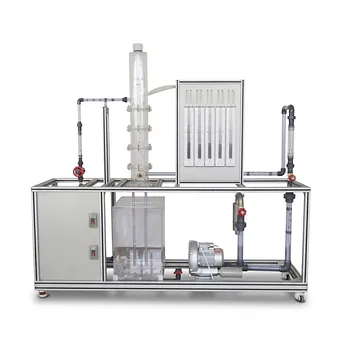
The choice of liquid flow pattern and downcomer design is not just a matter of hydraulic necessity—it is the pedagogical backbone of the entire distillation teaching laboratory. For educational pilot plants with small column diameters (typically under 2.2 meters), the single-pass crossflow configuration with a segmental downcomer is the definitive standard because it provides the simplest, most observable, and highest-efficiency demonstration of fundamental mass transfer principles. This pairing allows students to visually connect the theoretical concepts of liquid path length, residence time on the tray, and weir hydraulics directly to the measured separation performance and pressure profile of the column.
While educational pilot plants are scaled-down physical models, the core teaching imperative is to manage the deep hydraulic relationship between the tray and its downcomer. The ultimate goal is not to maximize throughput, but to create a stable, safe, and transparent platform where the rules of gravity-driven flow and vapor-liquid equilibrium are made plainly visible through easily measured variables like pressure drop and downcomer backup.
How Liquid Flow Patterns Dictate the Teaching Model
The path the liquid takes across a tray determines what students can observe, measure, and calculate. In an educational setting, the chosen flow pattern must balance operational stability with instructional clarity.
The Pedagogical Case for Single-Pass Crossflow
In small-diameter pilot plant columns, where the liquid flow rate is relatively low, the single-pass crossflow is the clear choice for instruction. It provides a long enough liquid path to establish a measurable concentration gradient across the tray.
This gradient is the physical manifestation of the mass transfer occurring. Students can sample liquid from the inlet to the outlet weir and quantify the change, making an abstract process tangible. Its structural simplicity means students spend less time troubleshooting complex hydraulics and more time analyzing the core principles of distillation.
When Multi-Pass Flow Becomes a Necessary Complexity
Single-pass flow fails in larger pilot plants or with very high liquid loads due to excessive liquid gradients and downcomer backup. In these scenarios, a double-pass flow pattern must be introduced to handle the volume.
From a teaching perspective, this shifts the lesson from basic principles to industrial unit operations modeling. Students learn why scaling up a process is not merely linear, and how improper flow distribution in a single-pass tray can lead to deviating from optimal design parameters—a key troubleshooting skill for a real-world laboratory environment.
The False Economy of U-Flow in Small Columns
While structurally simple, the reverse flow or U-flow pattern is a poor pedagogical choice for a core distillation experiment. The long, folded path significantly increases liquid residence time, which can degrade separation efficiency.
More critically, the hydraulic dead zones it creates are difficult for novice operators to identify. The data becomes "noisy" and the root cause of performance issues is hidden, teaching frustration rather than fundamental engineering principles.
Downcomer Design as the Gateway to Hydraulic Understanding
The downcomer is not a passive pipe; it is the critical control valve that governs the entire column's stability. Its design directly connects the abstract "flooding" theory to a measurable liquid backup height.
The Three Non-Negotiable Rules of Downcomer Design
Industry standards define three core rules that form the perfect framework for an educational curriculum. These rules dictate that gravity is the sole motive force, the downcomer area must be distributed for equal liquid flow, and each downcomer on a given tray must handle an identical liquid rate per area.
By applying these rules, the complex tray hydraulics are simplified into just three variables: tower diameter, side downcomer width, and the number of passes. This empowers students to define and design a stable column from scratch, moving them from passive observers to active system definers.
Visualizing the "Hidden Threat" with the Backup Calculation
The most powerful teaching tool a downcomer provides is the calculation of liquid backup height ($h_b$). This is a direct predictor of flooding.
The design guideline states that this backup height must not exceed half the sum of the tray spacing and weir height. A pilot plant equipped with pressure sensors makes this invisible phenomenon visible: students can watch the pressure drop rise, calculate the predicted backup, and physically observe its approach to the downcomer's top. This creates an unforgettable, cause-and-effect learning moment that connects total tray pressure drop—a sum of dry tray resistance, liquid head, and surface tension—to the catastrophic failure of flooding.
Segmental vs. Circular Downcomers for Student Learning
The segmental downcomer is the pedagogical partner of the single-pass tray. Its large area at the column wall is easy to inspect through viewports during operation, allowing for visual confirmation of froth height and clear liquid separation.
A circular downcomer, often used for smaller liquid loads, is less useful for teaching basic principles. Its hidden internal dynamics and smaller active frothing zones make it harder to observe and relate to the tray's active area. The segmental design provides a clear, unobstructed view of the process, reinforcing the connection between design geometry and phase separation.
Understanding the Fundamental Trade-offs
Selecting a design for a teaching environment is an exercise in balancing instructional value against operational risk. Ignoring these trade-offs can turn an educational tool into a source of constant frustration.
The Trap of Prioritizing Low Pressure Drop Above All Else
Minimizing pressure drop is crucial for smooth vapor-liquid countercurrent flow, but it cannot be the only design driver. A tray with an extremely low dry pressure drop may have poor turndown capability, leading to weeping at low vapor velocities.
In an educational setting, this instability is worse than a high pressure drop. When liquid weeps through the tray holes, the classic equilibrium stage model collapses. Students see poor separation and cannot diagnose the cause because it violates the simplified theory they are being taught.
Stability vs. Efficiency at the Cost of Visual Access
A column with perfect efficiency but solid metal walls teaches nothing. The decision to use viewports, even if they slightly compromise thermal insulation, is a critical trade-off. Instruments can report that a column is flooding, but a viewport showing the downcomer filling and the froth rising into the tray above is what cements a student's understanding. In a pilot plant, the ability to observe flow regimes is an essential "sensor" for deep learning.
The Common Misstep of Disregarding Active Area Flooding
A frequent teaching error is to focus solely on downcomer flooding while ignoring the tray's active area. In pilot plants, matching the active area flood percentage with the downcomer flood percentage is essential for stable operations.
If the active area floods due to high vapor velocity (jet flood) before the downcomer backs up, the column fails, but the measured downcomer pressure differential may not tell the full story. The pedagogical takeaway is that flooding is a system-level symptom, and students must learn to calculate and compare both flood mechanisms to successfully identify, prevent, and recover from operational failure.
Making the Right Choice for Your Educational Goals
The optimal configuration is entirely dependent on your primary learning objective. Use these specific, goal-oriented recommendations to guide your final decision.
- If your primary focus is teaching core mass transfer fundamentals: Select a single-pass crossflow tray with a wide, observable segmental downcomer. This is the clearest, most stable platform for demonstrating how liquid path length directly influences separation efficiency.
- If your primary focus is advanced operator training on industrial-scale phenomena: Choose a two-pass tray system. This configuration allows you to teach the complexities of managing liquid gradients, ensuring downcomer area is properly distributed, and troubleshooting the uneven flow problems that are common in real-world units.
- If your primary focus is demonstrating column failure and recovery modes: You must equip a single-pass system with precise pressure sensors across the tray and downcomer. This setup transparently visualizes the link between a rising pressure drop, the calculated liquid backup height, and the physical onset of flooding, turning a dangerous industrial event into a safe, repeatable classroom lesson.
The column you choose becomes the textbook your students will remember; a transparent, stable, and rule-governed single-pass design teaches the art and science of process engineering far more effectively than any opaque, high-performance black box ever could.
Summary Table:
| Design Element | Recommended Option | Pedagogical Value | Best Application |
|---|---|---|---|
| Liquid Flow Pattern | Single-pass crossflow | Establishes clear concentration gradients and observable mass transfer | Core chemical engineering labs |
| Downcomer Design | Segmental downcomer | Allows direct visual monitoring of froth height and liquid backup | Hydraulic and flooding demonstrations |
| Flow Pattern (Advanced) | Multi-pass flow | Introduces complex industrial scale-up challenges and flow distribution | Advanced operator training |
| Monitoring Tools | Viewports & pressure sensors | Connects physical flooding phenomena to real-time data readings | Quantitative & qualitative learning |
Enhance Process Engineering Education with LABPARK
At LABPARK, we empower universities, research institutes, and enterprises with state-of-the-art Educational and Vocational Unit Operations Pilot Plants in chemical engineering, bioprocess & biotech, and environmental & water treatment.
Our custom-engineered distillation columns feature transparent viewports and precise sensor integration, allowing students to visualize complex tray hydraulics, calculate downcomer backup, and study flooding phenomena in a safe, controlled environment.
Ready to upgrade your laboratory training equipment? Contact us today to discuss your curriculum requirements with our technical specialists!
Related Products
- Continuous Sieve-Plate Distillation Pilot Plant for Unit Operations Laboratory Education
- Multi-Functional Special Distillation Educational Pilot Plant
- Continuous Batch Extractive Distillation Educational Pilot Plant
- Multi-Modal Distillation Unit Operations Training Pilot Plant
- Dual-Mode Rectification Pilot Plant for Practical Training Unit Operations
People Also Ask
- How do distillation pilot plants validate VLE data? Achieve reliable solvent separation scale-up.
- Why is the column performance diagram critical? Optimize distillation pilot plant safety & efficiency.
- How does catalyst water concentration affect distillation pilot plant design? Key separation train choices.
- Why is experimental validation on a distillation unit operations pilot plant essential? Reduce azeotropic scale-up risk
- What are the primary reflux ratio control strategies? Master Distillation Unit Operations