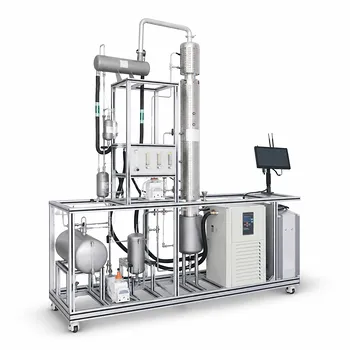
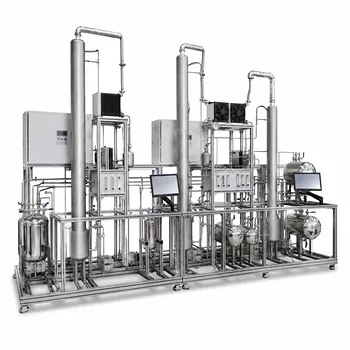
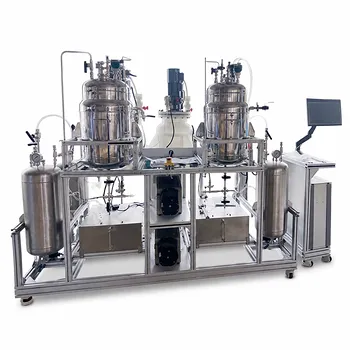
The q-value dictates the geometry of the feed line, and with it, the entire operating line landscape on a McCabe-Thiele diagram. A subcooled liquid (q > 1) creates a steep, positively sloped feed line; a saturated liquid (q = 1) yields a vertical line; and a saturated vapor (q = 0) yields a horizontal line. In a distillation pilot plant, simply adjusting the feed preheater temperature lets students directly observe how this single parameter shifts the intersection of the rectifying and stripping operating lines, altering the required number of theoretical stages and the internal vapor/liquid traffic.
The q-value is not just a parameter—it is a diagnostic lens that connects feed preheating to column traffic, stage count, and utility loads. When you vary the feed temperature in a pilot plant, you can watch operating lines shift, stage requirements change, and duties rebalance, making an abstract McCabe-Thiele concept physically tangible.
The McCabe-Thiele Foundation: Understanding the q-Line and Operating Lines
What the q-Value Really Represents
The feed thermal condition is quantified by q, the liquid fraction of the feed. Physically, it is the ratio of the heat needed to bring one mole of feed to a saturated vapor to the molar latent heat of vaporization.
For a subcooled liquid, q > 1 because extra sensible heat must first be supplied.
For a saturated vapor, q = 0, and for a vapor-liquid mixture, 0 < q < 1.
The slope of the feed line (q-line) is q/(q-1), which governs exactly where the rectifying and stripping operating lines must intersect.
Visualizing the Shift: From Subcooled to Superheated
Plotting the q-line on a McCabe-Thiele diagram makes these states visible.
A saturated liquid feed (q = 1) gives a vertical line; the intersection point is fixed at the x-coordinate of the feed composition.
A subcooled liquid (q > 1) tilts the line upward into the rectifying region, pushing the intersection higher.
A saturated vapor (q = 0) gives a horizontal line, while a superheated vapor (q < 0) slopes downward.
These shifts change how the stripping operating line is drawn relative to the equilibrium curve, directly influencing the number of theoretical plates required.
Translating Theory to a Pilot Plant Experiment
How the Feed Preheater Changes the Game
A modern distillation pilot plant is equipped with a feed preheater and precise temperature controllers, which allow you to set the exact thermal state of the stream entering the column.
By raising or lowering the preheater setpoint, you change the feed’s enthalpy and therefore its q-value.
This is the single variable that lets you demonstrate the feed-line effect without altering the feed composition, reflux ratio, or distillate rate.
Step-by-Step Lab Demonstration: Varying Feed Temperature
A structured lab exercise can involve running the column at total reflux, then introducing feed at three distinct thermal states—for example cold liquid (20 °C below bubble point), saturated liquid, and a vapor–liquid mixture (e.g., q = 0.5).
At each state, students record the temperature profile, draw the operating lines from internal flow measurements, and construct the McCabe-Thiele diagram.
They will see that with a cold liquid, the stripping operating line rotates closer to the equilibrium curve, requiring fewer total stages (a classic benzene–toluene pilot plant shifts from 13 to 11 theoretical stages when moving from a mixed feed to a cold liquid feed).
The optimal feed tray also moves—for the same system the feed point shifted from tray 7 to tray 5 from the top.
Observing the Impact on Internal Flows and Duties
The q-value dictates the discontinuity in liquid and vapor flows between the rectifying and stripping sections.
With a saturated liquid (q = 1), the liquid flow in the stripping section simply becomes L′ = L + F, while vapor flow remains unchanged.
With a subcooled liquid (q > 1), the cold feed condenses some rising vapor, increasing the internal liquid reflux rate and also raising the stripping-section vapor flow; this directly increases the reboiler heat load and steam consumption.
Conversely, a vapor-rich feed (q < 1) reduces reboiler duty, while the condenser duty remains relatively unaffected as long as the reflux ratio and distillate rate are held constant.
Understanding the Trade-offs
The Energy–Stage Trade-off: Fewer Stages vs. Higher Utility Costs
A cold liquid feed reduces the required number of theoretical stages—a tempting gain—but it always comes at a cost.
The extra sensible heat must come from somewhere; it is supplied by condensing upflowing vapor, which in turn demands a higher reboiler duty to maintain the same boil-up rate.
This is a classic capital-versus-operating-cost decision: you can build a shorter column if you are willing to pay for more steam.
In a pilot-plant setting, measuring steam and cooling water flow rates alongside stage counts makes this trade-off quantitative for students.
Pitfall: Misreading the Feed Line at Boundaries
When the feed is exactly at its bubble point or dew point, the q-line becomes vertical or horizontal, and small temperature errors can push the actual state into the adjacent region.
At these boundaries, the slope of the operating lines changes abruptly, and internal hydraulics can shift enough to risk weeping or flooding if the column internals were not designed for the altered vapor/liquid ratios.
Pilot plant experiments must therefore monitor pressure drop and tray activity closely when stepping across q = 1 or q = 0.
Making the Right Choice for Your Experiment Goal
After establishing a stable baseline, you can tune the feed thermal condition to emphasize different learning outcomes.
- If your primary focus is visualizing McCabe-Thiele principles: Run the column with a subcooled liquid, saturated liquid, and a vapor-liquid mixture. Have students plot the operating lines for each case and mark how the intersection point moves along the q-line.
- If your primary focus is energy optimization: Compare the reboiler steam and condenser cooling water demands at identical separation purity but different feed preheat temperatures. Let students calculate the cost-stage trade-off and propose an economic optimum.
- If your primary focus is column hydraulics and stability: Step the preheater through the entire range from subcooled to superheated and monitor the column pressure profile and level controls. This reveals how internal traffic loads the trays and where operational limits emerge.
A distillation pilot plant turns the q-value from an algebraic abstraction into a live operational handle. By manipulating feed temperature, you can see the operating lines move, feel the energy balance shift, and internalize the trade-offs that define real-world column design.
Summary Table:
| Feed Thermal State | q-Value | q-Line Slope | Stage Requirement | Reboiler Duty |
|---|---|---|---|---|
| Subcooled Liquid | q > 1 | Positive (Steep) | Decreased (Fewer stages) | Increased |
| Saturated Liquid | q = 1 | Vertical ($\infty$) | Baseline | Standard |
| Vapor-Liquid Mixture | 0 < q < 1 | Negative | Intermediate | Moderate |
| Saturated Vapor | q = 0 | Horizontal (0) | Increased (More stages) | Decreased |
| Superheated Vapor | q < 0 | Positive (Gentle) | Significantly Increased | Minimized |
Elevate Your Chemical Engineering Lab with LABPARK
Bridge the gap between distillation theory and hands-on practice. LABPARK provides state-of-the-art Educational and Vocational Unit Operations Pilot Plants in chemical engineering, bioprocess & biotech, and environmental & water treatment for universities, research institutes, and enterprises.
By choosing LABPARK, you gain:
- Hands-on Learning: High-fidelity systems that make abstract thermodynamics and McCabe-Thiele concepts tangible.
- Industrial Relevance: Real-world instrumentation and control systems to prepare students for industry careers.
- Robust Safety: Engineered with safety overrides and durable materials suitable for educational labs.
Ready to upgrade your lab's training capabilities? Contact LABPARK today to request a quote or custom design consultation!
Related Products
- Continuous Sieve-Plate Distillation Pilot Plant for Unit Operations Laboratory Education
- Multi-Functional Special Distillation Educational Pilot Plant
- Continuous Batch Extractive Distillation Educational Pilot Plant
- Multi-Modal Distillation Unit Operations Training Pilot Plant
- Electrolyte Distillation Purification and Formulation Educational Pilot Plant
People Also Ask
- How can real-time carbon number prediction improve distillation pilot plants? Optimize control.
- Why is vacuum operation capability an essential feature for a distillation unit operations pilot plant? Unlock Efficiency
- What are the primary reflux ratio control strategies? Master Distillation Unit Operations
- How to select the right activity coefficient model (Wilson, NRTL, UNIQUAC) for distillation pilot plants?
- How does catalyst water concentration affect distillation pilot plant design? Key separation train choices.