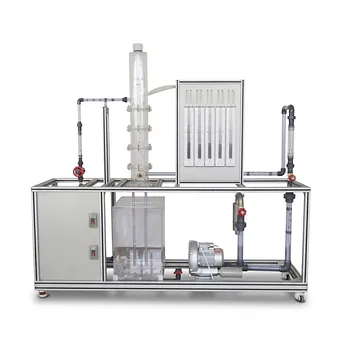
Mass transfer efficiency in an extraction column pilot plant is fundamentally controlled by how its internals manage backmixing and phase dispersion. Spray columns, the simplest configuration, rely on droplet flow but suffer from severe backmixing, yielding very low efficiency. Sieve plate columns improve performance by repeatedly forcing one phase to disperse through the other, requiring multiple plates per theoretical stage. Packed columns provide continuous, differential contact and achieve a Height Equivalent to a Theoretical Plate (HETP) typically between 0.5 and 1.5 meters, making them the preferred choice when high efficiency is needed within a modest number of stages.
The core insight: Column internals represent a direct trade‑off between simplicity and mass transfer performance. Spray columns trade efficiency for sheer simplicity, sieve plates discretize the process into observable stages, and random packing delivers the highest specific efficiency per unit height—but is best suited for duties requiring fewer than about three theoretical stages.
Why Column Internals Define Extraction Performance
Mass transfer in liquid‑liquid extraction depends on the interfacial area between phases and the concentration driving force along the column. Internals determine how these two factors are created and maintained.
The Central Role of Phase Redispersion
Each time the dispersed phase is broken into fresh droplets, new interfacial area is generated and the mass transfer driving force is re‑established. Sieve plates and packing both achieve this redispersion, but in fundamentally different ways—staged versus continuous.
Backmixing Destroys the Driving Force
Axial mixing, or backmixing, carries already‑transferred solute backwards, flattening the concentration profile. This reduces the effective driving force and can slash efficiency to a fraction of what equilibrium would predict. Spray columns are particularly vulnerable to this phenomenon.
Spray Columns: Simplicity at the Cost of Efficiency
How an Empty Tower Works
A spray column is simply an empty vessel where one liquid is atomized into droplets that rise or fall through a continuous phase. There are no internals to re‑disperse the droplets or counteract bulk fluid movement.
Severe Axial Backmixing and Poor Mass Transfer
Without internal structures, large‑scale circulation patterns develop. Droplets of the dispersed phase are entrained backwards, and the continuous phase mixes axially. The result is a very low volumetric efficiency, making spray columns impractical for any service demanding meaningful separation in a practical height.
Sieve Plate Columns: Staged Contact for Improved Stage Efficiency
Operating Principle – Repeated Dispersion Through Perforations
A sieve plate column uses a series of perforated trays. The heavier phase flows downward across each tray while the lighter phase jets upward through the holes, creating a new dispersion at every stage. This forced redispersion resets the interfacial area and suppresses backmixing between stages.
Efficiency Characteristics – 3 to 6 Plates per Theoretical Stage
Because mixing on a single tray is imperfect and some backmixing occurs, a single physical tray rarely achieves a true equilibrium stage. In extraction service, three to six sieve plates are typically required to realize one theoretical stage. This discretized behavior makes sieve plate columns excellent teaching tools, as students can directly sample between stages and measure tray‑by‑tray efficiency.
Downcomers and Counter‑Current Flow Stability
Downcomers guide the continuous phase from tray to tray without passing through the perforations. They stabilize the counter‑current flow and allow independent control of the phases. Without downcomers, the same perforations must handle both liquid streams, which can limit operating range.
Packed Columns: Continuous, High‑Efficiency Mass Transfer
Random and Structured Packing as a Continuous Contact Medium
Packing elements create a tortuous path that promotes droplet break‑up and coalescence along the entire column height. Unlike sieve plates, they do not impose discrete stages; mass transfer occurs continuously through a differential contact mechanism.
HETP and HETS – Measuring Packing Performance
The Height Equivalent to a Theoretical Plate (HETP) for random extraction packings typically falls between 0.5 and 1.5 meters, depending on packing size and type. In industrial terms, the Height Equivalent to a Theoretical Stage (HETS) often averages around 2.5 feet (0.76 m), with bed depths of 4 to 14 feet delivering the required number of stages. These low HETP values make packed columns significantly more efficient per unit height than sieve plate or spray alternatives.
Key Design Rules for Pilot‑Plant Packed Extraction
- Wetting selectivity: The packing must be preferentially wetted by the continuous phase to avoid droplet coalescence and maintain interfacial area.
- Packing size: Use a nominal size between 1/10 and 1/8 of the column diameter to minimize wall‑channeling effects.
- Redistribution: For taller beds, install liquid redistributors every 3 to 5 meters to curb axial backmixing.
- Stage limits: Packed extraction columns operate best when the duty requires fewer than about three theoretical stages; beyond that, pulsed or agitated columns are often necessary.
Understanding the Trade‑offs
Spray, sieve plate, and packed internals each map to a distinct balance of complexity, observability, and efficiency. Choosing the wrong one for a pilot‑plant objective can obscure the very phenomena you are trying to study.
- Spray columns are the simplest to build but virtually useless for meaningful separation—ideal only to convincingly demonstrate the ruinous impact of backmixing.
- Sieve plates divide the column into measurable stages, making them excellent for education and for troubleshooting tray‑specific problems. However, the need for multiple physical trays per theoretical stage limits compactness and can complicate scale‑up predictions.
- Packed columns offer the highest mass transfer per meter, but performance is sensitive to proper packing selection, wetting behavior, and redistribution. They are also limited to a small number of theoretical stages in a single continuous bed; large duties demand a different technology.
Making the Right Choice for Your Pilot‑Plant Goal
Your selection should be driven by what you need the pilot plant to teach or demonstrate.
- If your primary focus is demonstrating the devastating effect of backmixing on driving force: Use a spray column with no internals. The dramatic loss of efficiency will be immediately apparent and memorable.
- If your primary focus is achieving the highest mass transfer efficiency per unit of column height: Choose a randomly packed column and carefully match the packing material and size to your phase system and column diameter.
- If your primary focus is studying discrete‑stage behavior and measuring point‑ and tray‑efficiencies: A sieve plate column with downcomers and multiple tap points between trays is the best vehicle for that learning.
- If your primary focus is bridging to industrial practice for processes requiring more than three stages: Recognize that a simple packed or sieve plate column is not representative; you will need to consider pulsed columns or mechanically agitated internals.
Ultimately, the internal configuration turns a plain cylindrical vessel into a purposeful mass transfer device, and selecting the right one allows you to accurately isolate and investigate the physical factors that govern extraction efficiency.
Summary Table:
| Column Internal | Operating Principle | Efficiency Level | HETP / Stage Equivalent | Best For |
|---|---|---|---|---|
| Spray Column | Free droplet rise/fall without internals | Very Low | N/A (Severe backmixing) | Demonstrating backmixing |
| Sieve Plate | Discretized dispersion through trays | Moderate | 3–6 plates per theoretical stage | Stage-by-stage analysis & education |
| Packed Column | Continuous contact via packing media | High | 0.5–1.5 m HETP | Maximum efficiency in few stages |
Enhance Your Process Lab with LABPARK Pilot Plants
At LABPARK, we design and manufacture high-performance Educational and Vocational Unit Operations Pilot Plants in chemical engineering, bioprocess & biotech, and environmental & water treatment. Specifically tailored for universities, research institutes, and enterprises, our systems—including customizable extraction columns—bridge the gap between academic theory and industrial practice with unmatched reliability and precision.
Ready to upgrade your laboratory setup? Contact us today to discuss your requirements and receive a customized solution!
Related Products
- Comprehensive Liquid-Liquid Extraction Pilot Plant for Engineering Education
- Continuous Batch Extractive Distillation Educational Pilot Plant
- Natural Product Extraction Unit Operations Training Pilot Plant
- Multi-Functional Special Distillation Educational Pilot Plant
- Gallium and Indium Selective Extraction Educational Pilot Plant
People Also Ask
- How do pilot plants differentiate physical vs chemical extraction? Enhance Chemical Engineering Training
- How to Estimate KD for Liquid-Liquid Extraction Pilot Plants Using Henry's Law when Lab Data is Limited
- Why is the plait point a critical limit in liquid-liquid extraction pilot plants? Safe LLE Operation
- In a liquid-liquid extraction pilot plant, how is a ternary-phase diagram utilized to determine solvent feed requirements?
- How to Select a Liquid-Liquid Extraction Pilot Plant with Space Constraints: Key Factors