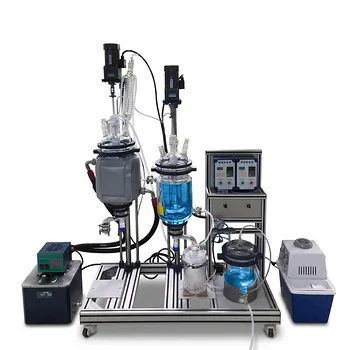
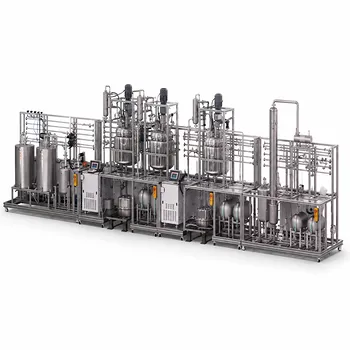
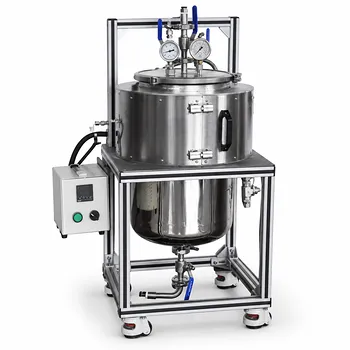
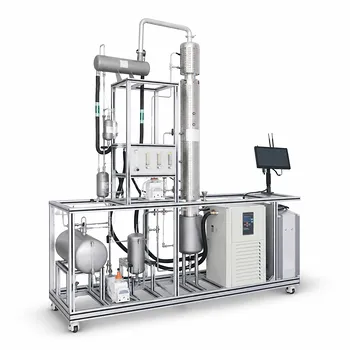
The physical attributes of your API—and therefore the efficacy of your final drug product—are not set by the chemical reaction, but by the purification steps that follow. Crystallization, filtration, and drying are the foundational unit operations that directly dictate critical quality attributes like particle size distribution, crystal form, and purity. Chemical engineering pilot plants provide the essential scaled-down environment to manipulate and master these processes, transforming theoretical knowledge into viable, scalable manufacturing strategies.
The sequence of crystallization, filtration, and drying forms an integrated chain where each step's efficiency is dependent on the one before it. A pilot plant is the only tool that lets you see this complete cause-and-effect relationship in action, allowing you to optimize not just individual steps, but the entire process cycle time and final API purity.
The Deep Link Between Processing and API Quality
The quality of an Active Pharmaceutical Ingredient (API) is defined by its physical properties. These properties are not just about chemical purity; they are about how the molecules arrange themselves into solid particles. The unit operations of crystallization, filtration, and drying are the direct manufacturing levers that control this arrangement.
Crystallization Defines the Foundation
The crystallization step establishes the fundamental physical blueprint of your API. By precisely controlling this single operation, you define the crystal's polymorphic form, size, and shape. A mistake here cannot be corrected later.
Filtration Reveals Process Efficiency
Filtration performance is a direct report card for the crystallization step. The size and shape of the crystals created earlier determine the porosity and resistance of the filter cake. A poor crystallization will inevitably lead to a slow, inefficient filtration.
Drying Seals the Final Form
Drying is not just about removing residual solvents. Applying heat can induce phase transitions, converting a desired metastable polymorph into an unwanted stable one. The drying temperature profile is the final guard against creating an unstable dose form with poor bioavailability.
How Pilot Plants Unlock Process Understanding
A textbook can provide the transport equations, but a pilot plant provides the physical intuition. These systems bridge the gap between a lab-scale synthesis that makes grams and a commercial plant that makes hundreds of kilograms. They are essential platforms for experiential learning and risk reduction.
From Batch Theory to Physical Reality
Pilot plants allow you to observe the direct consequences of thermodynamic manipulation. You can physically alter the cooling rate during crystallization and see, under a microscope, how it changes crystal size distribution. This transforms theoretical concepts into memorable, practical knowledge.
Validating In-Silico Screening
Computer simulations can screen hundreds of virtual solvents. A crystallization pilot plant validates these predictions in the real world. It shows you how mixing dynamics and heat transfer limitations at an intermediate scale can dramatically alter the outcome of a "perfect" on-screen recipe.
Exposing the Integrated Batch Recipe
A unit operations pilot plant does not run steps in isolation. It teaches how the discharge of a crystallizer directly feeds a Nutsche filter, and how that same filter might handle multiple batches. This exposes students and researchers to real-world challenges like scheduling, managing solvent-to-product ratios, and minimizing hazardous waste generation.
The Critical Crystallization-Filtration Trade-off
A key insight only gained from an integrated pilot plant is the direct conflict between crystallizer efficiency and filter efficiency. This trade-off dictates your total batch cycle time and cannot be understood by reading about the steps separately.
The Agitation and Cooling Rate Balance
Crystallization process design is a compromise. Slow cooling and low agitation grow large, pure crystals that filter beautifully and rinse easily. However, this ties up the crystallizer, a costly bottleneck in a manufacturing plant.
The Filter Cake Resistance Penalty
Conversely, rapid crystallization gets the material out of the vessel quickly but nucleates many small particles. These fines pack tightly, significantly increasing filter cake resistance and fluid kinematic viscosity. The result is a filtration step that slows to a crawl, negating any time savings.
Running the Full Cycle to Optimize
The only way to find the operational sweet spot is to run the entire crystallization-isolation sequence repeatedly. A pilot plant lets you measure the impact of particle size on cake resistance and filtration pressure, calculating the true total batch cycle time to determine the most profitable process control strategy.
Understanding the Trade-offs of Scale-Up
Transitioning from Phase I lab development to Phase II clinical supply is a minefield of scale-up risks. A pilot plant is the crucial proving ground for manufacturing processes in the 10–100 kg range, where the biggest unforeseen problems emerge.
Heat and Mass Transfer Limitations
In a 100 mL round-bottom flask, cooling and mixing are near-instantaneous. In a pilot-scale crystallizer, temperature gradients and mixing dead zones are unavoidable. These physical realities can cause uncontrolled nucleation and inconsistent crystal growth, directly impacting API powder attributes. A pilot plant is essential for identifying these critical process parameter ranges.
Continuous vs. Batch Processing
A pilot plant featuring both batch crystallizers and continuous systems, like a multistage extraction column, allows for a direct comparison. It shows how a continuous crystallizer maintains a large seed bed to prevent fine-crystal nucleation, a process design that inherently improves downstream filtration and throughput. This physical step-change from batch to continuous is a powerful learning tool.
Defining the Final Sequence
Pilot plants allow process engineers to finalize the entire unit operation sequence before locking it down for manufacturing. It's the testing ground for critical decisions like whether to use distillation or solvent extraction for purification, measuring parameters like reflux ratios and flow rates to minimize the process's environmental E-factor while ensuring maximum purity.
Making the Right Choice for Your Goal
The power of a unit operations pilot plant is that it can be focused on the specific problem you need to solve. Here’s how to apply it based on your primary objective.
- If your primary focus is developing a new controlled-release formulation: Use the pilot plant to quantify the direct relationship between crystallization cooling rates and the resulting particle size distribution to define your target physical properties.
- If your primary focus is solving a production bottleneck: Run integrated crystallization-filtration cycles to model total batch cycle time, identifying the precise particle size trade-off that balances tank time against filter speed.
- If your primary focus is de-risking a scale-up for clinical trial material: Use the pilot plant to map the heat and mass transfer limitations of your process, identifying the critical parameters that will prevent polymorph instability and ensure batch-to-batch consistency.
- If your primary focus is foundational engineering education: Structure the pilot plant curriculum around the complete batch recipe, teaching students how individual unit operations share physical resources and how waste generation is a direct function of process design choices.
The journey from a chemical formula to a life-saving medicine is a physical one. Mastering its path requires a physical teacher, and nothing prepares you for the real-world complexities of API formulation like the hands-on optimization only a pilot plant can provide.
Summary Table:
| Unit Operation | Impact on API Quality | Key Control Parameters |
|---|---|---|
| Crystallization | Defines crystal form, size, shape, and polymorph purity. | Cooling rate, agitation, solvent selection |
| Filtration | Determines processing efficiency and cake porosity. | Particle size, pressure, cake resistance |
| Drying | Finalizes physical form; prevents unwanted phase transitions. | Temperature profile, solvent removal rate |
Accelerate Your Process Optimization with LABPARK
Bridge the gap between theory and industrial reality. LABPARK provides state-of-the-art Educational and Vocational Unit Operations Pilot Plants in chemical engineering, bioprocess & biotech, and environmental & water treatment. Designed specifically for universities, research institutes, and enterprises, our pilot plants empower students and researchers to master crystallization, filtration, and drying processes first-hand.
Ready to enhance your lab's capabilities and de-risk your scale-up process? Contact us today to explore our custom pilot plant solutions!
Related Products
- Multi-Functional Drying Educational Unit Operations Pilot Plant
- Multi Functional Membrane Crystallization Educational Unit Operations Pilot Plant
- Potassium Salt Thermal Dissolution and Crystallization Separation Educational Unit Operations Pilot Plant
- Aspirin API Synthesis Unit Operations Training Pilot Plant
- Constant Pressure Filtration Educational Unit Operations Pilot Plant
People Also Ask
- How to study gasification in pilot plants? Compare exit gas composition & efficiency
- Why Use PTFE & Hastelloy in Chemical Pilot Plants? Prevent Corrosion & Ensure Safety
- Why is the chemical plant startup schedule crucial? De-risk scale-up with pilot plants.
- How do deviations in estimating latent heat impact pilot plant thermal systems? Avoid hardware mis-sizing.
- When to transition from PID to adaptive control in pilot plants? Key process indicators.