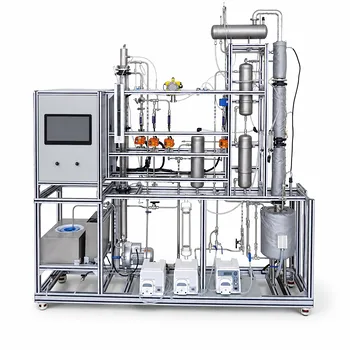
At the heart of acid gas removal lies a fundamental choice: chemically react or physically dissolve. Alkanolamine-based chemical solvents harness reversible chemical reactions to capture CO₂ and H₂S, delivering high selectivity and mass transfer even at the low partial pressures typical of post‑combustion flue gas. Physical solvents, by contrast, absorb acid gases purely through physical solubility, thrive when the gas stream is at high pressure, and can be regenerated by a simple pressure release. In a pilot‑plant setting, this dichotomy is not academic—it directly shapes the mass‑transfer kinetics, energy balances, and column‑design decisions that turn a small‑scale experiment into actionable engineering insight.
The operational sweet spots of chemical and physical solvents are diametrically opposed. Chemical amines excel where reaction‑driven mass transfer is paramount—dilute, low‑pressure streams—while physical solvents deliver their lowest energy footprint when high partial pressures make pressure‑swing regeneration viable. The pilot plant becomes your controlled arena to quantify these trade‑offs before committing to an industrial design.
Chemical vs. Physical Absorption: The Core Distinction
How Chemical Solvents Work
Alkanolamines such as monoethanolamine (MEA), diethanolamine (DEA), and methyldiethanolamine (MDEA) dissolve in water and react reversibly with acid gases. For primary and secondary amines, CO₂ forms carbamate and bicarbonate species, creating strong chemical bonds that sharply increase the driving force for mass transfer. This means a small concentration gradient can pull CO₂ out of the gas quickly, giving high removal efficiency even at low acid‑gas partial pressures.
How Physical Solvents Differ
Physical solvents—methanol (Rectisol), propylene carbonate, or dimethyl ether of polyethylene glycol (Selexol)—rely solely on van der Waals forces and hydrogen bonding to dissolve CO₂ and H₂S. The absorption capacity is governed by Henry’s Law: it scales directly with the partial pressure of the acid gas in the feed. When that pressure is high, the solvent can load heavily without a chemical reaction; when it is low, the capacity drops dramatically.
The Regeneration Divide
The binding strength dictates how you get the solvent back. Chemical solvents demand high‑temperature stripping (typically 110–125 °C) to break the chemical bonds, making regeneration the process’s energy bottleneck. Physical solvents require little more than a reduction in pressure to flash off the dissolved gases, shifting the energy demand from thermal to mechanical work.
When Chemical Solvents Shine
Tackling Low‑Pressure, Dilute Streams
Post‑combustion flue gas often contains only 3–15 vol% CO₂ at near‑atmospheric pressure. Here, amine‑based chemical absorption is the industrial benchmark. The reaction path crowds the vapor‑liquid equilibrium in favor of the liquid, so a short column can achieve high removal rates. In a pilot plant, this lets you study the fundamental interplay between reaction kinetics and gas‑side mass transfer coefficients under conditions directly relevant to power plant decarbonization.
MEA: High Reactivity, High Energy Bill
MEA remains the classic choice for teaching and research because its reaction with CO₂ is fast, giving sharp concentration profiles. The downside is that regenerating MEA is notoriously energy‑intensive—about 210 kJ per mole of CO₂ captured (equivalent to roughly 3.8 GJ per tonne CO₂). Additionally, MEA degrades to corrosive products, forcing you to limit its concentration to 15–20 wt% and to use stainless‑steel internals or corrosion inhibitors.
MDEA: A Lower‑Energy Alternative
MDEA, a tertiary amine, does not form a stable carbamate directly. Instead it catalyzes the hydration of CO₂, resulting in slower reaction kinetics but a much weaker bond. With the right additives, the regeneration energy can fall to 40–60 kJ/mol CO₂, roughly one‑quarter to one‑third of MEA’s demand. MDEA is also less corrosive, allowing solution concentrations of 40–55 wt%, which boosts the working capacity and reduces the solvent circulation rate. For a pilot plant focused on energy optimization, MDEA offers a richer experimental space.
The Physical Solvent Advantage at High Pressure
Capacity That Grows with Pressure
When the feed gas enters at 30–60 bar with CO₂ partial pressures exceeding several bar, physical solvents can load several times more acid gas than an amine solution on a volume‑for‑volume basis. This translates to smaller equipment and lower pumping costs. Pilot plants that simulate natural‑gas sweetening or pre‑combustion syngas cleaning can use physical solvents to demonstrate how much process intensification is possible solely by switching the separation mechanism.
Pressure‑Swing Regeneration in Practice
Instead of a steam‑driven stripper, a physical solvent pilot plant often pairs an absorber with a simple flash tank or multiple flash stages. A modest pressure letdown releases the dissolved gases, and the lean solvent is directly recirculated. This setup allows you to measure the electrical energy required for re‑compression (if the off‑gas must be sequestered or reused) versus the thermal energy needed for amine regeneration, addressing the complete process‑level energy balance.
Volatility and Solvent Loss
A critical caveat: physical solvents tend to have higher vapor pressures, so some solvent is carried out with the treated gas. Methanol, for example, typically requires a chilled‑methanol process (operating at –30 °C to –60 °C) to suppress evaporation. In a pilot plant, this introduces additional complexity—cryogenic temperatures, solvent recovery knock‑out drums, and safety protocols for flammable or toxic vapors—that must be accounted for in the experimental design.
Key Selection Factors for Pilot Plant Experiments
Solubility and Selectivity
The solvent must not only dissolve the target acid gas but also leave other components unaffected to avoid product loss and downstream fouling. Chemical amine solutions provide exceptional selectivity for CO₂ and H₂S over nitrogen or methane, making them safe bets for multicomponent synthetic gas studies. Physical solvents co‑absorb hydrocarbons more readily, so you will need to quantify and manage that co‑absorption if the pilot plant aims to replicate real field conditions.
Volatility, Viscosity, and Safety
Lower volatility prevents solvent drifting out of the absorber top, reducing material loss and simplifying mass balances. Low viscosity keeps the column pressure drop manageable and enhances liquid‑side mass transfer. Equally important is a safe laboratory environment—solvents should be non‑toxic, non‑flammable, and chemically stable. MEA and MDEA degrade slowly but can produce ammonia and heat‑stable salts; physical solvents like methanol are flammable and toxic, demanding sealed systems and gas detection.
Experimental Objectives vs. Practical Constraints
- If your goal is to teach reaction kinetics and absorption fundamentals, a simple aqueous amine solution (e.g., 15 wt% MEA) gives rapid, visible concentration changes and stable temperature profiles in the absorber (≈315 K) and regenerator (≈385 K).
- If the focus is energy integration or process intensification, side‑by‑side trials with MDEA‑based solvents (at ≥40 wt%) let you vary reboiler duty and measure the resulting CO₂ capture rate.
- If you want to demonstrate pressure‑swing regeneration, a physical solvent like propylene carbonate (non‑toxic, higher boiling point) allows you to operate at ambient temperature and focus on the flash‑tank design.
Understanding the Trade‑offs
The Amine Conundrum: Fast Kinetics vs. High Energy
MEA’s rapid reaction rate is a blessing for compact column design but a curse for regeneration. MDEA solves the energy problem but reacts more slowly, potentially requiring a taller column or a promoter like piperazine—adding complexity to the solvent formulation. Pilot plants must reconcile this trade‑off by deciding what to prioritize: kinetic data for mass‑transfer modeling or full‑cycle energy metrics.
Physical Solvent Limitations
At low partial pressures, physical solvents become impractical because the solvent circulation rate must be huge to achieve the required removal. Large pump capacities, higher solvent hold‑up, and the associated capital cost can distort the process economics. Moreover, many physical solvents demand operating temperatures far below ambient to control solubility and volatility, which introduces refrigerant loops and specialized materials.
Avoiding Common Pitfalls
- Neglecting corrosion management: MEA solutions degrade into corrosive species. Always select compatible wetted materials (stainless steel 304/316) and monitor pH and degradation products.
- Overlooking solvent degradation under regeneration cycling: Both chemical and physical solvents can form degradation compounds when cycling repeatedly; design your pilot plant to sample and replenish solvent regularly.
- Misinterpreting mass‑transfer coefficients: The presence of a chemical reaction alters the enhancement factor. If you compare a physical and chemical solvent in the same column, you must normalize for the effective interfacial area and the reaction kinetics to draw meaningful conclusions.
Making the Right Choice for Your Research Goal
Your pilot‑plant campaign will succeed when the solvent mirrors the conditions you aim to study and the infrastructure you can reliably support.
- If your primary focus is reaction kinetics and mass‑transfer fundamentals with a low‑pressure, dilute gas: Begin with 15–20 wt% MEA. It gives you fast, clear‑cut absorption profiles and direct access to temperature and concentration data for kinetic model validation.
- If your primary focus is energy efficiency and regeneration heat‑duty optimization: Select 40–55 wt% MDEA (possibly with a promoter). Measure the reboiler duty at varied lean loadings and build a process energy balance that informs economic feasibility.
- If your primary focus is demonstrating pressure‑swing regeneration and high‑pressure acid gas removal: Use a physical solvent such as propylene carbonate or methanol, supply your gas at 20–50 bar, and implement a flash‑tank sequence to quantify the pump‑only regeneration work.
- If your primary focus is safe, hands‑on teaching of absorption‑regeneration cycles: Prefer an aqueous amine system with a robust stainless‑steel setup and conduct thorough safety training on solvent handling, because the thermal regeneration teaches the complete loop in a single, tangible experiment.
Ultimately, every selection filter—solubility, energy demand, corrosion, safety—must be weighed against the specific learning or research outcome you aim to achieve, turning your pilot plant into a definitive, data‑driven decision tool.
Summary Table:
| Parameter | Chemical Solvents (e.g., MEA, MDEA) | Physical Solvents (e.g., Selexol, Methanol) |
|---|---|---|
| Mechanism | Reversible chemical reaction | Physical dissolution (Henry's Law) |
| Optimal Operating Pressure | Low to moderate partial pressures | High partial pressures (30–60 bar) |
| Regeneration Method | High-temperature thermal stripping (110–125 °C) | Pressure-swing flashing (mechanical reduction) |
| Energy Demand | High thermal energy (to break chemical bonds) | Low thermal energy; primary consumption is mechanical |
| Selectivity | Very high selectivity for CO₂ and H₂S | Variable; co-absorption of hydrocarbons can occur |
| Ideal Pilot Application | Post-combustion flue gas capture studies | Pre-combustion syngas or natural gas sweetening |
Scale Up Your Research with LABPARK Pilot Plants
Choosing the right solvent is just the first step in optimizing your separation processes. LABPARK designs and delivers high-performance Educational and Vocational Unit Operations Pilot Plants tailored specifically for universities, research institutes, and enterprises.
Whether your work spans chemical engineering, bioprocess & biotech, or environmental & water treatment, our custom pilot systems provide the precise, reliable data you need to bridge the gap between lab-scale testing and industrial design.
Ready to elevate your engineering experiments? Contact our technical specialists today to find the perfect pilot plant solution for your lab!
Related Products
- Fixed-Bed Chemical Reaction and Gas Dust Tar Removal Unit Operations Pilot Plant
- Gas-Solid Heterogeneous Separation Demonstration Educational Unit Operations Pilot Plant
- Dual-Mode Gas Absorption and Desorption Unit Operations Training Pilot Plant
- Absorption and Desorption Educational Unit Operations Pilot Plant
- Bench Scale Carbon Dioxide Capture Educational Unit Operations Pilot Plant
People Also Ask
- When to transition from PID to adaptive control in pilot plants? Key process indicators.
- How do deviations in estimating latent heat impact pilot plant thermal systems? Avoid hardware mis-sizing.
- Why Compare Predicted and Experimental Excess Enthalpy? Key to Accurate Pilot Plant Scale-up
- Why Use PTFE & Hastelloy in Chemical Pilot Plants? Prevent Corrosion & Ensure Safety
- How to study gasification in pilot plants? Compare exit gas composition & efficiency