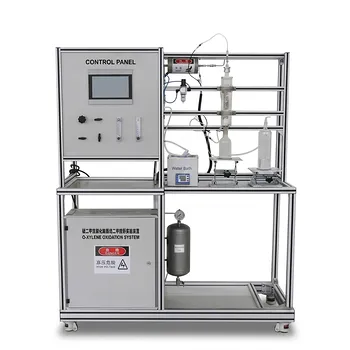
Chemical reactor pilot plants are the essential bridge between laboratory curiosity and industrial reality for studying highly exothermic reactions like selective hydrogenation. They provide a meticulously controlled, scaled-down environment where researchers can safely probe reaction kinetics, manage thermal runaway risks, and optimize catalyst performance—all while generating the critical data needed to design full-scale plants.
The central value of a pilot plant lies in transforming a hazardous, heat‑releasing reaction into a measurable, controllable experiment. By combining high‑fidelity sensors, flexible heat‑management strategies, and precise flow control, these systems allow engineers to study the reaction’s heart—its kinetics and thermal behavior—without the catastrophic consequences of a full‑scale runaway.
The Core Challenge: Taming the Exotherm in Cracked Gas Purification
Selective hydrogenation of ethyne and propyne to alkenes is a cornerstone of cracked gas purification. The chemistry is inherently dangerous because it releases enormous amounts of heat in a concentrated catalyst bed, creating a constant risk of thermal runaway.
Why Thermal Runaway Is the Defining Hazard
A thermal runaway occurs when the reaction generates heat faster than the cooling system can remove it. In a gas‑phase fixed‑bed reactor, a localized hotspot can accelerate the reaction rate exponentially, leading to catalyst sintering or even explosive decomposition.
The primary reference confirms that these reactions demand “advanced temperature profiling” and “thermal runaway mitigation strategies”—precisely the capabilities a pilot plant is built to deliver.
The Need for Empirical Kinetic Data Under Realistic Conditions
You cannot design a safe industrial reactor solely from chemistry textbooks. You need real‑time data on temperature, pressure, and concentration across a meaningful catalyst volume.
Pilot plants bridge this gap by enabling the collection of such data under conditions that mimic industrial operation, down to the gas hourly space velocity and catalyst pellet dimensions. This empirical data is then used to validate kinetic models and determine rate constants, as emphasized in the supplementary references.
Key Pilot Plant Features That Enable Safe Study
A well‑designed pilot plant is not just a shrunken reactor—it is an integrated measurement and control platform. Several specific features make it uniquely suited to highly exothermic hydrogenation studies.
Multidimensional Temperature Profiling
Instead of a single thermocouple, pilot plants embed multiple sensors along the axial and radial positions of the catalyst bed. This reveals the exact location and movement of hotspots. You can see whether the heat front migrates downstream as the catalyst deactivates, a phenomenon that is invisible at the bench scale.
Heat‑Flow Calorimetry for Reaction Enthalpy
The supplementary material describes jacketed reactor pilot plants that use continuous monitoring of the temperature difference between the reaction mixture (T_R) and the jacket fluid (T_J). Combined with a calibration heater, the system calculates the product of the heat transfer coefficient (U) and the heat exchange area (A).
This direct calorimetric measurement of the heat of reaction is indispensable. It tells you exactly how much cooling duty the full‑scale reactor will demand, removing the guesswork from scale‑up.
Flexible Heat‑Management Configurations
The primary reference highlights the ability to test both gas‑phase (fixed‑bed) and liquid‑phase (trickle‑bed) operations. The liquid phase itself acts as a heat sink, dramatically altering the thermal profile—a comparison you can only make clinically in a pilot plant.
The supplementary references expand on industrial heat‑removal methods that pilot plants can replicate. A cold‑shot quenching system injects cold feed gas at intermediate points along the bed to cap temperature rise. For fluidized‑bed configurations, internal heat transfer tubes circulate thermal fluid to draw heat directly from the reaction zone. Multi‑tubular fixed‑bed reactors use circulating molten salt or hot oil jackets to maintain near‑isothermal profiles while generating steam—a strategy that pilot plants simulate to teach thermal stability and energy balance.
Precision Flow Control and Analytical Integration
Selectivity in hydrogenation is extremely sensitive to the hydrogen‑to‑alkyne ratio. Even a slight local excess of hydrogen can over‑hydrogenate your desired olefins to alkanes. Pilot plants incorporate mass flow controllers with high turndown ratios and integrated sampling ports.
These ports, often connected to online gas chromatographs or mass spectrometers, allow researchers to map concentration profiles along the reactor length. This is how you directly correlate temperature excursions with loss of selectivity, building the cause‑and‑effect picture fundamental to catalyst optimization.
How Data from Pilot Plants De-Risks Scale‑Up
The raw measurements—temperature, pressure, concentration—are only as valuable as the engineering insights they produce. The pilot plant acts as a generator of design parameters.
Validating Kinetic Models and Rate Equations
With isothermal or near‑adiabatic datasets from the pilot plant, you can fit reaction rate equations that account for both concentration and temperature dependencies. This validated model then becomes the digital twin of your process. You can run hundreds of simulations on it to predict the behavior of a 10‑meter‑tall industrial column, something you could never do safely through direct experimentation.
Designing Emergency Relief Systems
The supplementary references note that pilot‑plant data is crucial for “designing relief systems.” In a runaway scenario, the peak pressure rise rate dictates the size of the rupture disk or relief valve. By deliberately inducing small, controlled excursions in the pilot plant (within a safety envelope), you can measure that pressure rise rate directly, providing the legal and engineering basis for your safety system sizing.
Comparing Gas‑Phase vs. Trickle‑Bed Operations Head‑to‑Head
A single pilot plant can often be reconfigured from a fixed‑bed to a trickle‑bed setup. The primary reference frames this as a core capability. Running the same catalyst with the same feed but with a liquid solvent present changes everything: heat removal becomes more efficient, but gas‑liquid mass transfer limitations can appear. The pilot plant quantifies this trade‑off, delivering the data needed to choose the right technology for a specific cracked gas cut.
Understanding the Trade‑offs and Limitations
No tool is perfect. A pilot plant’s strengths in control and measurement come with inherent compromises that must be acknowledged to avoid dangerous extrapolation errors.
Hydrodynamic and Scale Effects
A 2‑cm‑diameter tube filled with commercial‑sized catalyst pellets suffers from severe wall‑channeling and poor radial mixing. The flow distribution may be completely different from that in a 3‑meter‑diameter industrial reactor. What you measure as a hotspot in the pilot plant might be an artifact of bypassing, not a true kinetic phenomenon.
Catalyst Aging and Long‑Term Deactivation
Pilot plant campaigns typically run for hours or days, not months. Real‑world catalyst deactivation by coke formation or trace poisons (e.g., sulfur in cracked gas) is a slow process. The pilot plant’s pristine, short‑term selectivity and activity data may paint an overly optimistic picture if you ignore this time‑dependent degradation.
The Danger of Over‑Engineering the Control System
A pilot plant can maintain a set‑point temperature with a fast‑acting jacket and a suite of PID loops. An industrial reactor, with its larger thermal mass and slower utility response, cannot. If your kinetic model is trained only on perfectly isothermal data, it may fail to predict oscillations or runaways when the full‑scale system’s sluggishness kicks in. This is why deliberate transient experiments in the pilot plant are so valuable.
Configuration‑Specific Limitations
The cold‑shot method, while very effective industrially, is difficult to implement uniformly in a small‑scale pilot bed. The quench zone may simply bypass the catalyst, creating cold dead zones. Similarly, simulating molten salt circulation on a liter‑scale reactor requires significant engineering adaption that may alter the heat transfer characteristics you are trying to measure.
Making the Right Choice for Your Hydrogenation Study
A pilot plant is an investment of time and resources. How you configure and operate it must align with your deepest question.
- If your primary focus is catalyst selectivity screening: Prioritize a setup with multi‑point analytical sampling and the ability to rapidly swap between gas‑phase and trickle‑bed configurations. This lets you quickly identify the operating window where ethyne conversion is high but ethene over‑hydrogenation is minimal.
- If your primary focus is thermal runaway mitigation: Choose a plant with dense axial thermocouple arrays and a calorimetry‑capable jacket. Then, plan deliberate experiments where you step‑reduce cooling to map the margin between safe operation and the temperature inflection point.
- If your primary focus is generating scale‑up kinetic data: Run the pilot plant in a mode that closely mimics the intended industrial mixing and heat‑transfer regime. Accept that some isothermality must be sacrificed to capture the true dynamic behavior, and validate your model against transient (non‑steady‑state) data.
- If your primary focus is comparing heat removal strategies: Use a system that can be reconfigured to mimic a multi‑tubular molten‑salt‑cooled bed and a fluidized bed with internal coils. The direct, side‑by‑side measurement of heat transfer coefficients and temperature homogeneity will give you a definitive engineering basis for your technology selection.
The pilot plant does not eliminate the risk of studying highly exothermic reactions; it shrinks the hazard to a manageable scale and wraps it in an instrumented cocoon that turns danger into data.
Summary Table:
| Key Feature | Core Function | Scale-Up Benefit |
|---|---|---|
| Multidimensional Temp Profiling | Tracks axial/radial hotspot movement | Prevents catalyst runaway and sintering |
| Heat-Flow Calorimetry | Measures reaction enthalpy & heat transfer | Sizes industrial cooling duty accurately |
| Flexible Configurations | Simulates fixed-bed or trickle-bed setups | Optimizes phase choice for heat removal |
| Precision Flow Control | Regulates reactant ratios (e.g., $H_2$ to alkyne) | Maximizes product selectivity and yield |
Scale Up Your Research Safely with LABPARK Pilot Plants
Bridging the gap between laboratory discovery and industrial production requires precise control and reliable data. LABPARK provides advanced Educational and Vocational Unit Operations Pilot Plants in chemical engineering, bioprocess & biotech, and environmental & water treatment.
Tailored for universities, research institutes, and enterprises, our pilot plants are engineered to help you safely study highly exothermic reactions, optimize catalyst performance, and secure the empirical data needed for successful scale-up.
Ready to elevate your research capabilities? Contact LABPARK today to explore our customizable pilot plant solutions!
Related Products
- Fixed-Bed Chemical Reaction and Gas Dust Tar Removal Unit Operations Pilot Plant
- Fixed Bed Gas Solid Catalytic Reaction Educational Pilot Plant
- 100L Continuous Loop Hydrogenation Educational Unit Operations Pilot Plant
- Multi-Reactor Educational Pilot Plant for Reaction Engineering Unit Operations
- Residence Time Distribution and Reactor Flow Characteristics Determination Educational Pilot Plant
People Also Ask
- When to transition from PID to adaptive control in pilot plants? Key process indicators.
- How do deviations in estimating latent heat impact pilot plant thermal systems? Avoid hardware mis-sizing.
- Why Compare Predicted and Experimental Excess Enthalpy? Key to Accurate Pilot Plant Scale-up
- How to study gasification in pilot plants? Compare exit gas composition & efficiency
- Why Use PTFE & Hastelloy in Chemical Pilot Plants? Prevent Corrosion & Ensure Safety