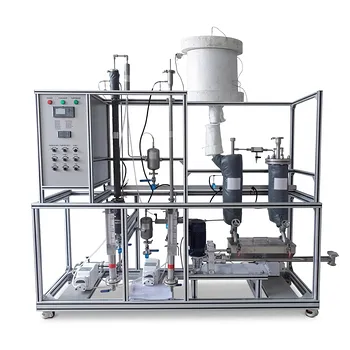
They translate an abstract equilibrium equation into a visceral lesson in material failure, process safety, and thermodynamic compromise. Chemical engineering educational pilot plants bridge the gap between textbook theory and industrial reality by forcing students to confront the physical constraints that equations ignore. While theory states that high pressure favors ammonia yield and high temperature accelerates the reaction, a pilot plant demonstrates that these two variables cannot be optimized in isolation—they create a dangerous environment where hydrogen atoms infiltrate steel, catalysts sinter at excessive temperatures, and exothermic runaway is a constant threat.
The core challenge of high-pressure catalytic processes isn't the chemistry of the reaction itself; it’s the hostile physical environment the reaction creates. Educational pilot plants shift the focus from molecular conversion percentages to the engineering realities of materials science, dynamic heat management, and safety system design.
Confronting the Limits of Materials
Before students can optimize a reaction yield, a pilot plant teaches them that the reactor vessel itself is a consumable variable.
The Threat of Hydrogen Embrittlement
High-temperature hydrogen gas is molecularly small and highly diffusive. Under pressures exceeding 100 bar, atomic hydrogen penetrates the crystal lattice of standard stainless steel, reacting with carbon to form methane. This causes internal decarburization and micro-cracking, leading to sudden, catastrophic brittle failure. A pilot plant designed with specialized high-strength, low-alloy steels makes this invisible threat tangible, showing why material selection is the first step in reactor design.
Real-Time Kinetic and Thermodynamic Mapping
Textbooks present the rate law and Le Chatelier’s principle as separate concepts. A pilot plant integrates them dynamically. By manipulating a fixed-bed catalytic reactor’s temperature control zones, students observe that a lower inlet temperature increases the equilibrium potential but collapses the reaction rate, yielding almost no product. This teaches that a "compromise temperature" (around 670–700 K) is a hard requirement, not a theoretical suggestion.
Managing the Exothermic Reality
The reaction is not isothermal. The physics of heat transfer dominate the design far more than the stoichiometry.
Observing Temperature Profiles
In a packed bed reactor, the exothermic reaction releases heat axially, creating a pronounced hot spot. A pilot plant with multi-point thermocouples reveals that the average bed temperature is a misleading metric. Students see the actual location of the peak temperature, learning that they must manage heat removal to prevent thermal degradation of the downstream catalyst or, worse, a positive feedback loop leading to a thermal excursion.
Pressure Drop and Mass Transfer
The kinetic equation assumes uniform partial pressures, but a packed bed creates friction. A pilot plant with differential pressure transmitters across the catalyst bed quantifies the energy loss required to simply push gases through the reactor. This teaches the economic reality of high-pressure operation: compression costs money, and a crushed or fouled catalyst bed with a high pressure drop can render a process economically unviable, regardless of its conversion efficiency.
Safety as a Design Parameter, Not a Protocol
In a pilot plant, safety is not a rule posted on the wall; it is integrated into the equipment's physical architecture.
The Hierarchy of Controls
Students operate systems where containment is the primary defense. They see blast shields, double-walled tubing, and automated interlock sequences that trigger emergency depressurization. When an overpressure event is detected by a sensor, the logic solver cuts the high-pressure gas feed and opens a vent valve within milliseconds. This experience permanently links process design to functional safety, a link often missed in theoretical study.
Gas Leak Detection and Confinement
Ammonia is toxic, and hydrogen is highly flammable in air. These pilot plants feature continuous extraction systems and electrochemical sensors that detect leaks at parts-per-million levels. The system shuts down before a flammable cloud can form, teaching that handling hazardous products requires designing for the failure mode, not just the steady state.
Understanding the Trade-offs
Objectively, not every educational insight requires the risk and expense of a high-pressure catalytic rig. There are distinct limitations to this approach.
The High Cost of Authenticity
Pilot units rated for 200 bar and constructed of exotic alloys are capital-intensive to build and costly to maintain. Seals, metal diaphragms, and valve seats degrade rapidly, particularly under hydrogen service. This overhead means student throughput is often limited, and the learning experience is focused on a narrow, albeit deep, set of chemical processes.
The "Black Box" Risk
Paradoxically, the advanced automation required for safety can obscure fundamental understanding. If a student simply inputs a setpoint into a PID loop and a logic solver handles the rest, the manual "feel" for process dynamics can be lost. The pilot plant becomes an exercise in software monitoring rather than hands-on process engineering, requiring instructors to design experiments that deliberately require manual intervention before a high-level alarm trips.
Making the Right Choice for Your Learning Goal
A high-pressure catalytic pilot plant is a specialized tool. Its value depends entirely on your specific educational objective.
- If your primary focus is teaching fundamental reaction kinetics and equilibrium: Use the pilot plant. Only by witnessing the yield plateau before reaching theoretical equilibrium can students internalize the kinetic limit.
- If your primary focus is material science and process safety training: Use the pilot plant. Exercises in hydrogen embrittlement analysis or pressure relief valve sizing require the physical context of a high-pressure system.
- If your primary focus is basic unit operations and standard process control: A low-pressure, air-water system is more effective and far cheaper. The extreme material constraints and safety interlocks of a high-pressure cell distract from basic PID tuning and flow measurement principles.
- If your primary focus is operator training for an industrial facility: Use the pilot plant, but only if it is a meticulous replica of the full-scale unit’s control logic. Psychological fidelity to the plant floor is paramount.
The ultimate value of an educational high-pressure pilot plant lies not in proving the Haber-Bosch process works—it’s in demonstrating all the ways it can fail if the physics of the non-ideal world are ignored.
Summary Table:
| Challenge | Textbook Theory | Pilot Plant Reality (Educational Value) |
|---|---|---|
| Material Limits | Assumes reactor vessels are static & inert | Teaches hydrogen embrittlement & material failure risks |
| Heat Management | Assumes ideal isothermal/adiabatic conditions | Reveals real-time thermal runaways & catalyst hot spots |
| Process Economics | Ignores friction & compression costs | Demonstrates pressure drops & catalyst fouling impact |
| Process Safety | Presented as theoretical rules & protocols | Integrates automated interlocks & containment barriers |
Bring Industrial Reality to Your Lab with LABPARK
Bridging the gap between chemical engineering theory and hands-on reality requires robust, safe, and reliable equipment. LABPARK provides state-of-the-art Educational and Vocational Unit Operations Pilot Plants in chemical engineering, bioprocess & biotech, and environmental & water treatment designed specifically for universities, research institutes, and enterprises.
Our pilot plants allow students and researchers to safely confront real-world challenges like high-pressure kinetics, thermodynamic limits, and advanced process safety control.
Ready to elevate your engineering curriculum or research capabilities? Contact us today to request a quote or custom consultation!
Related Products
- Methanol Synthesis and Catalyst Performance Evaluation Educational Unit Operations Pilot Plant
- Ethyl Acetate Synthesis Unit Operations Pilot Plant for Practical Training
- Multi-Functional Special Distillation Educational Pilot Plant
- Carbon Dioxide Hydrogenation Methanol Synthesis Educational Unit Operations Pilot Plant
- Carbon Dioxide Hydrogen Methanol Synthesis Educational Unit Operations Pilot Plant
People Also Ask
- Why is a purge system necessary when operating a gas recirculation loop in a methanol synthesis pilot plant? (Guide)
- How do temp & pressure affect methanol synthesis pilot plants? Optimize equilibrium and catalyst performance.
- Why do modern methanol pilot plants operate at lower pressures? Catalyst & Feed Requirements Explained
- What are the operational requirements for catalyst activation? Safe Methanol Pilot Plant Operation
- How do steady-state and dynamic simulations complement pilot plants? Validate scale-up and controllability