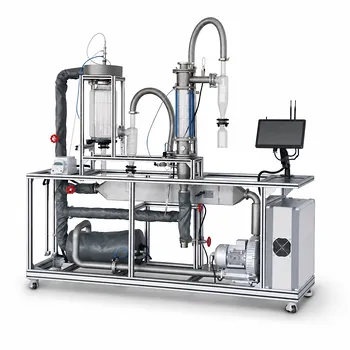
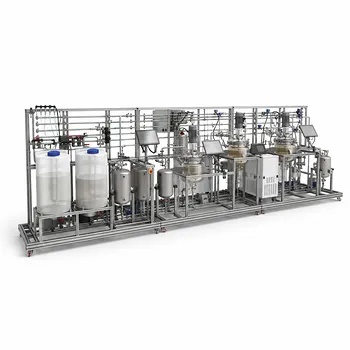
Pilot-scale chromatography and EBA units are your most powerful tools for cracking the toughest purification challenges. Bioprocess pilot plants address downstream purification bottlenecks by letting you master high-resolution chromatography for polishing and by collapsing three costly steps into one with Expanded Bed Adsorption (EBA). These scaled-down systems make it possible to systematically optimize separation mechanisms, handle dirty, cell-laden feeds directly, and minimize the denaturation that destroys fragile biomolecules—all while generating real-world scale-up data that prevents expensive industrial failures.
The core takeaway: Chromatography pilot units teach you to fine-tune selectivity and master the hidden complexities of column packing, while EBA pilot units let you process unclarified broths directly, merging clarification, concentration, and initial capture into a single, clog-free unit operation that can slash downstream costs—often the lion’s share of total production expense.
The Costly Challenge of Downstream Purification
Downstream processing typically devours between 40% and 90% of the total manufacturing cost for modern bioproducts. The culprits are the extreme dilution of target molecules in fermentation broths, the minuscule size of biological particles (often 0.01–10 µm), and the sheer fragility of proteins and viruses. Pilot plants bridge the gap between benchtop concepts and factory floors, giving you a controlled environment where you can attack these cost drivers systematically.
Pilot-Scale Chromatography: Mastering High-Resolution Separation
Chromatography pilot units are not just bigger lab columns—they are rigorous engineering platforms that force you to confront the physics and logistics of purification at production-relevant scales.
Simulating Real-World Separation Mechanisms
These units let you evaluate ion exchange, affinity, hydrophobic interaction, and gel filtration techniques side by side. By adjusting pH, salt gradients, and flow rates, you can isolate high-purity proteins, organic acids, or antibiotics from clarified media while building a purification protocol that balances yield, purity, and throughput.
Understanding Scale-Up Dynamics
A fundamental rule taught by chromatography pilot plants is that during scale-up you keep bed height and linear flow rate constant, and simply increase column diameter and bed volume to boost volumetric throughput. This principle looks simple on paper, but the pilot scale reveals how resin compression, wall effects, and flow maldistribution truly behave when you move to wider columns.
Learning Critical Hardware and Packing Skills
Modern resins can offer protein loading capacities exceeding 30 g/L and withstand high operating pressures, but performance collapses if the column is packed poorly. Pilot plants expose you to the art of uniform slurry packing, the impact of distributor screens and headplates, and the real cost of channeling. You learn that column hardware is as important as the chemistry inside it.
Expanded Bed Adsorption: The Single-Unit Revolution for Crude Feeds
EBA pilot units attack the most stubborn bottleneck in downstream processing: the need to clarify viscous, particle-laden broths before any capture step can begin.
How EBA Collapses Three Steps into One
In traditional processing, you must centrifuge or filter whole fermentation broth to remove cells and debris, then concentrate the dilute product, and only then begin initial purification. EBA eliminates these separate operations by capturing the target protein directly from the crude, unclarified feed. The adsorbent bed is fluidized into a stable, expanded state, creating space for cells and debris to flow through while product molecules bind to the resin.
Managing Unclogged, Dirty Feedstocks
Because the bed is expanded rather than packed, EBA avoids the clogging that would instantly ruin a traditional chromatography column. You can pump whole fermentation broth—complete with cells, cell debris, and particulates—straight into the column. This direct-from-bioreactor approach dramatically shortens processing time and reduces open-handling steps where shear or microbial contamination can strike.
Optimizing Parameters to Shield Fragile Biomolecules
EBA pilot units let you study how to balance flow velocity, bed expansion ratio, and dynamic binding capacity while keeping target biomolecules intact. By controlling the upward liquid flow and carefully selecting bead density and size, you minimize the shear stress, pH swings, and temperature gradients that cause denaturation. You learn to design a capture step that treats your product gently while handling the harshest industrial feedstocks.
Navigating the Trade-offs and Practical Pitfalls
No technology is without its weaknesses, and an honest pilot-plant curriculum teaches you exactly where these methods can fail.
For chromatography, the pilot scale exposes how column packing becomes exponentially more difficult as diameter grows, often requiring mechanical packing stations and strict quality control. Resin costs are significant, and cleaning-in-place protocols must be validated to avoid cross-contamination. The high resolution comes at the price of lower throughput compared to bulk-capture methods.
For EBA, the expanded bed is highly sensitive to variations in feed viscosity and biomass concentration. Improper flow distribution can cause the bed to become unstable, leading to loss of adsorption efficiency and channeling. Additionally, EBA typically offers lower resolving power than packed-bed chromatography, making it a capture step that must be followed by polishing—usually on a chromatography pilot unit. Finally, the feedstock’s conductivity and pH must still be adjusted, so EBA is not entirely “plug-and-play” from the fermenter.
Making the Right Choice for Your Goal
Your downstream pilot-plant strategy should be driven by the specific problem you are trying to solve.
- If your primary focus is slashing overall production costs: Prioritize the EBA pilot unit to collapse clarification, concentration, and capture into a single operation and eliminate expensive centrifugation or filtration equipment.
- If your primary focus is meeting the strictest purity standards for a therapeutic protein: Deepen your work on multi-step chromatography pilot units, using the platform to optimize selectivity, gradient elution, and column packing reproducibility.
- If your primary focus is preparing a workforce for industrial scale-up: Integrate both unit operations, so operators gain hands-on experience with the entire spectrum—from handling crude feedstocks in EBA to mastering the nuances of high-resolution polishing and column hardware.
The right pilot plant does more than replicate industrial equipment; it transforms your team’s understanding of purification economics and gives you the hard data to build processes that work at scale the first time.
Summary Table:
| Feature | Chromatography Pilot Units | Expanded Bed Adsorption (EBA) |
|---|---|---|
| Primary Application | High-resolution purification & polishing | Direct capture & clarification of crude feeds |
| Process Flow | Requires pre-clarified, filtered feed | Processes unclarified fermentation broth directly |
| Step Efficiency | High resolution, multi-step process | Collapses clarification, concentration, and capture |
| Key Scale-up Focus | Column packing, wall effects, bed height | Bed stability, fluid velocity, feed viscosity |
Bring Industry-Scale Bioprocessing to Your Lab with LABPARK
Bridge the gap between benchtop theory and industrial reality. LABPARK provides state-of-the-art Educational and Vocational Unit Operations Pilot Plants in chemical engineering, bioprocess & biotech, and environmental & water treatment.
Engineered specifically for universities, research institutes, and enterprises, our pilot systems empower your team to master chromatography column packing, EBA fluid dynamics, and downstream scale-up economics.
Ready to enhance your training and research capabilities? Contact us today to find the perfect pilot plant for your facility!
Related Products
- Bio-fermentation Ethanol Production Practical Training Unit Operations Pilot Plant
- Multimodal Absorption and Desorption Pilot Plant for Unit Operations Training
- Natural Product Extraction Unit Operations Training Pilot Plant
- Multi Pump Fluid Transport Process Piping Unit Operations Training Pilot Plant
- Multi-Functional Drying Educational Unit Operations Pilot Plant
People Also Ask
- Why Use PTFE & Hastelloy in Chemical Pilot Plants? Prevent Corrosion & Ensure Safety
- Why Compare Predicted and Experimental Excess Enthalpy? Key to Accurate Pilot Plant Scale-up
- Why is the chemical plant startup schedule crucial? De-risk scale-up with pilot plants.
- When to transition from PID to adaptive control in pilot plants? Key process indicators.
- Why must batch and fed-batch fermentation pilot plants be designed to accommodate changing rheological conditions?