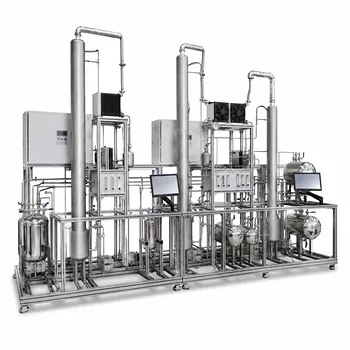
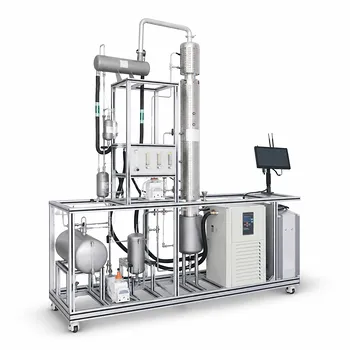
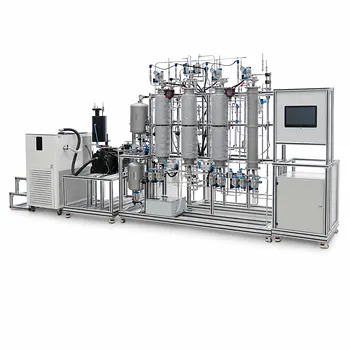
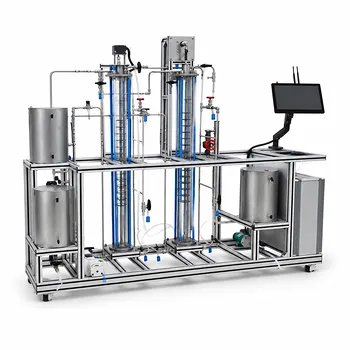
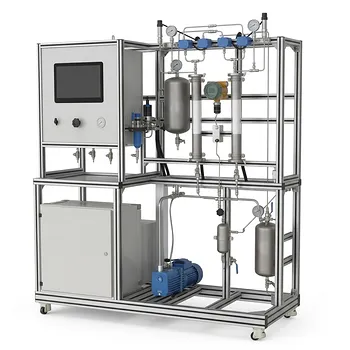
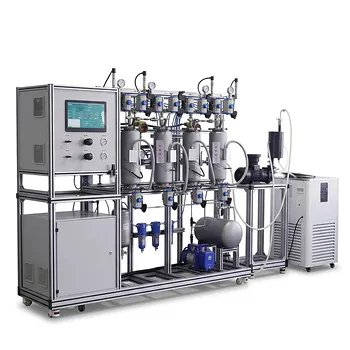
The key to shattering the ethanol-water azeotrope in a pilot plant lies not in adding more chemicals, but in adding a selective membrane. A unit operations pilot plant integrates a distillation column with a pervaporation (PV) unit. The distillation column first concentrates the ethanol-water mixture to its atmospheric azeotropic composition (about 95.6% ethanol). This near-azeotropic distillate is then fed directly into the PV unit, where a hydrophilic membrane (such as polyvinyl alcohol or zeolite) selectively permeates water vapor. The retentate emerges as high-purity, absolute ethanol, bypassing the thermodynamic ceiling that would otherwise require an entrainer.
The hybrid distillation–pervaporation pilot plant overcomes the ethanol-water azeotrope without any chemical additives. It does so by coupling a pre-concentration column with a membrane that removes the last fraction of water, delivering 30–40% energy savings compared to conventional azeotropic distillation and enabling ethanol purities up to 99.8%.
Why Ethanol-Water Forms an Unbreakable Wall for Distillation
The Azeotrope That Blocks Simple Stripping
When ethanol and water are mixed, their vapor-liquid equilibrium creates a minimum-boiling azeotrope at roughly 95.6 wt% ethanol. No matter how many stages you add, an ordinary distillation column cannot produce a distillate richer in ethanol than this composition because the vapor and liquid phases become identical.
In educational and research pilot plants, this thermodynamic barrier is the perfect demonstration of a fundamental separation limit. The only way around it in a purely distillation-based system is to introduce an entrainer (e.g., benzene, cyclohexane) and operate complex multi-column sequences with decanters. That approach consumes significant energy and adds chemical complexity.
The Membrane’s Role: Separation by Permeation, Not Equilibrium
Pervaporation circumvents the azeotrope entirely because it does not rely on vapor-liquid equilibrium. Instead, separation is driven by differences in chemical potential and permeation rates through the membrane. A hydrophilic membrane preferentially sorbes and transports water molecules, while ethanol is retained. This physical selectivity persists regardless of the feed’s proximity to the azeotropic composition, making it the ideal tool for the final dehydration step.
How the Integrated Pilot Plant Is Configured and Operated
The Two-Stage Hybrid Flow Sheet
A typical hybrid pilot plant for ethanol dehydration is built from two core modules connected in series:
- Distillation column – A packed or tray column that concentrates the ethanol-water feed. The column is operated to deliver a distillate that is as close as mechanically feasible to the azeotrope.
- Pervaporation (or vapor permeation) unit – The near-azeotropic stream is fed to the membrane module. If the column’s top vapor is taken directly (vapor permeation mode), the feed is already hot (often around 100°C), minimizing additional heating. In standard pervaporation, a liquid distillate is reheated before contacting the membrane.
The permeated water vapor is collected on the low-pressure side of the membrane, condensed, and often recycled back to the distillation column. This recycle stream ensures nearly 100% ethanol recovery while keeping the column’s feed composition stable. The retentate leaving the membrane—now ultra-dry ethanol—is cooled and collected as the final product.
Essential Instrumentation for Teaching and Research
Modern pilot plants are equipped with temperature sensors, pressure transmitters, and in-line concentration analyzers at key points: column reboiler, top of column, PV feed, permeate, and retentate. This real-time data allows students and researchers to:
- Calculate mass and energy balances across the hybrid boundary.
- Observe how the membrane unit’s removal rate shifts the column’s operating profile.
- Physically verify that the process breaks an azeotrope without an entrainer, bridging simulation and physical operation.
The Energy and Efficiency Gains That Make This Hybrid a Benchmark
Why Energy Drops by 30–40%
In pervaporation, only the permeating component (water) is vaporized, not the entire feed mixture. The heat of vaporization is supplied in a focused manner to the membrane surface, whereas distillation requires boiling and reboiling the bulk liquid. Additionally, eliminating the azeotropic entrainer avoids the energy penalties of entrainer recovery columns, solvent make-up purification, and liquid-liquid phase separation heating. The result is a total energy consumption 30–40% lower than a conventional three-column azeotropic distillation sequence.
How Throughput Can Increase by up to 40%
When the permeate (water-rich) is recycled to the column, the distillation column’s load is effectively split. The membrane takes on the difficult final purification step, freeing the column to operate at a higher feed rate. In pilot-scale studies, this balanced load can increase the processing capacity of the distillation column by up to 40%, allowing the same hardware to train larger volumes of ethanol.
Understanding the Trade-offs and Potential Pitfalls
Membrane Lifetime and Fouling
Hydrophilic membranes are susceptible to fouling by trace impurities (sugars, proteins, salts) if the feed is not a clean ethanol-water mixture. In a pilot plant environment, even small amounts of contaminant in the recycling permeate can degrade membrane performance over time. This demands rigorous upstream filtration and periodic cleaning, adding operational complexity.
Heat Integration Sensitivity
The energy advantage relies on the distillation column delivering a hot stream. If the PV module requires additional heating or if the permeate recycle is too cold, the overall energy balance can worsen. Poor synchronization between the column duty and the membrane heating requirement can erase the advertised 30% savings. Precise temperature control is essential.
System Dynamics with Recycle Loops
Recycling the water-rich permeate back to the column couples the two units strongly. This can introduce slow control oscillations if the membrane’s removal rate fluctuates. Operators must learn to tune the column’s reflux ratio and reboiler duty in tandem with the membrane’s vacuum pressure to prevent the column from flooding or drying out. Pilot plants are excellent training grounds for mastering this dynamic interaction.
Capital Investment vs. Operational Benefit
While the process saves energy, the membrane module and vacuum system increase capital cost compared to a simple distillation column. For a small pilot plant used in education, the value lies in the ability to demonstrate two separation principles in one rig. For volume production evaluation, the trade-off between membrane replacement costs and energy savings must be carefully mapped.
Making the Right Choice for Your Pilot Plant Goal
The exact integration architecture you choose should be driven by your primary objective.
- If your primary focus is demonstrating green separation principles: Use a standalone pervaporation module fed by the column’s top vapor (vapor permeation). This configuration most clearly shows that no entrainer is needed, and the energy savings are visually apparent because you bypass an entire second column.
- If your primary focus is teaching dynamic process control and mass balance closure: Implement the full recycle loop from the permeate back to the column feed. This mirrors industrial practice and gives students experience with coupled unit dynamics, data reconciliation, and PID tuning on an interactive separation network.
- If your primary focus is benchmarking energy consumption for scale-up: Run identical tests with and without the membrane, and measure total utility consumption (steam, vacuum pump electricity) while monitoring retentate purity. The 30–40% energy saving figure becomes a quantifiable student project or research dataset.
By treating the distillation column and pervaporation unit not as separate experiments but as a single, integrated separation system, you equip your pilot plant to teach the most important lesson in modern chemical engineering: how to combine thermal and membrane processes to conquer thermodynamic barriers cleanly and efficiently.
Summary Table:
| Metric | Conventional Distillation | Hybrid Distillation-Pervaporation |
|---|---|---|
| Azeotrope Breaker | Chemical entrainers (e.g., benzene) | Hydrophilic membrane (physical barrier) |
| Energy Savings | Baseline | 30% to 40% reduction |
| Max Ethanol Purity | ~95.6% (without entrainer) | Up to 99.8% |
| Throughput Capacity | Baseline | Up to 40% increase |
Optimize Your Lab with LABPARK's Hybrid Pilot Plants
Are you looking to bridge the gap between thermodynamic theory and green industrial practices?
LABPARK provides state-of-the-art Educational and Vocational Unit Operations Pilot Plants in chemical engineering, bioprocess & biotech, and environmental & water treatment. Designed specifically for universities, research institutes, and enterprises, our systems enable hands-on experience with advanced hybrid separations, energy optimization, and real-time process control.
Ready to upgrade your laboratory capabilities? Contact our team of experts today to discuss your custom pilot plant configuration!
Related Products
- Multi-Functional Special Distillation Educational Pilot Plant
- Bio-fermentation Ethanol Production Practical Training Unit Operations Pilot Plant
- Green Anhydrous Ethanol Purification Extractive Distillation Unit Operations Training Pilot Plant
- Green Anhydrous Ethanol Refining Practical Training Pilot Plant
- Continuous Batch Extractive Distillation Educational Pilot Plant
People Also Ask
- Why does simple distillation yield higher efficiency than flash distillation? Key thermodynamic differences.
- How Batch vs Continuous Configuration Affects Distillation Pilot Plant Versatility & Footprint
- How to Estimate Distillation Pilot Plant Tray Efficiency? O'Connell's Correlation Guide
- Why is the acentric factor important in pilot plants? Fluid property prediction.
- How to Verify Distillation Boundary Lines & Composition Regions with Pilot Plants