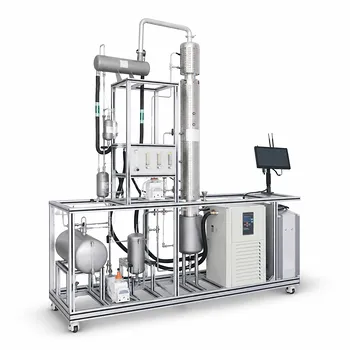
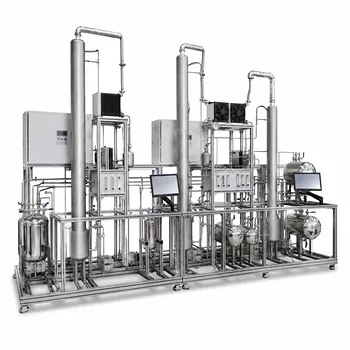
The safe distillation of carbon disulfide in a pilot plant is not a standard configuration—it is a deliberate exercise in hazard mitigation. A system for this highly volatile, flammable, and toxic solvent must be built around three non‑negotiable pillars: explosion‑proof design, complete vapor containment, and an inert operating atmosphere. In practical terms, that means ATEX‑rated electrical components, high‑efficiency condensers capable of trapping the 46 °C vapor, and a closed‑loop vent system with a scrubber that eliminates dangerous emissions.
The core challenge is that carbon disulfide’s extreme flammability and toxicity leave no room for experimental error. A pilot plant that safely handles it must be engineered as a sealed, oxygen‑free environment where every energy source is ignition‑proof and every vapor pathway ends in a capture or destruction device—not in the breathing zone of the operator.
Decoding the Hazard Profile of Carbon Disulfide
A Perfect Storm of Low Boiling Point and Extreme Volatility
Carbon disulfide boils at just 46 °C—barely above body temperature. This means even a small amount of uncontrolled heat will generate a dense, flammable vapor cloud. The distillation column must therefore be designed for extremely tight temperature control, using low‑gradient heating sources (like steam or an enclosed‑mantle) to prevent sudden ebullition and vapor surge.
Flammability and Toxicity Demand a Zero‑Leak Philosophy
The liquid is only slightly soluble in water, so aqueous scrubbing alone is insufficient. Its vapor is heavier than air and can travel long distances to an ignition source. This forces a closed‑loop philosophy: the entire distillation train, from reboiler to receiver, must be a sealed system that does not release vapor into the lab. Any vent line must be routed through an activated‑carbon or chemical scrubber before discharge, and the pilot plant must reside under a dedicated fume hood or in an open‑frame structure with high air exchange.
Building the Physical Barrier: The Containment‑First Architecture
The Condensation Chain: No Vapor Left Behind
A single condenser is not enough for a low boiler like CS₂. A cascaded condensation system is required: a primary high‑efficiency condenser (glass coil or shell‑and‑tube type) chilled to 0–5 °C, followed by a secondary cold trap or cryogenic condenser to capture any residual vapor that escapes the first stage. Metal condensers with adequate thermal mass prevent hot spots; if glass is used for visibility, it must be heavy‑walled and absolutely free of star cracks.
From Vent to Scrubber: Closing the Loop
A closed‑loop vent scrubber is the final environmental barrier. The primary reference specifies a scrubber that neutralizes toxic CS₂; in practice, this often means a packed column charged with a caustic or oxidizing solution that chemically destroys the vapor. All tank vents, pressure relief devices, and sampling points must tie back to this scrubber, ensuring that the only thing leaving the system is treated, clean air.
Eliminating the Spark: Ignition Source Control
Explosion‑Proof Equipment from Foundation to Transmitter
Every electrical component—heating mantle, pump motor, stirrer, temperature sensor, pressure transmitter, even the lighting—must be ATEX‑rated for the gas group and temperature class of CS₂. Standard lab‑grade instruments are not acceptable. This extends to non‑electrical ignition sources: static electricity must be managed through bonding and grounding of all metal parts, and the use of non‑conductive materials like plastic tubing is severely restricted.
The Power of Inert Gas Blanketing
The single most effective safety measure is to run the entire distillation under a nitrogen blanket. Before heat is applied, the system is pressure‑cycled with nitrogen to bring the oxygen concentration well below the limiting oxygen concentration for CS₂ combustion. A continuous low‑flow nitrogen purge on the headspace of the reboiler and receiver tanks maintains this inert atmosphere, while a back‑pressure regulator ensures the blanket is not lost when the system cools.
Operational Watchdogs: Monitoring and Response
Fixed Gas Detectors as Your Early Warning
Fixed gas detectors with alarm functions must be installed at the base of the pilot plant and near any potential leak points. These are not optional—they are the automated guard that tells you a leak has occurred before your nose does. The alarm set point should be a fraction of the lower flammability limit (LFL), triggering an immediate shutdown of heating and automatic isolation of the feed.
Ventilation as the Passive Shield
An open‑frame pilot plant structure or a fully exhausted walk‑in hood provides a passive safety layer. The air exchange rate must be sufficient to dilute a worst‑case vapor release below 25 % of the LFL. Reliable containment is the first line of defense, but mechanical ventilation is the backstop that protects the room.
Understanding the Trade‑offs
Glass Visibility vs. Metal Toughness
Glass offers direct observation of column hydraulics and flooding, which is invaluable in a teaching pilot plant. However, glass is fragile, and a crack under even mild vacuum could lead to an implosion. For CS₂, if a vacuum step is ever required (for example, to dry the system), glass must be inspected with a polariscope. A fully metal column eliminates implosion risk but sacrifices visual access. The right choice depends on whether student learning or maximum safety is the higher priority.
Full Containment Complexity vs. Operational Flexibility
A truly closed‑loop system with a scrubber is intrinsically safer, but it adds capital cost and maintenance. Sampling becomes a challenge—every online sample point must be a sealed, flush‑mounted grab that does not break the inert atmosphere. Simpler setups that rely on a fume hood alone are easier to operate but expose the room to risk if the hood fails. In a pilot‑scale educational environment, the safer, more complex path is almost always the correct one, because the goal is to teach best‑practice engineering, not shortcuts.
Avoiding the “Boil to Dryness” Trap
The supplementary references highlight that evaporating a vessel to dryness is highly discouraged. With CS₂, the danger is magnified: as the liquid level falls below the agitator blades, heat transfer becomes non‑uniform, and the hot wall can ignite a stagnant vapor pocket. Instead, use a solvent exchange—distill off CS₂ until a safe heel remains, then add an inert chase solvent under continuous agitation to keep the reboiler wetted at all times.
Applying These Principles to Your Specific Goal
Even for a single solvent like carbon disulfide, the final pilot plant configuration hinges on what you are trying to achieve. Use the following goal‑based recommendations to finalize your design.
- If your primary focus is student training and VLE demonstration: Prioritize a glass column with high‑efficiency condensers and a transparent scrubber, allowing safe visibility. Accept the inspection overhead and use a nitrogen‑blanketed, open‑frame structure with fixed gas detectors. This teaches both the physics and the safety culture.
- If your primary focus is process development for scale‑up: Choose an all‑metal, ATEX‑rated skid with automated pressure control and a scrubber capable of continuous neutralization. Incorporate a solvent‑exchange protocol as a programmable step to avoid any manual intervention near the boiling point.
- If your primary focus is maximum simplicity for a research campaign: Build the smallest feasible closed‑loop system—a 2‑liter reboiler, a cooled finger condenser, and a cold trap, all under a nitrogen purge in a fume hood. Minimize flange connections by welding, and test the entire assembly for leaks before every run.
The pilot plant that safely handles carbon disulfide is the one where containment, inerting, and ignition source elimination are designed in from the start, not bolted on as afterthoughts. Your goal dictates the complexity, but the safety principles are absolute.
Summary Table:
| Safety Pillar | Key Equipment & Configuration | Safety Function |
|---|---|---|
| Vapor Containment | Cascaded condensers & closed-loop scrubbers | Traps volatile vapors and prevents toxic emissions |
| Ignition Control | ATEX-rated components & static grounding | Eliminates electrical and static spark hazards |
| Inert Atmosphere | Nitrogen blanketing & continuous purge | Lowers oxygen levels below explosive limits |
| Active Monitoring | Fixed gas detectors & automated shutdown | Automatically stops heating if a leak is detected |
Ensure absolute safety and regulatory compliance in your laboratory. LABPARK provides state-of-the-art Educational and Vocational Unit Operations Pilot Plants in chemical engineering, bioprocess & biotech, and environmental & water treatment for universities, research institutes, and enterprises.
Whether you need high-visibility glass columns for student training or robust, ATEX-rated metal systems for advanced process scale-up, our custom designs prioritize operator safety and system integrity. Contact our engineering experts today to discuss your specific pilot plant requirements!
Related Products
- Continuous Sieve-Plate Distillation Pilot Plant for Unit Operations Laboratory Education
- Multi-Modal Distillation Unit Operations Training Pilot Plant
- Dual-Mode Rectification Pilot Plant for Practical Training Unit Operations
- Multi Functional Membrane Crystallization Educational Unit Operations Pilot Plant
- Ethyl Acetate Synthesis Unit Operations Pilot Plant for Practical Training
People Also Ask
- What are the primary reflux ratio control strategies? Master Distillation Unit Operations
- Why is vacuum operation capability an essential feature for a distillation unit operations pilot plant? Unlock Efficiency
- How to select the right activity coefficient model (Wilson, NRTL, UNIQUAC) for distillation pilot plants?
- How does catalyst water concentration affect distillation pilot plant design? Key separation train choices.
- How can real-time carbon number prediction improve distillation pilot plants? Optimize control.