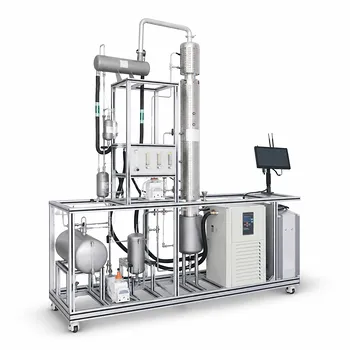
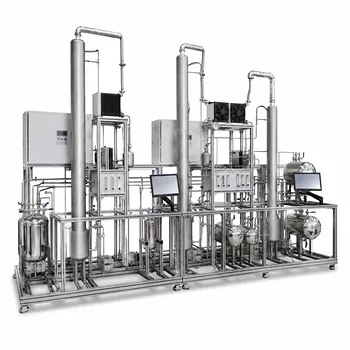
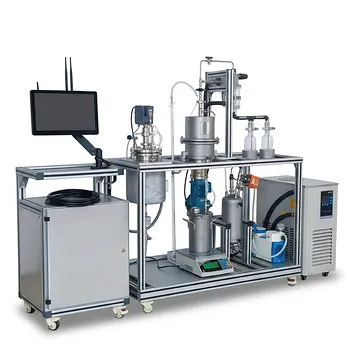
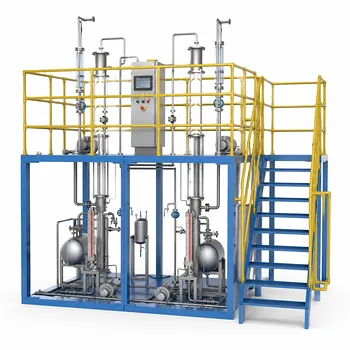
In a unit operations pilot plant, the physical integration of a distillation column with a pervaporation membrane module directly demonstrates how to shatter the azeotropic barrier that stops conventional distillation. The plant concentrates an ethanol-water feed to exactly the azeotropic composition in the column, then passes the near-azeotropic vapor through a selective membrane that strips out the remaining water. The dehydrated alcohol leaves the membrane as a high-purity retentate while the water-rich permeate is condensed and often recycled. This visible, measurable loop gives students and researchers concrete proof that a membrane can perform a separation that thermodynamics alone would forbid, and it often boosts the effective plant capacity by up to 40%.
The core insight is that distillation and pervaporation together accomplish what neither can do alone. The distillation column does the heavy lifting up to the azeotrope, and the membrane module—operating by chemical affinity, not boiling point—selectively transports the water across the thermodynamic deadlock. The result is a demonstrable increase in product purity and processing capacity without adding any external entrainer.
Why Traditional Distillation Hits an Invisible Wall
The Azeotropic Bottleneck
When ethanol and water are boiled, the vapor becomes richer in ethanol until the mixture reaches roughly 95.6% ethanol by weight. At this azeotropic point, the vapor and liquid have exactly the same composition, and no amount of additional distillation stages can further enrich the product. The column has done everything boiling-point differences can do, and it has reached an absolute thermodynamic limit.
The Energy Penalty of Chemical Workarounds
Industrial processes often break this deadlock by injecting an entrainer—a third component that alters the relative volatility. This extra chemical must then be separated in additional columns, decanters, and recovery loops, multiplying energy demand and capital cost. In a teaching pilot plant, that complexity often obscures the fundamental separation principles behind a wall of auxiliary unit operations.
How the Hybrid Pilot Plant Proves the Concept
Step 1: Concentrating the Feed Right Up to the Azeotrope
The feed enters a standard distillation column just like in any classic setup. The column is operated to maximize the alcohol concentration in the overhead vapor, deliberately driving the top product as close to the azeotropic composition as possible. Temperature and composition sensors along the column height let students plot the internal concentration profile and confirm that the top stage is pinned at the azeotrope.
Step 2: Dehydrating the Vapor with a Selective Membrane
Instead of condensing the azeotropic vapor and declaring the separation finished, the pilot plant routes the hot overhead vapor stream directly to a pervaporation (or vapor-permeation) membrane module. Inside the module, a thin dense membrane—often a hydrophilic zeolite layer—acts as a molecular filter that preferentially permeates water. The water molecules dissolve into the membrane, diffuse through it, and are pulled off as a low-pressure permeate vapor, while the dried ethanol-rich retentate remains on the feed side.
Because the membrane separates by affinity and partial-pressure driving force, not by boiling point, it ignores the azeotrope completely. The water is removed continuously, and the ethanol concentration in the retentate climbs well above the azeotropic limit. Operating the membrane at a modest temperature (often around 100°C) further improves the flux without introducing thermal degradation issues.
Step 3: Closing the Loop and Boosting Capacity
The water-laden permeate stream is condensed and can be sent back to the distillation column for solvent recovery. Recycling this stream closes the overall mass balance and prevents product loss, effectively making the system a near-zero-waste process. The key practical result is that the distillation column no longer needs to do the impossible final purification—it simply feeds a membrane that does, increasing the overall processing capacity by up to 40% compared to a stand-alone column trying (and failing) to exceed the azeotrope.
The Power of Physical Demonstration and Real-Time Data
Turning Equations into Observable Phenomena
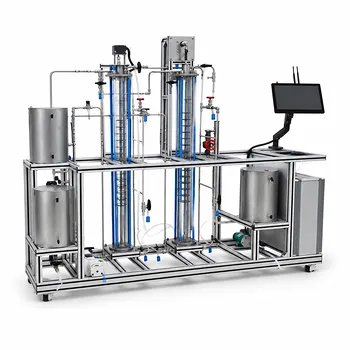
The hybrid pilot plant turns the theoretical concept of azeotrope-bypassing into a tangible process. With transparent glass columns and integrated temperature, pressure, and flow sensors, students can physically watch the liquid-vapor equilibrium, monitor the purity spike after the membrane module, and sample the retentate to confirm absolute ethanol concentrations that distillation alone could never produce.
Bridging Simulation and Operation
By logging all key variables, the pilot plant enables real-time mass and energy balance calculations. The membrane permeate flow, the retentate composition, and the recycled stream rates become measurable proof that the system is crossing the azeotropic barrier. This demystifies membrane separation, making it a routine unit operation that can be optimized alongside distillation, rather than an exotic add-on.
How Pervaporation Compares to Other Azeotrope-Breaking Methods
A modern pilot plant can be reconfigured to demonstrate the three principal strategies for homogeneous azeotrope separation:
- Pressure-swing distillation – uses two columns at different pressures to shift the azeotropic composition, requiring no third chemical but demanding strict pressure control.
- Extractive distillation – introduces an entrainer to alter relative volatility, increasing complexity with additional columns and solvent recovery.
- Membrane-assisted distillation (pervaporation/vapor permeation) – integrates a selective membrane module, eliminating the entrainer entirely while often reducing the overall energy footprint.
The hybrid setup thereby becomes a comparator, letting researchers measure energy consumption, capital intensity, and operational robustness side by side. For heat-sensitive or high-value products, pervaporation stands out because it operates at moderate temperatures and avoids contaminating the product with a foreign solvent.
Understanding the Trade-offs and Practical Constraints
Membrane Robustness and Longevity
While the hybrid plan demonstrates a clean separation, real operation introduces membrane fouling and degradation. Trace impurities present in fermentation-derived ethanol can attack hydrophilic zeolite membranes or reduce permeability over time. A pilot plant makes these lifetime effects measurable, teaching students the importance of pretreatment and cleaning protocols.
Capital and Operating Cost Balancing Act
The membrane module adds upfront capital and requires vacuum pumps, condensers, and a thermal energy supply to sustain the permeate-side pressure difference. In exchange, it removes the need for an entrainer recovery system and often lowers the total thermal duty. The pilot plant’s instrumental data lets users identify the sweet spot where the cost savings in steam outweigh the added membrane and pump expenses.
Single-Stage Limitations
The configuration typically uses a single membrane stage, which may not achieve the deepest possible dehydration if feed compositions fluctuate. In such cases, the demonstration reveals the need for multistaging or a pressure boost on the retentate side, prompting realistic discussions about scale-up.
How to Leverage a Hybrid Pilot Plant for Your Goals
After observing the distillation-pervaporation loop, the most impactful learning depends on what you want to achieve.
- If your primary focus is understanding the thermodynamic principle: Let the pilot plant’s composition profiles and purity data be your teacher. Measure the azeotropic pinch point on the column, then compare the retentate composition after the membrane to see the thermodynamic barrier being broken in real time.
- If your primary focus is optimizing energy efficiency: Run comparative experiments with and without the membrane loop, tracking steam and electricity consumption. Use the plant’s integrated sensors to calculate the energy saved per kilogram of absolute product—and use that data to size the membrane optimally.
- If your primary focus is evaluating pervaporation against entrainer-based methods: Reconfigure the pilot plant (or a parallel column setup) to perform extractive distillation, and then contrast the overall mass balances, solvent waste, and energy load. The hybrid plant becomes a direct competitiveness assessment tool.
- If your primary focus is training skilled operators: Use the transparent columns and real-time data dashboards to demonstrate how process disturbances propagate through the integrated system and how operators can stabilize both the distillation and membrane units simultaneously.
The hybrid setup transforms a thermodynamic impossibility into a controllable, observable unit operation—proving that when equipment works together, no azeotrope is truly a dead end.
Summary Table:
| Method | Azeotrope-Breaking Mechanism | Key Advantages | Limitations |
|---|---|---|---|
| Pressure-Swing | Shifts azeotrope via system pressure changes | No chemical entrainer needed | Requires dual columns & strict pressure control |
| Extractive | Introduces an entrainer to alter relative volatility | Well-established industrial method | High energy demand; requires solvent recovery loop |
| Hybrid (Membrane) | Vapor-permeation/pervaporation membrane module | Up to 40% capacity boost; zero chemical entrainers | Membrane fouling over time; vacuum system required |
Bring Advanced Chemical Engineering to Your Lab
Ready to demonstrate cutting-edge hybrid separations in your curriculum or research? LABPARK provides state-of-the-art Educational and Vocational Unit Operations Pilot Plants in chemical engineering, bioprocess & biotech, and environmental & water treatment.
Designed specifically for universities, research institutes, and enterprises, our systems feature transparent columns, real-time data logging, and robust membrane integration to turn complex thermodynamic theory into hands-on mastery.
Contact LABPARK today to customize your pilot plant!
Related Products
- Electrolyte Distillation Purification and Formulation Educational Pilot Plant
- Continuous Sieve-Plate Distillation Pilot Plant for Unit Operations Laboratory Education
- Multi-Modal Distillation Unit Operations Training Pilot Plant
- Continuous Batch Extractive Distillation Educational Pilot Plant
- Multi-Functional Special Distillation Educational Pilot Plant
People Also Ask
- Why does simple distillation yield higher efficiency than flash distillation? Key thermodynamic differences.
- How to Integrate Spectroscopy in Distillation Pilot Plants for Advanced Process Control
- Why use non-ideal VLE calculations in distillation pilot plants? Ensure accurate scale-up & purity
- How to Estimate Distillation Pilot Plant Tray Efficiency? O'Connell's Correlation Guide
- How does the feed thermal state influence distillation pilot plant design and utility consumption?