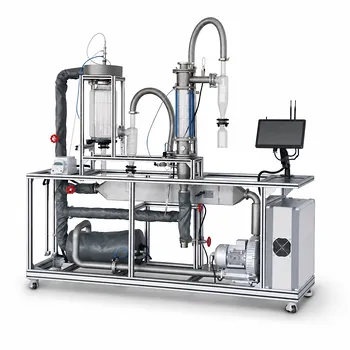
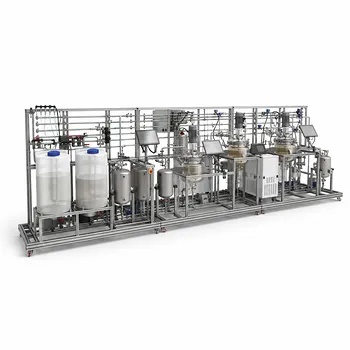
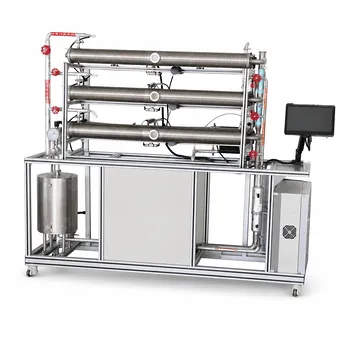
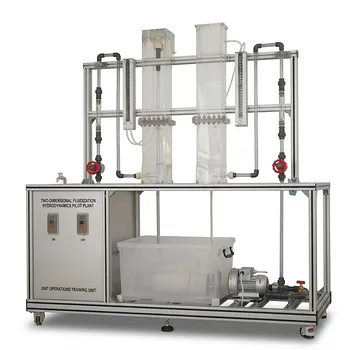
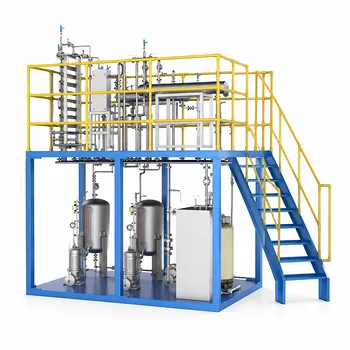
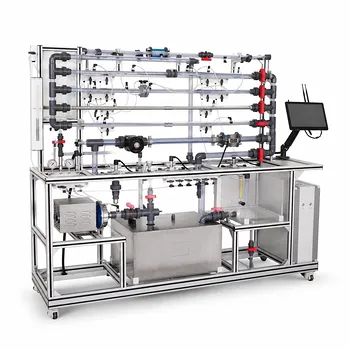
The simplest way to demonstrate the stepwise increase in refinery complexity is through modular unit operations pilot plants. A topping configuration only requires a crude distillation column. Add a naphtha hydrotreater and catalytic reformer, and you have a hydroskimming setup. To model conversion refineries, you integrate a vacuum distillation unit, a fluid catalytic cracker (FCC) or hydrocracker, and—for coking—a delayed coker. This modular approach lets students trace how each configuration upgrades feedstock and where the heaviest residues end up.
By assembling unit operations like building blocks—from simple distillation to thermal and catalytic conversion—educators make the evolution from topping to full conversion refineries tangible. The essential teaching point is residue upgrading: topping leaves an unusable atmospheric residue, hydroskimming refines naphtha, cracking converts vacuum gas oil (VGO), and coking handles even the last barrel of vacuum residue.
Starting with the Base: The Topping Configuration
The topping refinery represents the simplest possible crude processing arrangement. It separates crude oil into straight‑run products but performs no chemical upgrading. The entire demonstration revolves around a single unit operation.
Core Unit: Atmospheric Crude Distillation
A crude distillation pilot plant is the only requirement. These scaled‑down columns mimic industrial units with multiple sidestreams, condensation systems, and temperature‑controlled reboilers. Students can physically perform the thermal separation of a hydrocarbon mixture, measure tray temperatures, and collect fractions like naphtha, kerosene, diesel, and atmospheric residue. By adjusting the reflux ratio and feed preheat, they directly observe how cut‑point control influences fraction purity and yield, without any downstream conversion.
What Students See
The key lesson is that the heaviest portion—the atmospheric residue—leaves as a low‑value fuel oil or asphalt precursor. No further valorization occurs, clearly illustrating the topping refinery’s limitation when crude prices or product demand shift toward light transportation fuels.
Adding Upgrading: The Hydroskimming Configuration
To move beyond straight‑run products, the pilot plant gains two new unit operations. The goal shifts from simple separation to light‑product quality improvement.
Naphtha Hydrotreating and Catalytic Reforming
A hydrotreating unit first removes sulfur, nitrogen, and metals from the straight‑run naphtha using hydrogen and a catalyst bed. The treated naphtha then feeds a catalytic reforming unit, where naphthenes and paraffins are restructured into high‑octane aromatics. By connecting these modules after the atmospheric column’s naphtha draw, students can measure the octane jump and hydrogen production, linking octane economics directly to the reformer’s operating temperature and space velocity.
Configuration Boundaries
At pilot scale, a hydroskimming line‑up still does not upgrade heavier fractions—the atmospheric residue remains unconverted. This teaches the fundamental constraint that refineries only make money on the light end, and that a market shift toward diesel or lighter crudes requires a different configuration.
Introducing Conversion: Cracking Configuration
When the goal is to convert heavy gas oils and residues into high‑demand transportation fuels, a conversion refinery becomes necessary. The pilot plant must now separate and upgrade the material that atmospheric distillation cannot vaporize without thermally decomposing it.
The Role of Vacuum Distillation
A vacuum distillation unit is placed directly after the atmospheric column. Because the heavy residue would crack or polymerize at atmospheric boiling temperatures, reducing the operating pressure lowers its boiling point into a safe working range. Students physically switch the column to vacuum mode, observing how a deeper cut produces vacuum gas oil (VGO)—the critical feedstock for catalytic cracking—while leaving a concentrated vacuum residue.
Cracking Options: FCC and Hydrocracking
The VGO is then routed to a conversion unit. Two pilot‑plant modules teach different chemistries:
- An FCC pilot plant uses a fluidized catalyst riser to crack VGO primarily into gasoline and light olefins. Students control the catalyst‑to‑oil ratio and riser temperature to see how gasoline versus LPG yields shift.
- A hydrocracking pilot plant adds hydrogen and a dual‑function catalyst. Its advantage is the ability to produce ultra‑low sulfur diesel and jet fuel, not just gasoline.
Studying Hydrocracking Modes Deeply
A multi‑configuration hydrocracking pilot plant lets students run three distinct setups, directly showing how process severity and product slate are linked:
- Single‑stage once‑through hydrocracking performs partial conversion. Unconverted bottoms (hydrowax) can be recycled or sent to an FCC, demonstrating a hybrid configuration.
- Two‑stage hydrocracking uses two reactors with intermediate separation of ammonia and hydrogen sulfide. This prevents second‑stage catalyst poisoning and enables complete conversion to naphtha or middle distillates.
- Series‑flow hydrocracking sends the first‑stage effluent directly into the second reactor without gas removal. Here, students see how a specially designed ammonia‑tolerant catalyst (e.g., NiW/USY zeolite) compensates for activity‑suppressing conditions, teaching the link between catalyst design and process simplification.
By rotating between these modes, the same hardware illustrates partial versus full conversion and the trade‑offs in capital cost, catalyst life, and product flexibility.
Pushing the Limits: The Coking Configuration
The most complete refinery configuration demonstrates how to handle the vacuum residue that even a cracking refinery leaves behind. This requires a thermal, non‑catalytic unit operation.
Delayed Coker Pilot Plant
A delayed coker thermally cracks the vacuum residue at high temperature and low pressure, producing petroleum coke, coker naphtha, and coker gas oil. At pilot scale, students observe the drum‑switching cycle, measure gas and liquid yields, and handle the solid coke by‑product. Integrating a coker after vacuum distillation shows that essentially all of the barrel can be converted into salable products, leaving only solid coke—a powerful visual lesson in refinery residue minimization.
Understanding the Trade‑offs
Each step up in configuration complexity brings concrete constraints that a modular pilot plant makes visible. Capital and footprint jump sharply: a topping skid is simple and compact; a coking configuration requires additional high‑temperature modules, heavy piping, and coke‑handling equipment. Safety and operability intensify. Hydroprocessing units handle high‑pressure hydrogen and toxic H₂S, while the coker operates near 500 °C. The pilot plant must mirror industrial safeguards. Product‑quality interdependencies emerge. For example, FCC light cycle oil often requires separate hydrotreating before blending, a constraint absent in the simpler hydrocracking route. Running these side‑by‑side trains students to evaluate not just yield, but the overall refinery product pool quality.
Designing an Educational Pilot‑Plant Sequence
The choice of which modules to commission depends entirely on the learning objective. Use a staged approach to isolate the essential message.
- If your primary focus is teaching basic separation principles: Start with the topping configuration and let students vary cut points and reflux ratio. Keep the system as simple as possible to reinforce mass and energy balances.
- If your primary focus is clean‑fuel production and octane improvement: Add the hydrotreating and reforming modules. Emphasize how hydrogen addition changes product properties without heavy conversion.
- If your primary focus is illustrating heavy‑feed upgrading and conversion economics: Integrate vacuum distillation and either an FCC or hydrocracker. Run comparative experiments that show gasoline‑max versus diesel‑max modes.
- If your primary focus is demonstrating ultimate residue destruction and carbon rejection: Commission a coker unit after the vacuum column. Highlight material balance closure and the elimination of the fuel‑oil stream.
By methodically connecting unit operations in a stepwise fashion, you transform a collection of pilot plants into a living diagram of refinery evolution—showing students exactly how the industry’s answer to heavier crude and lighter product demand changes from simple separation to thermal conversion.
Summary Table:
| Refinery Configuration | Core Unit Operations Required | Primary Products & Upgrades | Residue Destination |
|---|---|---|---|
| Topping | Atmospheric Crude Distillation | Straight-run fractions (naphtha, diesel) | Low-value atmospheric residue |
| Hydroskimming | Distillation + Hydrotreating + Catalytic Reforming | High-octane aromatics, clean fuels, $H_2$ | Unconverted atmospheric residue |
| Cracking | Vacuum Distillation + FCC or Hydrocracker | Gasoline, light olefins, ultra-low sulfur diesel | Unconverted vacuum residue |
| Coking | Vacuum Distillation + Delayed Coker | Coker naphtha, gas oil, petroleum coke | Minimized liquid residue; solid coke product |
Bring Industrial Refinery Processes to Life in Your Lab
Teaching complex chemical engineering and refining processes requires hands-on, reliable, and safe training equipment. LABPARK provides state-of-the-art Educational and Vocational Unit Operations Pilot Plants in chemical engineering, bioprocess & biotech, and environmental & water treatment tailored for universities, research institutes, and enterprises.
By partnering with LABPARK, you benefit from:
- Modular & Expandable Designs: Easily scale from simple distillation columns to multi-stage hydroprocessing and coking configurations.
- Industrial-Grade Reliability: Robust control systems and advanced safety features built to handle realistic pressure and temperature conditions.
- Practical Learning Outcomes: Clear demonstration of mass balances, separation cut-points, catalyst activity, and conversion economics.
Ready to elevate your engineering curriculum or research capabilities? Contact LABPARK today to request a quote!
Related Products
- Multi-Functional Drying Educational Unit Operations Pilot Plant
- General Purpose Cosmetics Production Unit Operations Training Pilot Plant
- Dual-Mode Rectification Pilot Plant for Practical Training Unit Operations
- Multi-Reactor Educational Pilot Plant for Reaction Engineering Unit Operations
- Multimodal Absorption and Desorption Pilot Plant for Unit Operations Training
People Also Ask
- How do deviations in estimating latent heat impact pilot plant thermal systems? Avoid hardware mis-sizing.
- Why is the chemical plant startup schedule crucial? De-risk scale-up with pilot plants.
- Why Use PTFE & Hastelloy in Chemical Pilot Plants? Prevent Corrosion & Ensure Safety
- How to study gasification in pilot plants? Compare exit gas composition & efficiency
- When to transition from PID to adaptive control in pilot plants? Key process indicators.