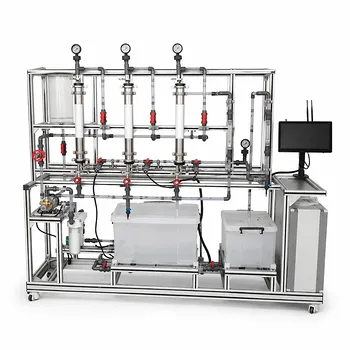
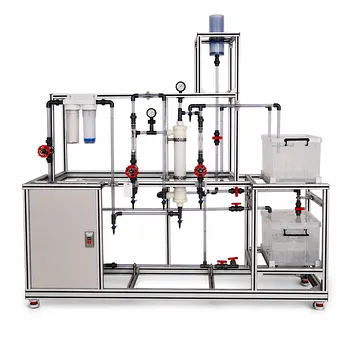
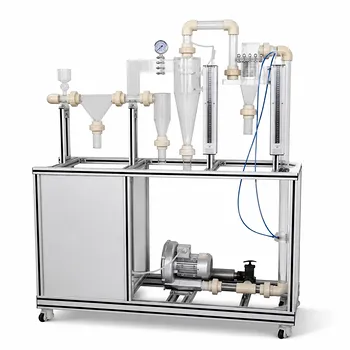
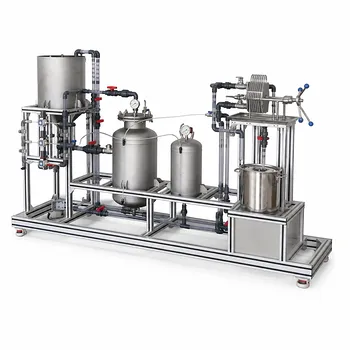
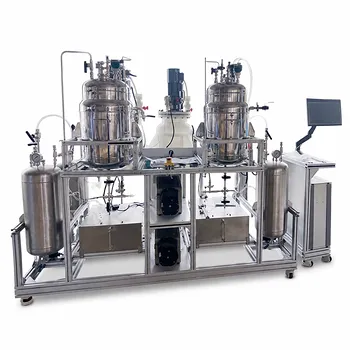
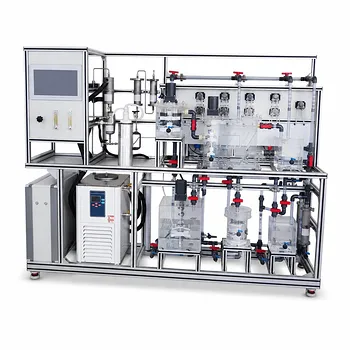
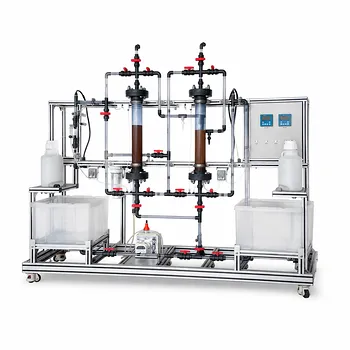
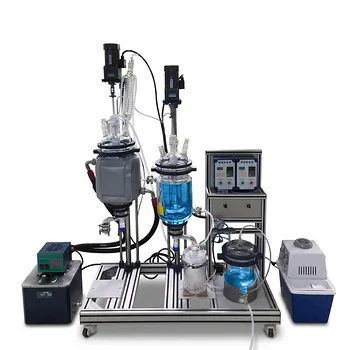
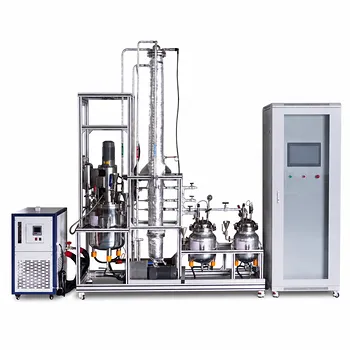
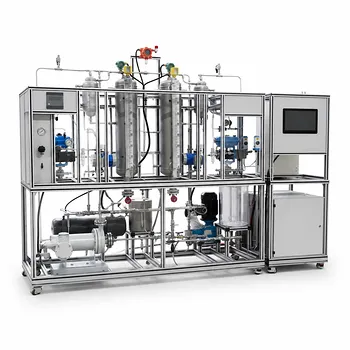
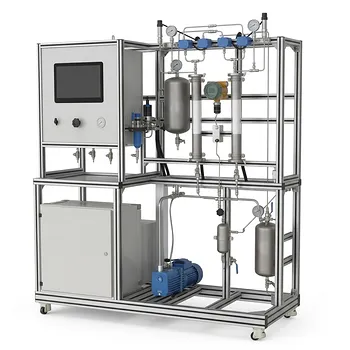
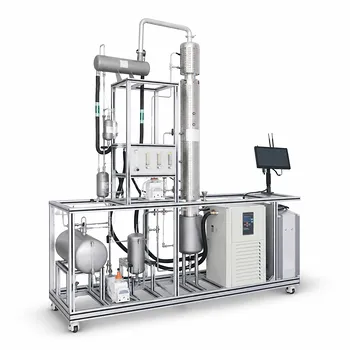
The most effective demonstration replaces a simple glass piece with an integrated, transparent industrial module. Instead of a benchtop Dean-Stark trap, students engage with a pilot-scale batch reactor connected to a distillation column and a continuous decanter. This configuration directly translates the chemistry of equilibrium shift into the chemical engineering reality of a unit operation.
The core pedagogical leap is moving from a static glassware demonstration to a dynamic, controllable industrial process. The key is an integrated pilot plant where students don't just see water removed—they manipulate reflux ratios, observe a ternary azeotrope's phase separation in real-time, and calculate mass balances, thereby understanding the engineering required to turn a lab principle into industrial yields.
From Benchtop Glassware to Pilot-Plant Unit Operation
The Dean-Stark principle is simple: remove one product (water) to drive a reversible reaction to completion. The educational challenge is scaling this abstraction into an engineering reality. A pilot plant achieves this by making the separation process the central, observable focus.
The Core Setup: Reactor, Column, and Decanter
The demonstration requires a batch reactor integrated with a fractional distillation column. The reaction mixture of ethanol, acetic acid, and an acid catalyst is heated here, generating vapors. These vapors don't just condense; they enter the engineering heart of the system.
At the top of the column, the vapor is condensed and directed into a continuous decanter, which is the industrial analog of the Dean-Stark sidearm. This is where the critical visual and conceptual instruction happens. The mixture naturally separates into two liquid layers: an organic-rich top layer and an aqueous-rich bottom layer, a phenomenon students observe directly through the vessel’s transparent walls.
Demonstrating the Ternary Azeotrope
The educational power comes from explaining what is separating. The system doesn't just produce pure water. Instead, the column distills a minimum-boiling ternary azeotrope (approximately 83.2% ethyl acetate, 9% ethanol, and 7.8% water) that boils at 70.2°C. This is a far more complex and educationally rich point than simple water removal.
- The Conceptual Bridge: Students learn that the Dean-Stark trap works because the condensed distillate is a heterogeneous azeotrope that separates upon condensation.
- Visual Learning: They monitor the liquid-liquid interface rise in the decanter, seeing the water phase accumulate in real-time, just as in a lab trap, but with precise flow control.
Closing the Loop: Reflux and Phase Return
The pilot plant demonstrates continuous operation, a critical distinction from the lab's batch accumulation. The organic-rich top phase from the decanter is continuously returned to the column as reflux. Manipulating the reflux ratio shows students how to control product purity and column efficiency, turning a chemistry equilibrium problem into a separations engineering problem. The aqueous bottom phase is drawn off, and depending on the plant's setup, can be recycled to a secondary recovery column.
The Learning Objectives: What Students Measure and Observe
The value of the pilot plant is not just visual; it’s quantitative. Students engage with the process as an instrumented and controllable system, moving from qualitative observation to rigorous engineering analysis.
Monitoring Phase Separation Dynamics
Temperature sensors placed at the reactor, along the column, and in the decanter provide real-time data. Students correlate the 70.2°C plateau at the top of the column directly to the boiling of the ternary azeotrope, cementing their understanding of vapor-liquid equilibrium. They then visually confirm the physical consequence—the phase split in the decanter below.
Performing a Practical Mass Balance
This is the definitive test of understanding. Students measure input reactants and catalyst, collect the aqueous phase from the decanter, and sample the final reactor product. By calculating a complete reaction mass balance, they can directly prove how the removal of water in the decanter forces the kinetic shift of the esterification equilibrium towards over 90% conversion. This transforms an abstract Le Chatelier's principle into an empirical, calculated result.
Understanding the Trade-offs and Instructional Points
Every educational demonstration has limits, and a good instructor highlights these. The pilot plant itself is not a magic black box; its deviations from theory are key learning moments.
Common Pitfalls to Avoid
- Treating it as a “Water-Only” Trap: The primary pitfall is allowing students to believe only pure water is removed. The observation of the organic layer return is crucial. If they don't measure the ethanol and ethyl acetate content in the drawn-off aqueous phase, their mass balance will be inaccurate, leading to a powerful lesson on azeotrope composition.
- Ignoring Column Dynamics: A poorly controlled reflux ratio can flood the column or fail to establish a stable azeotrope at the top. Students must learn that this isn't an automatic process; it's an operating discipline.
- Overlooking the Phase Separation Rate: The decanter must be sized correctly for the pilot plant’s vapor rate. If the residence time is too short, the phase separation is incomplete, and water gets entrained back into the reactor, killing the reaction rate. This illustrates the critical scale-up concept of residence time versus simple phase behavior.
Making the Right Choice for Your Teaching Goal
The specific pilot plant features you emphasize should align with your core educational objective. Here is how to tailor the experiment.
- If your primary focus is conceptual clarity on azeotropic distillation: Select a system with fully transparent glass distillation columns and decanter. The visual connection between the condensing vapor on the trays and the layer separation in the decanter is paramount.
- If your primary focus is quantitative process engineering: Prioritize a plant with numerous, high-precision digital temperature and pressure sensors connected to a data acquisition system. The goal is for students to build a McCabe-Thiele diagram from their own experimental VLE data and compare calculated tray efficiency against theoretical predictions.
- If your primary focus is dynamic process control and scale-up: The key feature is a programmable reflux controller. The learning occurs when students must adjust the reflux ratio in real-time to respond to a dropping reaction rate, directly linking a manual control action to both product purity and reaction conversion.
Teaching the Dean-Stark principle with a pilot plant transforms a simple laboratory trick into a foundational lesson in reaction-separation integration, giving students the confidence that they can manage the coupled equilibrium and kinetic challenges of any industrial chemical process.
Summary Table:
| Feature | Laboratory Benchtop Setup | Educational Pilot Plant |
|---|---|---|
| Equipment | Static glassware (Dean-Stark trap) | Integrated reactor, distillation column, & decanter |
| Azeotrope Dynamics | Simple water accumulation | Ternary heterogeneous azeotrope separation (70.2°C) |
| Process Control | None (static batch) | Adjustable reflux ratio, flow rates, & temperature control |
| Key Metrics | Qualitative yield observation | Real-time mass balance, McCabe-Thiele data, & tray efficiency |
Bring Industrial Reality to Your Laboratory
Bridge the gap between chemistry theory and industrial practice with hands-on learning.
LABPARK provides premium Educational and Vocational Unit Operations Pilot Plants designed for universities, research institutes, and enterprises across key disciplines:
- Chemical Engineering (including reaction, distillation, and separation processes)
- Bioprocess & Biotech
- Environmental & Water Treatment
Our highly instrumented, transparent pilot plants empower students and researchers to visualize complex chemical dynamics, run precise mass balances, and master real-world process control.
Ready to upgrade your educational or research facility? Contact LABPARK today to find the ideal pilot plant solution for your lab!
Related Products
- Multifunctional Membrane Separation Educational Pilot Plant with Ultrafiltration, Nanofiltration, Reverse Osmosis
- Multi-Functional Membrane Separation Educational Pilot Plant for Unit Operations Lab
- Ultrafiltration Membrane Separation Educational Pilot Plant
- Multi-Functional Special Distillation Educational Pilot Plant
- Gas-Solid Heterogeneous Separation Demonstration Educational Unit Operations Pilot Plant
People Also Ask
- Pervaporation vs. Vapor Permeation: Handling Suspended Solids in Membrane Pilot Plants
- How do PEI, PVDF, and PSU membranes compare in pilot plants? Find the best fit.
- What are the trade-offs of polymer vs inorganic membranes in teaching pilot plants? Key laboratory comparison.
- What are the advantages of membrane separation in pilot plants? Efficient Organic Vapor Recovery
- How can operators optimize operating conditions and cleaning protocols in membrane separation pilot plants to mitigate fouling?