Here’s the direct answer: Students use an open‑channel pilot plant to measure water depth and velocity, then apply two complementary criteria. The first is the specific energy method – for a fixed discharge, plot specific energy against depth to find the critical depth where specific energy is minimal. The second is the Froude number (or velocity‑head ratio) – compute (Fr = V/\sqrt{gy}); flow is subcritical when (Fr < 1), critical at (Fr = 1), and supercritical when (Fr > 1). A handy field shortcut: if the velocity head is less than half the water depth, the flow is tranquil (subcritical); if it’s greater, the flow is rapid (supercritical).
The power of a flume pilot plant lies not just in calculating numbers, but in watching a smooth, glassy surface break into a frothy supercritical stream as you adjust the slope or sluice gate. By systematically measuring depth and velocity, students transform abstract concepts like specific energy and the Froude number into tangible, verifiable flow regimes.
Understanding the Physics of Open‑Channel Flow Stages
The Principle of Specific Energy
Specific energy ((E)) is the total head relative to the channel bed: (E = y + \frac{V^2}{2g}).
For a fixed discharge per unit width, this relationship traces a curve with a defined minimum.
The depth at that minimum is critical depth ((y_c)) – it’s where the flow transitions between two distinct regimes.
When the water depth is greater than (y_c) (upper branch of the curve), extra depth stores potential energy and the velocity is lower – this is subcritical flow.
When depth falls below (y_c) (lower branch), the flow thins out and speeds up dramatically – that’s supercritical flow.
Students can measure multiple (\left(y, V\right)) pairs in the flume, calculate (E), and plot the curve to experimentally locate (y_c).
The Froude Number Criterion
The Froude number compares inertia to gravity forces: (Fr = \frac{V}{\sqrt{gy}}).
It directly classifies the flow stage: (Fr < 1) is subcritical (tranquil), (Fr = 1) is critical, and (Fr > 1) is supercritical.
In the gradually varied flow equation, the denominator ((1 - Fr^2)) changes sign at (Fr = 1).
That sign reversal is what makes the water surface profile rise in subcritical flow but drop in a supercritical drawdown curve.
Students compute (Fr) directly from their depth and velocity measurements in the flume, removing all guesswork.
The Velocity‑Head Ratio Shortcut
At critical flow, the Froude number equals 1, which simplifies to (V^2/(2g) = y/2).
This gives a quick field check: compare the velocity head with half the depth.
If (\frac{V^2}{2g} < \frac{y}{2}), the flow is subcritical. If (\frac{V^2}{2g} > \frac{y}{2}), it’s supercritical.
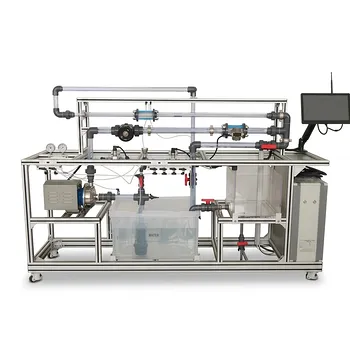
This rule-of‑thumb is especially useful when a Flume pilot plant has point gauges and a Pitot tube – you can get an immediate classification without a calculator.
Using the Pilot Plant to Determine Critical Conditions
Accurate Measurement Setup
Reliable classification starts with steady flow. Use the adjustable slope and tailgate to stabilize the water surface.
Measure depth with a point gauge, and velocity with a Pitot‑static tube or a calibrated current meter.
Take readings at mid‑channel, away from sidewall effects, and repeat each measurement to catch any fluctuation.
Finding Critical Depth by Adjusting the Flume
For a selected discharge, gradually change the slope or the downstream sluice gate.
You’ll see a control section appear where the water surface profile breaks – the flow passes from a deep, slow subcritical state to a shallow, fast supercritical state.
Measure the depth right at that break; it should match the theoretical critical depth (y_c = \left( q^2/g \right)^{1/3}) for a rectangular channel. This visual and numerical verification cements the concept.
Verifying Transitions with a Hydraulic Jump
Supercritical flow cannot persist indefinitely – it often transitions back to subcritical through a hydraulic jump.
By measuring the conjugate depths before and after the jump, students can apply the momentum principle and see that the upstream depth is supercritical while the downstream depth is subcritical.
This visual event is a powerful, memorable verification that the flow regime truly changed.
Understanding the Trade‑offs and Common Pitfalls
Sensitivity Near Critical Depth
Around (Fr \approx 1), small measurement errors in depth or velocity can flip the classification.
Surface undulations make it hard to read a point gauge; even a millimeter error can shift the computed Froude number across the critical threshold.
Take multiple readings and average them to increase confidence.
Transition Region Instability
Exactly at critical flow, the water surface often appears wavy and unstable.
This is the “transition region” in open‑channel hydraulics – analogous to the laminar‑turbulent transition in pipes.
Don’t expect a quiet, glassy surface here; treat any measurement taken in this zone as approximate.
Uniform Flow Assumption
The Froude number and velocity‑head shortcut work at a local section regardless of whether the flow is uniform.
However, students sometimes confuse gradually varied flow profiles (where depth changes slowly) with a change in regime.
The classification stays valid so long as you use the local depth and velocity at the section of interest.
Making the Right Choice for Your Lab Objective
- If your primary focus is a quick, intuitive check: Use the velocity‑head vs. half‑depth rule. It’s a one‑line comparison that gives an immediate verdict and connects well with the physical feel of the flow.
- If your primary focus is rigorous verification: Compute the Froude number and, if time permits, plot experimental (E) vs. (y) data to identify the critical point. This reinforces the underlying theory and confirms the discharge‑dependent nature of (y_c).
- If your primary focus is visual learning: Intentionally create a clear supercritical tongue downstream of a sluice gate and then force a hydraulic jump back to subcritical flow. Measure the depths on both sides to see the regime change encoded in the numbers.
With a well‑designed flume and a systematic approach, you can move beyond textbook equations and directly witness how water shifts between its two fundamental open‑channel states.
Summary Table:
| Flow Stage | Froude Number ($Fr$) | Water Depth ($y$) | Velocity-Head Ratio | Physical Appearance |
|---|---|---|---|---|
| Subcritical (Tranquil) | $Fr < 1$ | $y > y_c$ | $V^2/(2g) < y/2$ | Deep, slow, smooth water surface |
| Critical | $Fr = 1$ | $y = y_c$ | $V^2/(2g) = y/2$ | Unstable, wavy transition zone |
| Supercritical (Rapid) | $Fr > 1$ | $y < y_c$ | $V^2/(2g) > y/2$ | Shallow, fast, turbulent stream |
Bring Fluid Mechanics to Life in Your Lab
Looking to equip your students and researchers with hands-on learning tools? LABPARK provides state-of-the-art Educational and Vocational Unit Operations Pilot Plants across chemical engineering, bioprocess & biotech, and environmental & water treatment.
Designed specifically for universities, research institutes, and enterprises, our high-quality flumes and hydraulic pilot plants transform abstract concepts like the Froude number and specific energy into visual, repeatable, and verifiable experiments.
Contact LABPARK today to find the perfect pilot plant system for your laboratory and research needs!
Related Products
- 100L Continuous Loop Hydrogenation Educational Unit Operations Pilot Plant
- Two-Dimensional Fluidization Hydrodynamics Educational Pilot Plant for Unit Operations Training
- Multi Pump Fluid Transport Process Piping Unit Operations Training Pilot Plant
- Plate Column Hydrodynamics Tray Demonstration Educational Pilot Plant
- Steam Methane Reforming Hydrogen Production and Purification Educational Pilot Plant
People Also Ask
- How do deviations in estimating latent heat impact pilot plant thermal systems? Avoid hardware mis-sizing.
- Why is the chemical plant startup schedule crucial? De-risk scale-up with pilot plants.
- Why Use PTFE & Hastelloy in Chemical Pilot Plants? Prevent Corrosion & Ensure Safety
- How to study gasification in pilot plants? Compare exit gas composition & efficiency
- Why Compare Predicted and Experimental Excess Enthalpy? Key to Accurate Pilot Plant Scale-up