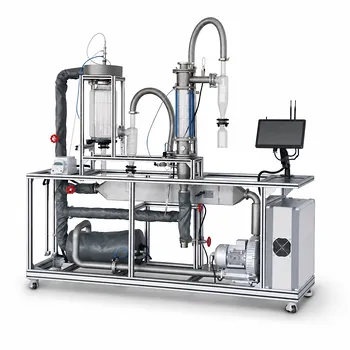
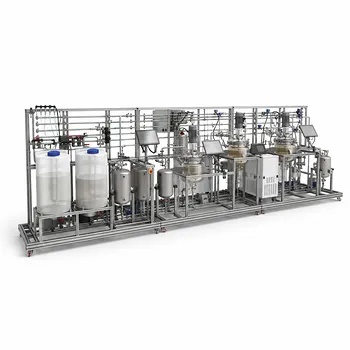
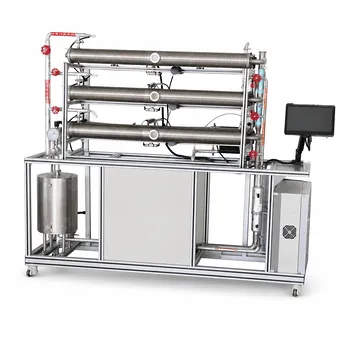
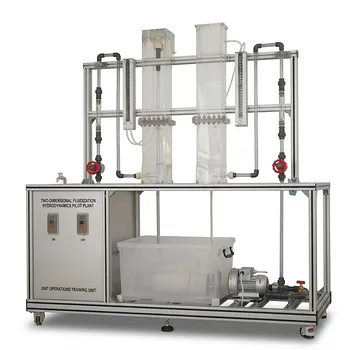
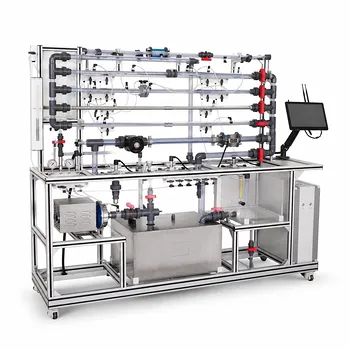
The blueprint isn’t the building. Researchers use unit operations pilot plants to validate theoretical mass and energy balances by running the physical process and directly measuring real-world inputs, outputs, and accumulation. They then compare this empirical data—such as actual flow rates, temperatures, and concentration changes—against the predictions made by their design calculations and simulation software. This side-by-side comparison exposes the gaps between ideal assumptions and reality, enabling researchers to refine critical model parameters like heat transfer coefficients and separation efficiencies before committing to industrial scale.
Theoretical mass and energy balances are built on simplifying assumptions. A pilot plant flips these assumptions into measurable facts, revealing where real-world constraints—like heat loss, fouling, or unexpected fluid dynamics—break the model. The result is not just a validated balance, but a proven pathway to confident scale-up.
Why Theoretical Models Demand Physical Validation
The Hidden Cost of Untested Assumptions
Every simulation model starts with assumptions: perfect mixing, constant heat transfer coefficients, ideal phase behavior. These shortcuts make calculations fast but fragile.
Real equipment introduces non-idealities that no equation can fully predict—thermal gradients, fouling, two-phase flow patterns, or subtle side reactions. Without physical data, a beautifully mass-balanced flowsheet can fail catastrophically at scale.
When the Numbers on the Screen Aren’t Enough
Process simulation software is excellent for scoping. But it cannot tell you if the distillation column will foam, if the reactor jacket will deliver the intended cooling rate, or if your chosen packing will actually achieve the predicted separation efficiency.
Empirical validation turns probabilistic design into deterministic reality. The pilot plant is the only tool that converts theoretical “should work” into measured “does work.”
How the Pilot Plant Validates the Model
Turning a Flowsheet into a Live Control Volume
A pilot plant physically defines the control volume that sits at the heart of every mass and energy balance. Researchers draw the boundary around a reactor, a heat exchanger, or an entire loop, and then measure everything that crosses it.
By directly monitoring inlet flows, outlet flows, and accumulation within the system, they can calculate the exact accumulation term from the equation Accumulation = Input – Output + Generation. If the measured accumulation doesn’t match the theoretical prediction, a key assumption is wrong—and that’s the discovery you need.
Collecting the Empirical Data That Matter
The power of a pilot plant lies in its instrumentation. Critical data points include:
- Flow rates of all process streams (liquid, gas, and even solids).
- Temperature profiles inlet, outlet, and at multiple points along a reactor or column.
- Concentrations and compositions via online analyzers or grab sampling.
- Energy flows through jacket duties, condenser duties, and electrical inputs.
These measurements are fed directly into the same balance equations used in the initial design. The output is a gap analysis: a quantified comparison between predicted and actual performance.
Closing the Balance and Exposing Discrepancies
A closed mass balance means the total mass entering equals the total mass leaving, accounting for inventory change. If the pilot plant shows a consistent 3% mass loss, it’s not magic—it’s a leak, an unmeasured vent, or an instrument error. Each discrepancy maps to a model shortcoming.
Similarly, an unclosed energy balance—where lost heat is higher than predicted—forces recalculation of insulation requirements or heat transfer coefficients. The pilot plant becomes a detective, pinpointing exactly where the model diverges from physical truth.
Validating the “Untouchable” Design Parameters
The parameters that most influence scale-up are exactly those that simulators estimate the worst: heat transfer coefficients (U), reaction rate constants (k), and mass transfer coefficients. In a pilot plant reactor, researchers log the reactor temperature and jacket temperature over time. By fitting the actual dynamic response to the energy balance ODE, they can back-calculate a true, system-specific U-value—no generic correlations needed.
For a distillation column, they measure overhead and bottoms compositions at varying reflux ratios to validate the column’s actual number of theoretical stages and efficiency. The theoretical model then gets a surgical update, not a blind tune.
When the Pilot Plant Is the Only Answer
Processes That Demand Physical Testing
Chemical engineering rules of thumb are clear: reactors, extraction columns, and dryers/solids handling systems almost always require pilot plant validation. Their scale-up behavior is too complex—fluid dynamics, mixing patterns, and mass transfer regimes change non-linearly with size.
For example, a fluidized bed dryer’s performance hinges on particle size distribution and gas distribution, factors that simulations can model only crudely. A pilot run provides direct measurements of drying curves, pressure drops, and elutriation rates that make the energy balance accurate.
When You Can Safely Skip the Pilot Plant
Not every process needs a pilot plant. Single-phase fluid flow in pipes and standard distillation of well-characterized mixtures are typically predicted reliably by simulations. Unless there are specific complications—such as foaming in distillation columns or unexpected two-phase flow regimes—you can often move directly from simulation to detailed design.
However, even for “standard” units, if the mixture includes unknown trace components or the column internals are novel, a small-scale test can save millions in startup troubleshooting.
Understanding the Trade-offs and Limitations
Pilot plants are not a silver bullet. They cost time and money, and if not designed carefully, they can mislead. A poorly scaled-down reactor may have a completely different heat transfer regime than the full-scale version, giving you a validated U-value that is irrelevant.
Pilot-plant data is only as good as its representativeness. The same physical laws apply, but the ratios of surface area to volume, mixing intensity, and wall effects can distort results. Researchers must always couple pilot experiments with dimensionless analysis—using Reynolds, Nusselt, and Froude numbers—to ensure the critical driving forces are preserved during scale-up. The pilot plant validates the model, but only after you’ve confirmed that the pilot itself is a valid physical analog of the intended industrial system.
Making the Right Choice for Your Validation Goal
Your decision to use a pilot plant—and how you run it—should be driven by the primary source of uncertainty in your theoretical model. Here’s how to focus your effort:
- If your primary focus is validating kinetic parameters and reaction selectivity: Run a well-instrumented batch or continuous stirred-tank reactor pilot plant. Capture real-time concentration-time curves and fit them to your kinetic model to extract true rate constants and identify unexpected side products.
- If your primary focus is confirming heat and mass transfer in a novel separation: Operate a distillation or extraction pilot unit and measure actual stage efficiencies and flooding points. Compare the empirical temperature profile with the simulated one to calibrate tray or packing performance.
- If your primary focus is closing the energy balance on a heating or cooling loop: Use a heat exchanger pilot rig to log inlet and outlet temperatures and flow rates on both sides. Calculate the actual UA value and compare it to the theoretical prediction derived from correlations; the difference is your engineering safety factor.
- If your primary focus is de-risking scale-up of a solids handling process: You must run a pilot dryer or granulator. Measure outlet moisture, particle size distribution, and air flow patterns physically—these parameters rarely scale predictably from textbook models alone.
By turning your theoretical balance into a checklist of measurable physical outputs, you stop guessing and start knowing. That’s the difference between a paper design and a process that works.
Summary Table:
| Validation Focus | Key Measurements | Refined Model Parameters |
|---|---|---|
| Kinetics & Selectivity | Concentration over time, temperature profiles | Reaction rate constants (k), selectivity |
| Mass Transfer & Separation | Stream compositions, flow rates, reflux ratios | Stage efficiencies, mass transfer coefficients |
| Heat & Energy Balance | Inlet/outlet temperatures, utility flow rates | Heat transfer coefficients (U), heat loss factors |
| Solids Handling | Moisture content, particle size distribution | Drying curves, pressure drop, fluidization regimes |
De-Risk Your Scale-Up with LABPARK Pilot Plants
Moving from theoretical models to real-world application requires physical precision. LABPARK provides advanced Educational and Vocational Unit Operations Pilot Plants across chemical engineering, bioprocess & biotech, and environmental & water treatment.
Tailored for universities, research institutes, and enterprises, our pilot plants empower you to validate mass and energy balances, calibrate simulations, and train researchers with high-fidelity, empirical data.
Ready to bridge the gap between simulation and reality? Contact LABPARK today to find the ideal pilot plant solution for your lab or facility!
Related Products
- Multi-Functional Drying Educational Unit Operations Pilot Plant
- General Purpose Cosmetics Production Unit Operations Training Pilot Plant
- Dual-Mode Rectification Pilot Plant for Practical Training Unit Operations
- Multi-Reactor Educational Pilot Plant for Reaction Engineering Unit Operations
- Multimodal Absorption and Desorption Pilot Plant for Unit Operations Training
People Also Ask
- Why Use PTFE & Hastelloy in Chemical Pilot Plants? Prevent Corrosion & Ensure Safety
- How to study gasification in pilot plants? Compare exit gas composition & efficiency
- How do deviations in estimating latent heat impact pilot plant thermal systems? Avoid hardware mis-sizing.
- Why is the chemical plant startup schedule crucial? De-risk scale-up with pilot plants.
- When to transition from PID to adaptive control in pilot plants? Key process indicators.