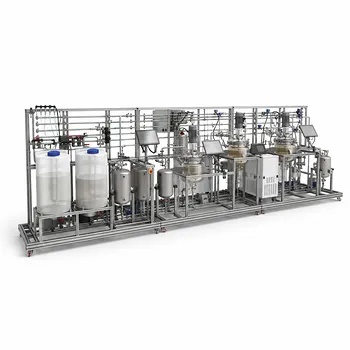
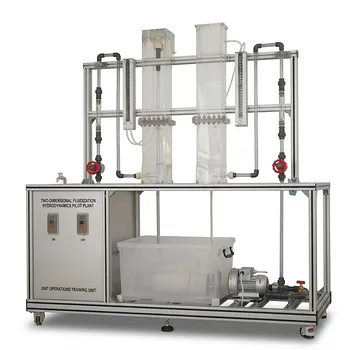
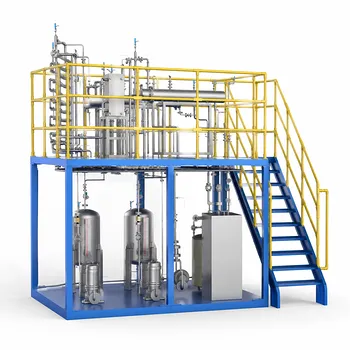
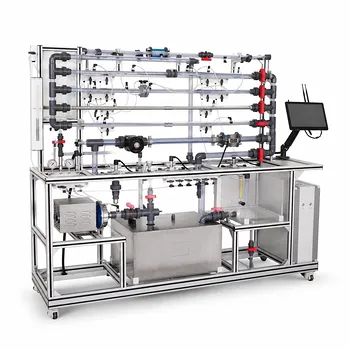
Economic viability begins at the pilot scale.
Researchers determine the economic feasibility of recovering chemical byproducts by operating unit operations pilot plants—miniature versions of key separation equipment—to physically measure the true costs and yields of purification. This process quantifies the capital and operating expenses of an extra separation step against the combined financial benefit of product sales plus avoided waste treatment fees, validating whether the net gain justifies scale-up. Without this empirical backbone, any feasibility calculation remains a theoretical guess.
Byproduct recovery only makes financial sense when the incremental revenue and disposal cost savings clearly exceed the total cost of the extra separation equipment and energy. Pilot plants close the gap between spreadsheet optimism and industrial reality by generating defensible data on solvent use, energy demand, and achievable purity—the exact inputs needed for a rigorous business case.
Why Pilot Plants Are Non-Negotiable for Byproduct Recovery Decisions
Economic feasibility is ultimately a function of precise cost and revenue numbers. Pilot plants supply the only reliable, non-simulated version of those numbers for novel byproduct streams.
The True Cost of Separation Is Never Theoretical
Textbook calculations often underestimate energy, solvent loss, and the number of theoretical stages required. A pilot distillation or extraction column reveals the actual reflux ratio, solvent-to-feed ratio, and column efficiency under real fouling or foaming conditions. Only by running the physical separation can you nail down the operating costs (OPEX) that dominate the project’s long-term viabilty.
Purity Dictates Revenue — and Pilot Plants Dictate Purity
Potential buyers of a recovered byproduct demand a minimum specification. A pilot plant lets you map exactly how many separation stages, or how much solvent, are required to hit that spec. The resulting purity analysis then defines the realistic sales price, not a hypothetical market value for a perfect product.
Avoiding the “Disposal Cost Trap”
Many projects look attractive only because the current waste treatment bill is high. A pilot plant reveals if the separation itself generates a new, difficult waste stream—like a solvent-laden residue—that eats away the avoided disposal savings. You can’t predict secondary waste without hands-on testing.
Key Data Points Collected in Pilot Testing
Every credible economic model depends on a handful of measured variables. Pilot plants transform those variables from assumptions into hard data.
Exact Utility and Consumable Consumption
By metering steam, electricity, cooling water, and solvents during a continuous pilot run, researchers obtain real utility intensities (e.g., kWh per kg of recovered product). These numbers directly feed the variable cost line in a cash flow analysis.
Separation Efficiency and Yield Trade-offs
A pilot plant demonstrates the real relationship between recovery yield and product purity. You might discover that pushing purity from 98% to 99.5% requires a 40% higher energy penalty — information that a simple mass balance cannot provide. This truth-tests the gross margin assumptions for different market scenarios.
Capital Equipment Sizing and Materials of Construction
Scaling up from a pilot column involves well-established principles, but only if you have the pilot’s flooding point, pressure drop, and stage efficiency data. Additionally, exposing the pilot unit to the actual process stream for extended periods reveals corrosion or fouling tendencies that dictate the correct metallurgy and capital cost of a full-scale plant.
Validating Thermodynamic and Kinetic Models
Many researchers screen solvents or catalysts using software. A pilot-scale batch distillation or extraction unit then confirms whether the predicted phase behavior actually delivers the required solvent recovery rate and byproduct purity. This experimental validation prevents reliance on simulation optimism when calculating material balance revenues.
Translating Pilot Data into Financial Metrics
Raw data is worthless until it feeds a decision-ready economic analysis. Advanced evaluation goes far beyond a simple payback period.
From Pilot Data to Cash Flow Components
Every minute of pilot operation supplies the key elements of an annual cash flow statement:
- Revenue: mass of byproduct sold × validated market price.
- OPEX: measured utility, consumables, maintenance, and labor.
- Capital expenditure: scaled-up equipment cost based on pilot sizing.
- Depreciation and tax shield: derived from the capital estimate.
This level of detail is mandatory for calculating Net Present Value (NPV) or Discounted Cash Flow Rate of Return (DCFROR) .
Applying the Correct Yardstick: Incremental ROI vs. DCFROR
For smaller retrofit projects—adding a recovery skid to an existing plant—the Incremental ROI method is often most appropriate: (Incremental Annual Profit from Recovery / Incremental Investment) × 100%. It isolates the benefit of the byproduct step alone.
For greenfield or large capital projects, NPV and DCFROR must be used. The pilot plant data feeds these by providing lifecycle-accurate estimates of raw material conversion rates, energy consumption, and maintenance costs, ensuring the computed return genuinely exceeds the company’s hurdle rate.
Validating the Source Reduction Angle
Often, the most profitable byproduct strategy is to avoid making it in the first place. A pilot plant allows safe testing of alternative feedstocks, temperatures, or catalysts that minimize undesired byproduct formation. The economic benefit then becomes the reduction in downstream separation cost, measurable directly from the pilot’s improved yield data.
Understanding the Trade-offs and Hidden Pitfalls
Objective feasibility analysis must also confront the reasons pilot-supported projects still fail.
The Purity-Yield-Profit Trilemma
A pilot plant may reveal that hitting a premium-purity target slashes overall recovery yield so dramatically that the net revenue actually drops. Similarly, pushing for the maximum possible recovery may create a diluted stream that costs more to concentrate than it’s worth. The pilot data forces you to find the economic optimum, not the technical maximum.
Pilot-to-Plant Scale-Up Risk
Not all unit operations scale predictably. Fluid flow and standard distillation columns are forgiving. However, reactors, extraction units, dryers, and solids-handling systems behave in complex, non-linear ways, making pilot data essential—and even then, a small pilot may miss mixing or mass transfer limitations that appear at full scale. Recognize that a pilot reduces, but does not eliminate, scale-up risk.
The Danger of Overlooking Integration Costs
A pilot plant measures the separation process in isolation. In a real plant, integrating that new recovery unit may require additional tankage, utility connections, instrumentation, and safety systems. These ancillary costs can dwarf the primary separator cost and must be added to the capital estimate before declaring feasibility.
When Pilot Testing Adds Risk or Delay
For processes where byproduct recovery uses mature, well-understood technology (e.g., a simple distillation of a binary mixture with no foaming), a lengthy pilot program can delay time-to-market and add cost without providing proportional insight. The decision to pilot must itself be economically justified against the cost of a conservative full-scale design.
Making the Right Choice for Your Project
A unit operations pilot program is an investment in decision confidence. The way you apply it must match your business goal.
- If your primary focus is de-risking a high-stakes capital project: Use the pilot to generate rigorous NPV and DCFROR models. Prioritize gathering multi-day continuous run data that captures fouling, solvent degradation, and steady-state performance to feed lifecycle cash flow estimates.
- If your primary focus is an incremental upgrade or retrofit: Use the Incremental ROI framework. Run side-by-side tests (existing vs. new recovery mode) on the pilot plant to directly measure utility savings, yield improvement, or reduced disposal volume and calculate the clean profit uplift.
- If your primary focus is process innovation or source reduction: Leverage the pilot as a safe sandbox to test alternative chemistries or operating conditions that minimize byproduct generation altogether, validating the cost savings from reduced separation loads.
- If your primary focus is a market entry strategy: Run the pilot to produce enough byproduct material for customer qualification samples. This simultaneously validates your economic model and proves you can deliver spec product, unlocking a sales contract that transforms a paper revenue figure into a real order.
Ultimately, a pilot plant answers the question that spreadsheet economics cannot touch: “Will this separation actually work, and will it pay for itself in the real world?” Run the right experiments, feed the right data into your financial tools, and your feasibility conclusion will be one you can take to the board with confidence.
Summary Table:
| Key Pilot Data Point | Economic Impact & Application |
|---|---|
| Utility & Consumable Use | Estimates variable operating costs (OPEX) |
| Purity-Yield Dynamics | Determines product sales price & gross margin |
| Equipment Sizing & Metallurgy | Defines capital expenditure (CAPEX) & depreciation |
| Model Validation | Prevents simulation optimism in material balance |
Validate Your Process Economics with LABPARK
Don't rely on theoretical calculations to prove the viability of your byproduct recovery. LABPARK provides state-of-the-art Educational and Vocational Unit Operations Pilot Plants in chemical engineering, bioprocess & biotech, and environmental & water treatment.
We help universities, research institutes, and enterprises:
- Generate defensible OPEX and CAPEX data.
- Determine precise purity-yield relationships.
- Safely scale up chemical and environmental processes.
Contact us today to explore our pilot plant solutions and take the guesswork out of your economic feasibility studies!
Related Products
- General Purpose Cosmetics Production Unit Operations Training Pilot Plant
- Multi Pump Fluid Transport Process Piping Unit Operations Training Pilot Plant
- Multi-Functional Drying Educational Unit Operations Pilot Plant
- Fixed-Bed Chemical Reaction and Gas Dust Tar Removal Unit Operations Pilot Plant
- 100L Continuous Loop Hydrogenation Educational Unit Operations Pilot Plant
People Also Ask
- How do deviations in estimating latent heat impact pilot plant thermal systems? Avoid hardware mis-sizing.
- Why is the chemical plant startup schedule crucial? De-risk scale-up with pilot plants.
- When to transition from PID to adaptive control in pilot plants? Key process indicators.
- Why Compare Predicted and Experimental Excess Enthalpy? Key to Accurate Pilot Plant Scale-up
- Why Use PTFE & Hastelloy in Chemical Pilot Plants? Prevent Corrosion & Ensure Safety