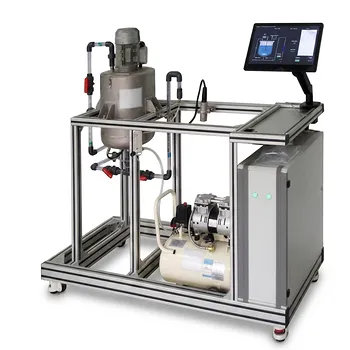
When scaling up wet granulation in mixer granulator pilot plants, the most direct way to preserve consistent powder flow and eliminate stagnant zones is to apply impeller speed scaling rules that go beyond Constant Tip Speed. Instead, use Froude number scaling (ND¹ = constant) or an “equal shear” criterion (ND⁰.⁸⁻⁰.⁸⁵ = constant). These relationships ensure the powder surface velocity remains adequate, preventing the flow from collapsing into an inefficient “bumping” regime where portions of the bed sit motionless.
Flow pattern collapse is the hidden risk in scale-up. By anchoring your impeller speed to a Froude number or equal shear scaling rule, you maintain the dynamic powder circulation seen at lab scale and deliberately avoid the stagnant zones that ruin granule uniformity.
The Flow Pattern Problem: Roping vs. Bumping
What is Roping Flow?
At lab scale, high-shear mixer granulators typically operate in a roping flow regime. The powder mass rotates as a coherent, twisted ribbon, with every particle constantly tumbling and renewing its position. This vigorous circulation delivers uniform wetting and shear.
The Scale-Up Pitfall: Bumping Flow and Stagnation
When you simply increase equipment size without adjusting the physics, roping often degrades into bumping flow. The larger bed heaves in place instead of rolling. Large stagnant zones form near the vessel walls and around the chopper, leading to over‑wetted lumps in some regions and under‑processed powder in others.
The Science of Scale-Up: Impeller Speed Scaling Rules
The Constant Tip Speed Myth
A common rule of thumb keeps the impeller tip speed (πDN) constant, which corresponds to an exponent n = 0.5 in the relation ND^n = constant. This preserves the outer blade velocity but fails to account for the increased bed depth and reduced centrifugal acceleration acting on the powder in a larger bowl.
Froude Number Scaling: Matching Centrifugal Forces
The Froude number (N²D/g) captures the ratio of centrifugal to gravitational forces, dictating whether powder climbs the vessel wall and cascades back onto itself. Keeping Fr constant requires n = 1, meaning the impeller speed (rpm) drops less aggressively than tip speed scaling would suggest. This directly preserves the powder surface velocity and prevents bed stagnation.
The Equal Shear Criterion: A Practical Middle Ground
Research shows that matching the bulk shear stress imparted to the wet mass often calls for an exponent between 0.8 and 0.85. This equal shear approach accounts for vessel geometry and fill level, offering a balance between avoiding stagnation and controlling over‑granulation from excessive blade impacts.
Understanding the Trade-offs
Impact on Shear and Granule Growth
Higher impeller speeds (from Froude or equal shear scaling) increase shear stress, which boosts granule densification and can accelerate breakage. In a “steady‑state” granulation process, this shifts the equilibrium size distribution. You must pair the chosen speed with a liquid level that delivers the same wet mass consistency across scales.
Balancing with Liquid Distribution
As you scale up, maintaining dimensionless spray flux is just as critical. A larger bowl with the same addition time creates a narrower spray footprint and flooding. Multi‑nozzle manifolds or proportionally extended addition times prevent the liquid‑rich pockets that amplify stagnation.
Leveraging Pilot Plant Capabilities for Validation
Achieving Steady-State Conditions
A mixer granulator pilot plant lets you observe the true steady‑state granulation where growth and breakage reach equilibrium. At that endpoint, the entire granule size distribution can be matched between scales by adjusting only one variable—the impeller speed, and therefore the shear stress.
Using Dimensional Analysis to Identify Key Groups
Buckingham Pi analysis distills the process into dimensionless groups like Froude number, Pseudo Reynolds number, and Power number. Pilot‑scale experiments that hold these groups constant, combined with the correct ND^n rule, transform scale‑up from trial‑and‑error into a predictable calculation.
Making the Right Choice for Your Scale-Up Goal
Choose your scaling strategy based on what you must preserve.
- If your primary focus is preventing stagnant zones: Use Froude number scaling (n = 1). It maintains powder surface velocity and cone‑shaped rolling.
- If your primary focus is balancing flow with granule shear history: Apply the equal shear criterion (n = 0.8–0.85), adjusting for your specific fill level.
- If your primary focus is maintaining identical granule size distribution: Combine the chosen speed scaling with a constant‑saturation “steady‑state” approach, validating final shear stress and liquid level in the pilot plant.
- If your primary focus is a fast, low‑risk first attempt: Start with constant tip speed but immediately check for bed motion; shift to Froude scaling if bumping is observed.
A mixer granulator pilot plant is your direct window into the flow pattern. Use it to see the motion, not just the numbers, and scale with confidence.
Summary Table:
| Scaling Rule | Exponent ($ND^n$) | Primary Focus | Best Used For |
|---|---|---|---|
| Constant Tip Speed | $n = 0.5$ | Preserves outer blade velocity | Fast, low-risk initial trials |
| Equal Shear | $n = 0.8 - 0.85$ | Balances bulk shear stress and bed depth | Optimizing granule size distribution |
| Froude Number | $n = 1.0$ | Matches centrifugal and gravitation forces | Preventing stagnant zones and bumping |
Optimize Your Scale-Up with LABPARK Pilot Plants
Transitioning wet granulation from lab to production scale requires precise control over process physics. LABPARK provides state-of-the-art Educational and Vocational Unit Operations Pilot Plants in chemical engineering, bioprocess & biotech, and environmental & water treatment.
Specifically built for universities, research institutes, and enterprises, our advanced pilot systems empower you to accurately study impeller speed dynamics, prevent bed stagnation, and ensure steady-state process predictability.
Ready to elevate your research and engineering training? Contact LABPARK today to explore our custom pilot plant solutions!
Related Products
- Polymerization Granulation and Pellet Processing Educational Unit Operations Pilot Plant
- Agitation and Mixing Educational Unit Operations Pilot Plant
- Multi-Stage Stirred Tanks in Series Residence Time Distribution and Mixing Performance Determination Educational Pilot Plant
- Natural Product Extraction Unit Operations Training Pilot Plant
- High-Gravity Emulsification and Mass Transfer Educational Pilot Plant
People Also Ask
- How to configure a polymerization pilot plant for molecular weight control? Key Setup Guide
- How do unit operation requirements differ between traditional chemical processes and bioprocesses? Build Better Pilot Plant Curricula
- How do educational unit operations pilot plants address safety and waste management when scaling up?
- How do educational unit operations pilot plants bridge theory and design? Bridge the Engineering Gap
- How do educational unit operations pilot plants bridge theory and industrial process development? Hands-On Learning