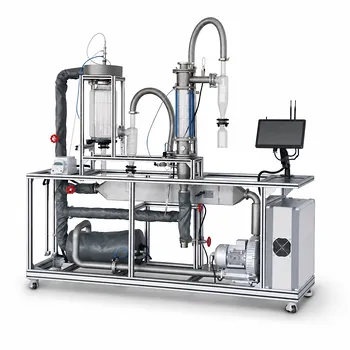
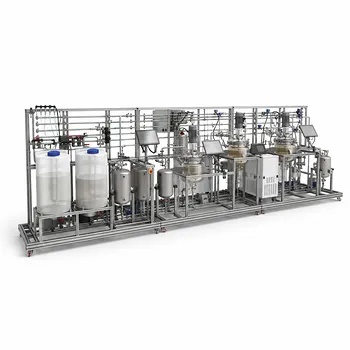
The core distinction lies in the driving force. To differentiate osmotic-driven release from pure diffusion in controlled-release tablets, researchers systematically alter the external dissolution medium. Specifically, they run dissolution tests in media with varying osmotic pressure—commonly using sucrose solutions—and in a medium saturated with the drug itself. When the external osmotic pressure matches the tablet’s internal osmotic pressure, the osmotic pump mechanism shuts down, and any drug release observed is solely due to Fickian diffusion.
By manipulating external osmotic pressure and using drug-saturated media, you can decouple the convective solvent influx from concentration-gradient-driven transport. A bioprocess unit operations pilot plant turns this elegant experiment into an engineering-grade measurement, providing the precise environmental control and real-time analytics required to quantify each release component with confidence.
The Scientific Principle: Isolating Two Mechanisms of Release
Before diving into pilot plant execution, it’s essential to understand what you are separating. Osmotic and diffusive release coexist in many systems, but they respond differently to changes in the external environment.
How an Osmotic Pump Works
An osmotic controlled-release system relies on a water-swellable core surrounded by a semipermeable membrane. As water permeates into the core due to the osmotic pressure gradient, it creates a hydrostatic pressure that pushes a drug solution or suspension out through a delivery orifice.
This is a convective, bulk flow process. The release rate is primarily governed by the volumetric inflow of water, which depends on the membrane’s hydraulic permeability and the net osmotic pressure difference across it.
The Diffusive Contribution
Even in the absence of any pumping, drug can still leave the tablet. When the membrane is permeable to the drug or the tablet matrix itself is not perfectly sealed, molecules migrate down their own concentration gradient.
This Fickian release is a molecular, random-walk process. It persists as long as a drug concentration difference exists between the core and the surrounding medium, independent of osmotic forces.
The Critical Experiment: Matching Osmotic Pressure
The key to separating these mechanisms is to nullify the osmotic gradient. Researchers add an inert, impermeable solute (like sucrose) to the dissolution medium until the external osmotic pressure equals the tablet core’s internal osmotic pressure.
At that balance point, the net water influx becomes zero—the osmotic pump stops. Any drug measured in the vessel must therefore originate from diffusion through the membrane or matrix. The osmotic-driven fraction is then simply the total release under normal conditions minus this diffusive baseline.
Executing the Differentiation in a Pilot Plant
A bioprocess unit operations pilot plant is far more than a collection of beakers. It provides a controlled engineering environment where thermodynamic and transport variables can be precisely set, monitored, and linked to mathematical models.
Precision Control of External Osmotic Pressure
The pilot plant’s controlled dissolution vessels allow you to systematically spike and maintain exact sucrose concentrations. Temperature regulation is equally critical, as osmotic pressure is temperature-dependent.
You can execute a series of runs where the external osmotic pressure is stepped from zero (pure water) up to the tablet’s internal value. At each step, the measured release rate will decrease if an osmotic mechanism is active, perfectly following the linear relationship predicted by the volumetric flux equation.
Using Drug-Saturated Media to Isolate Diffusion
A more direct method for capturing the pure diffusive component is to run the dissolution in a medium already saturated with the drug. This eliminates the concentration gradient for diffusion, meaning any release observed originates entirely from convective osmotic pumping.
In a pilot plant, inline concentration monitoring (e.g., UV-Vis probes) makes this feasible without disturbing the system. You can continuously track the drug concentration and verify when saturation is achieved, then measure any further increase as the direct osmotic contribution.
Real-Time Analytics and Model Validation
The pilot plant’s integrated analytics let you transform a static end-point assay into a dynamic rate measurement. Sampling and dilution errors are minimized, and the high-frequency data directly feeds into the mathematical transport models.
This capability connects the physical experiment to the core equation shared with membrane unit operations: ( \frac{dV}{dt} = \frac{A}{h} L_p (\sigma \Delta \pi - \Delta P) ). By plotting release rate against the applied osmotic pressure difference, you can extract the membrane’s hydraulic conductivity and the reflection coefficient, validating the governing physics at a scale relevant to process design.
The Deep Engineering Analogy: Learning from Membrane Science
The pilot plant’s role extends beyond this single drug delivery experiment. It serves as a bridge to fundamental chemical engineering principles used in bioseparations and water treatment.
A Shared Mathematical Framework
The volumetric water flow equation that governs osmotic drug release is mathematically identical to the one guiding reverse osmosis and forward osmosis membrane processes. The same parameters—area, thickness, permeability, and net driving force—control flux.
For a pilot plant operator or researcher, studying these osmotic tablets becomes a tangible, small-scale lesson in flux behavior, concentration polarization, and even membrane fouling. The tablet’s polymeric membrane, when exposed to complex biologics or high drug loads, can experience surface phenomena analogous to those in industrial membrane modules.
Connecting Pilot Plant Work to Process Scale-Up
Running these differentiation experiments in a pilot plant forces you to confront hydrodynamic reproducibility. Stirring rates, shear stress, and baffle geometry all influence the external mass transfer coefficient, which can confound the measurement of the true membrane-controlled rate.
This is also the environment where you characterize polymer erosion-based release systems. By systematically varying impeller speed, you can distinguish surface erosion from bulk degradation, just as you would in a stirred-tank reactor for pharmaceutical fermentation or cell culture. The pilot plant thus becomes a consistent, documentable platform that supports both mechanistic characterization and subsequent commercial scale-up.
Understanding the Trade-offs and Practical Challenges
This differentiation method is powerful, but it requires careful interpretation and an awareness of its limitations. Trust in an advisor is built on acknowledging these boundaries.
The Uncertainty of Internal Osmotic Pressure
The tablet core is a complex mixture of drug, polymer, and excipients, often in a semi-solid or partially dissolved state. The true internal osmotic pressure is not a single number; it changes with water uptake and drug dissolution. Matching it externally with sucrose is an approximation that demands iterative experimentation and a robust analytical model.
The Limitations of a Simplified In Vitro Model
Sucrose-spiked solutions effectively isolate the osmotic component, but they do not replicate the complex, variable environment of the gastrointestinal tract. Viscosity, ionic strength, and hydrodynamics can all shift the balance between pumping and diffusion in vivo. The pilot plant data provides a clean mechanistic understanding, but it must be contextualized with biorelevant testing.
The Investment in Pilot Plant Capability
A unit operations pilot plant with the necessary inline analytics, precise temperature control loops, and data integration systems is a significant capital and operational commitment. For early-stage feasibility studies, simpler dissolution baths may suffice. The pilot plant becomes an indispensable investment when the goal is to build a robust scale-up model, train operators, and generate datasets for regulatory filings that demand engineering-level process understanding.
Making the Right Choice for Your Characterization Goal
Ultimately, how you differentiate these mechanisms depends on your objective. The pilot plant is a tool that scales with your needs.
- If your primary focus is mechanistic understanding: Leverage the full osmotic-pressure-matching experiment in a highly instrumented vessel. Use the real-time flux data to extract intrinsic membrane parameters and validate the core mathematical transport model.
- If your primary focus is formulation screening: Use the drug-saturated medium method as a rapid binary check for the presence of an osmotic component. This can be done with benchtop equipment, but the pilot plant’s analytics will give you faster, more reliable answers when testing dozens of prototypes.
- If your primary focus is process scale-up and regulatory readiness: Invest in a unit operations pilot plant to characterize not just the release mechanism, but the hydrodynamic sensitivity of the system. Document how release rates change with agitation, vessel geometry, and scale—the exact data needed to de-risk commercial manufacturing.
A well-designed pilot plant experiment transforms a clever physico-chemical test into a rigorous, engineering-grade foundation for your controlled-release delivery system.
Summary Table:
| Release Mechanism | Driving Force | Key Characteristic | Isolation Method in Pilot Plant |
|---|---|---|---|
| Osmotic-Driven | Hydrostatic pressure gradient | Convective, bulk flow; dependent on membrane permeability | Use drug-saturated dissolution media to eliminate the concentration gradient. |
| Diffusional (Fickian) | Concentration gradient | Molecular, random-walk; independent of osmotic pressure | Match external and internal osmotic pressure (e.g., using sucrose) to stop the pump. |
Optimize Your Controlled-Release Formulations with LABPARK
Are you looking to bridge the gap between laboratory formulation and industrial scale-up? LABPARK provides state-of-the-art Educational and Vocational Unit Operations Pilot Plants in chemical engineering, bioprocess & biotech, and environmental & water treatment. Specifically designed for universities, research institutes, and enterprises, our pilot plants deliver the precise thermodynamic control and real-time analytics required to master transport phenomena.
Contact LABPARK Today to discover how our pilot plant solutions can elevate your research and training capabilities!
Related Products
- Bio-fermentation Ethanol Production Practical Training Unit Operations Pilot Plant
- Multimodal Absorption and Desorption Pilot Plant for Unit Operations Training
- Natural Product Extraction Unit Operations Training Pilot Plant
- Multi Pump Fluid Transport Process Piping Unit Operations Training Pilot Plant
- Multi-Functional Drying Educational Unit Operations Pilot Plant
People Also Ask
- Why Use PTFE & Hastelloy in Chemical Pilot Plants? Prevent Corrosion & Ensure Safety
- Why Compare Predicted and Experimental Excess Enthalpy? Key to Accurate Pilot Plant Scale-up
- Why is the chemical plant startup schedule crucial? De-risk scale-up with pilot plants.
- When to transition from PID to adaptive control in pilot plants? Key process indicators.
- Why must batch and fed-batch fermentation pilot plants be designed to accommodate changing rheological conditions?