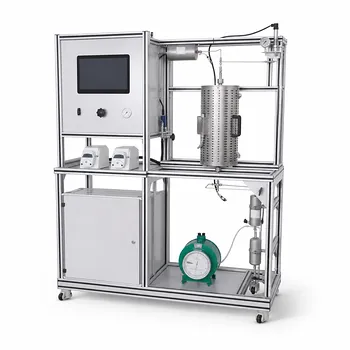
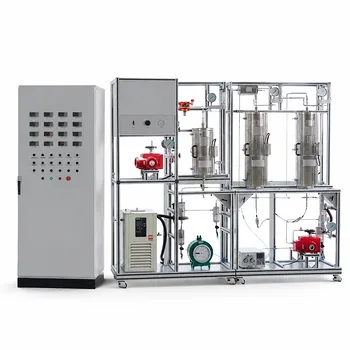
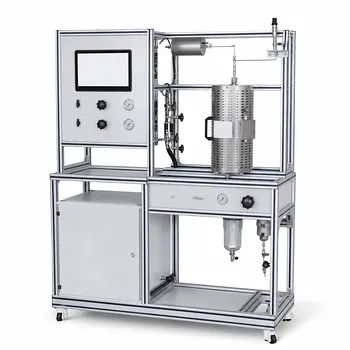
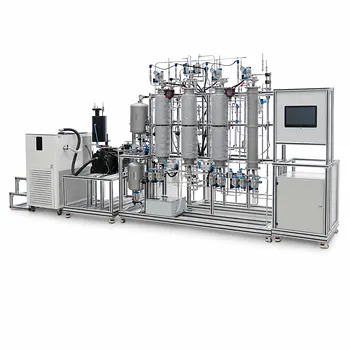
Teaching a dangerous reaction safely is not about eliminating risk—it’s about engineering risk into a measurable, controllable variable. Educational pilot plants for alkylation reactions accomplish exactly this. By scaling down the synthesis of ethylbenzene from benzene and ethylene, these systems use fixed-bed catalytic reactors with precise temperature and pressure monitoring to contain the exothermic reaction. Students can safely manipulate space velocity, benzene-to-ethylene feed ratios, and operating temperature, directly observing their impact on conversion rate and selectivity while being shielded from the hazards of a full-scale industrial runaway.
The true power of an alkylation pilot plant lies in shrinking a hazardous process into a controlled, data-rich teaching environment. It transforms abstract kinetic equations and safety principles into physical experience, embedding an intuition for reaction engineering and inherently safer design that no simulation can replicate.
The Anatomy of a Safe Alkylation Pilot Plant
Engineering the Exotherm into a Teachable Moment
The heart of the teaching setup is the fixed-bed catalytic reactor. Here, the exothermic substitution of hydrogen atoms on a benzene ring with an alkyl group is carefully managed. The reactor operates at reduced pressures and temperatures compared to industry—still high enough to demonstrate real kinetics, but within the safety envelope of a university lab. Precise temperature monitoring at multiple points along the catalyst bed prevents hot spots that could lead to a thermal runaway, turning the reactor itself into a lesson on heat transfer.
Instrumentation: The Window into Reaction Kinetics
Real-time process data from online sensors is what transforms a demonstration into a true research and teaching tool. Pressure transmitters, flowmeters, and temperature probes are integrated directly into the feed and effluent streams. By tracking changes in system pressure and component flow rates, students can quantitatively calculate reaction rates under varying conditions. This hands-on correlation between physical measurements (like a pressure drop as ethylene is consumed) and chemical kinetics builds a deep, intuitive understanding that stays with them far longer than a textbook graph.
Inherently Safer Design as a Foundational Principle
The pilot plant itself becomes a case study in inherently safer design (ISD). Students learn that safety does not start with add-on interlocks, but with fundamental process choices. They operate systems with reduced hazardous inventories, see how smaller reactor volumes limit the total energy available for a runaway, and evaluate solvent selections. Conducting a live risk assessment on their own pilot operation—identifying potential overpressure scenarios or leaks—teaches them to anticipate hazards rather than just react to them, an essential skill for engineering safer industrial plants.
Bridging Theory and Industrial Reality
From Hess’s Law to a Measured Heat Duty
The link between thermodynamic theory and pilot-plant reality becomes tangible when students perform an energy balance. Using a jacketed batch reactor or a calorimetric reactor unit, they monitor the flow rate and temperature change of a heat-transfer fluid circulating around the alkylation reactor. This direct measurement allows them to calculate the enthalpy change (ΔH) of the reaction and compare it to predictions from Hess’s Law. The exothermic alkylation heat is no longer a number on a page; it is a real thermal load they must manage.
Process Intensification: Learning for the Future of Manufacturing
Even at the pilot scale, students can be exposed to process intensification concepts. Compact equipment like microreactors or monolithic catalysts can be integrated into the setup to demonstrate how high-activity catalysts and superior heat transfer can shrink reactor volume dramatically. Operating an intensified alkylation unit shows that sustainable, modern chemical engineering is not about building a bigger plant, but a smarter one—a critical lesson for their future careers.
The Full Process Flow: A Miniature Ethylbenzene Plant
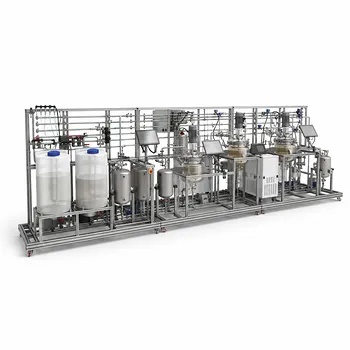
To truly prepare students for industry, some advanced educational pilots replicate the complete synthesis train. For gas-phase alkylation using a ZSM-5 catalyst, this means including raw material preheating, the catalytic reaction section operating at around 370–425°C, and a separation train. This downstream section, featuring a benzene recovery column, an ethylbenzene column, and a polyethylbenzene column, teaches a critical real-world lesson. Students analyze how recycling unreacted benzene and heavier byproducts back to the reactor optimizes raw material utilization and prevents waste, mirroring an operational petrochemical complex on a benchtop scale.
Understanding the Trade-offs
The Limits of Scaling Down
An educational pilot plant is a powerful tool, but it has inherent limitations that must be acknowledged. Heat and mass transfer dynamics do not scale linearly. The surface-area-to-volume ratio in a small reactor is much higher, meaning heat removal is often more efficient and hot spots are less likely than in an industrial counterpart. Students must be taught to recognize that this safer behavior can mask a real industrial hazard, preventing complacency. The lesson is not that the chemistry is safe, but that the engineering controls are effective.
Safety Can Overshadow Operational Reality
Prioritizing absolute safety can sometimes sanitize the industrial experience. Operating at severely de-rated temperatures and pressures may produce such high selectivities that students never grapple with the frustrating coking, side reactions, or catalyst deactivation rates seen in the field. A well-designed curriculum balances this by having students predict industrial performance from their pilot data using kinetic models, explicitly discussing how the safety margin changes the observed outcomes. The goal is not to simulate danger, but to model it intellectually with hands-on support.
Making the Right Choice for Your Educational Goal
The type of alkylation pilot plant you integrate into a university lab should map directly to your core learning objectives. Here is how to decide:
- If your primary focus is foundational reaction kinetics and safety training: Select a simple fixed-bed reactor with robust process instrumentation. Emphasize the ability to safely explore temperature, feed ratio, and space velocity while performing a live risk assessment on an exothermic process.
- If your primary focus is bridging theory with thermodynamics: Choose a jacketed or calorimetric reactor setup. The educational value lies in measuring the reaction enthalpy directly and performing real-time energy balances, making Hess’s Law tangible.
- If your primary focus is demonstrating complete industrial process integration: Invest in a miniaturized plant with a separation train and recycle loops. This teaches raw material efficiency, byproduct management, and the economic drivers behind full-scale plant design.
- If your primary focus is future-oriented process design and sustainability: Look to pilot units equipped with microreactors or monolithic catalysts. They illustrate how intensification can replace large, hazardous volumes with compact, inherently safer equipment.
The most memorable chemical engineers are not made from theory alone, but from the controlled encounter with reality. A well-chosen pilot plant ensures that encounter is enlightening, not dangerous.
Summary Table:
| Pilot Plant Type | Key Equipment & Features | Core Learning Objective |
|---|---|---|
| Kinetics & Safety | Fixed-bed reactor, online sensors, temperature monitoring | Space velocity, feed ratios, live risk assessment |
| Thermodynamics | Jacketed or calorimetric reactor, heat-transfer fluid | Energy balances, measuring reaction enthalpy (ΔH) |
| Industrial Integration | Miniaturized synthesis train, separation columns, recycle loops | Raw material optimization, byproduct management |
| Process Intensification | Microreactors, monolithic catalysts | Sustainable design, compact equipment operations |
Bring Hands-On Industrial Reality to Your Laboratory
Are you looking to equip your students or researchers with real-world chemical engineering experience without compromising on safety?
LABPARK provides state-of-the-art Educational and Vocational Unit Operations Pilot Plants in chemical engineering, bioprocess & biotech, and environmental & water treatment designed specifically for universities, research institutes, and enterprises.
Our pilot plants allow you to safely teach high-stakes processes—like exothermic alkylation and ethylbenzene synthesis—using scaled-down, instrumented systems that make reaction kinetics and process dynamics tangible.
Ready to transform your laboratory training? Contact LABPARK today to discuss your educational goals and find the perfect pilot plant solution for your institution.
Related Products
- Ethylbenzene Dehydrogenation Educational Unit Operations Pilot Plant
- Crude Benzene Hydrogenation Educational Unit Operations Pilot Plant
- Ethyl Acetate Synthesis Unit Operations Pilot Plant for Practical Training
- Bio-fermentation Ethanol Production Practical Training Unit Operations Pilot Plant
- Methanol Synthesis and Catalyst Performance Evaluation Educational Unit Operations Pilot Plant
People Also Ask
- What parameters & reactor configurations are needed for ethylbenzene dehydrogenation pilot plants?
- Why is steam dilution critical in dehydrogenation? Pilot Plant Control Guide
- Isothermal vs Adiabatic Reactors: Key Differences in Ethylbenzene Dehydrogenation Pilot Plants
- How do pilot plants help students verify material balances? Bridge Theory with Real-world Data
- Why is the steam-to-feedstock ratio critical in catalytic dehydrogenation? Learn the 3 key roles of steam.