The key to preventing overfitting in PCR is not simply choosing a magic number of principal components—it’s executing a disciplined validation workflow that proves your model works on truly unseen process data.
In bioprocess and chemical pilot plants, overfitting turns a calibration model into a noise‑tracker. It memorizes the quirks of the training spectra rather than the real chemical or physical relationships, making predictions fragile and unreliable when small process disturbances occur. You avoid this by determining the optimal model complexity through cross‑validation, verifying that complexity on an independent external test set, and then continuously monitoring the model’s applicability during real‑time runs.
The most reliable safeguard against overfitting in PCR models is a multi‑step validation strategy: use cross‑validation to find the number of principal components that minimizes prediction error, confirm that performance holds on a completely separate pilot‑plant data set, and finally examine the regression coefficients and real‑time process statistics to catch any sign that the model is fitting noise rather than signal.
The Dangers of Overfitting in a Pilot Plant Environment
Overfitting occurs when the PCR model includes too many principal components. Those extra components capture random spectral noise, analyzer drift, or minor reference‑measurement errors instead of the true process variation. The result is a model that appears excellent on its training data but fails catastrophically when a subtle change, such as a slight temperature shift or a new batch of media, appears in the process stream.
For pilot plants—where run‑to‑run variability is high and the cost of a failed run can derail development timelines—an overfit model can recommend incorrect control actions. You might see a prediction that looks credible but is actually an extrapolation into an unmodeled process state. This can damage equipment, waste raw materials, or mask a genuine process deviation.
Why Parsimony Matters in Spectroscopic Calibration
The guiding principle is parsimony: explain the most relevant variance with the fewest components. In PCR, the spectral data (X) is compressed into principal components that capture the directions of greatest variance in the spectra. The regression model then uses those components to predict the target property (y). Every additional component brings a diminishing return of explained y‑variance while injecting more noise. You need to stop before the model starts fitting the random wiggles in the baseline.
Proven Methods to Prevent Overfitting in PCR
1. Determine the Optimum Number of PCs Using Explained Variance
Plot the cumulative percentage of variance explained in both X and y against the number of principal components. The spectral variance curve will rise steeply at first, then flatten into a plateau. The concentration variance curve may show a similar behavior. Once the plateau is reached, adding more components yields negligible improvement in RMSEE (Root Mean Square Error of Estimation) but steadily increases model instability.
Interpreting the “elbow” visually is a useful first step, but it can be subjective. Two operators looking at the same plot might pick different stopping points. That’s why the next step—cross‑validation—is essential to move from judgment to evidence.
2. Rely on Cross‑Validation, Not Just the Calibration Fit
Never decide on the number of components based solely on how well the model fits the training data. The RMSEE always drops as you add components. Instead, use k‑fold cross‑validation (e.g., leave‑one‑run‑out or random sample splits) to compute the RMSE of cross‑validation (RMSECV). The optimum number of PCs is the one that minimizes RMSECV. After that point, RMSECV will plateau or even increase—a clear sign of overfitting.
For pilot plants, it is critical that the cross‑validation strategy respects the natural grouping of the runs. If you randomly split samples from the same reactor campaign into both training and validation folds, you risk an overly optimistic estimate. Structure the folds by run so that the model must predict on a process condition it has never seen during training.
3. Validate with an Independent External Test Set
Cross‑validation selects the model; an external test set proves it. Always reserve a block of data from separate pilot plant campaigns (different raw material lots, different equipment setups, different days) and use it only once the model is finalized. The RMSEP (Root Mean Square Error of Prediction) on this external set gives you the true measure of robustness. If the external error is significantly higher than the cross‑validation error, the model has likely overfit the training data’s peculiarities.
4. Examine Regression Vectors for Noise
Overfitting shows up visually in the regression coefficients. As you add more principal components, the regression vector starts to amplify noise. Instead of smooth, interpretable features that align with known spectral peaks, the vector becomes jagged and high‑amplitude. A qualitative check of the coefficient spectrum can flag the point where the model transitions from fitting signal to fitting disturbance. If the vector looks more like random noise than a spectroscopic fingerprint, you’ve gone too far.
5. Implement Real‑Time Process Monitoring to Catch Over‑parameterized Models
Even a perfectly validated model can fail if the online process sample falls outside the model’s calibration space. Compute the Hotelling T² and Q residual statistics for every new spectrum. An elevated Q residual means the sample contains spectral features not explained by the PCA model; a high T² indicates the sample’s projection deviates from the training score cluster. If these diagnostics trip, the process is an outlier—and any prediction from an overfit model (or a well‑fit one) is no longer trustworthy. This real‑time guard prevents the overfit model from ever issuing a false, high‑confidence prediction during operation.
Understanding the Trade‑offs: PCR vs. PLS and the Risk of Underfitting
PCR compresses the spectral data solely to capture maximum X‑variance, then regresses those components against the target property. Because it ignores y during compression, PCR can be more forgiving when the reference analytical data is noisy. The principal components focus on the dominant spectral trends, not on chasing spurious y‑correlations.
PLS, in contrast, builds latent variables that maximize the covariance between X and y. While this often yields fewer components and more directly predictive models, PLS is more susceptible to overfitting if the y‑reference contains significant error or if the number of calibration samples is small. For educational or research pilot plants, comparing both approaches teaches a valuable lesson in balancing predictive power against noise sensitivity.
Don’t over‑correct and underfit. An underfit model (too few PCs) fails to capture genuine interferences—temperature shifts, particle size variations, or secondary chemical interactions—and delivers inaccurate results even under nominal conditions. The goal is the narrow window where both bias (underfitting) and variance (overfitting) are minimized. Cross‑validation on a run‑wise basis is the most reliable way to find that sweet spot.
Making the Right Choice for Your Pilot Plant
Apply these strategies based on your immediate priority:
- If your primary focus is rapid model deployment for a new process: Start with a visual plateau analysis of explained variance, then use a single‑block cross‑validation to lock in the initial number of PCs. Confirm with a reserved run before handing the model to operations.
- If your primary focus is long‑term robustness against feedstock variability: Always structure validation folds by entire pilot runs, not individual samples. Invest time in evaluating the smoothness of the regression coefficients and implement T²/Q monitoring from day one.
- If your primary focus is training a team on chemometrics fundamentals: Compare PCR and PLS on the same data set. Show how the number of components affects the coefficient noise and how cross‑validation identifies the point of overfitting—this builds intuition that a software wizard can never deliver.
By treating PCR calibration as a rigorous, evidence‑driven process—validated on independent runs and monitored in real time—you build models that genuinely support process understanding and control, rather than models that simply chase noise.
Summary Table:
| Method to Prevent Overfitting | Key Action | Benefit to Pilot Plant |
|---|---|---|
| Explained Variance Analysis | Plot cumulative variance of X & y against PCs | Identifies initial plateau to avoid redundant components |
| Run-Wise Cross-Validation | Structure validation folds by entire pilot runs | Avoids overoptimistic error estimates from related samples |
| External Test Set Validation | Predict on separate campaigns (materials/days) | Verifies model robustness on truly unseen process data |
| Regression Vector Check | Visually inspect coefficients for high-frequency noise | Flags when the model starts fitting noise instead of signal |
| Real-Time Diagnostics | Monitor Q residuals and Hotelling T² online | Catches process outliers and prevents false predictions |
Optimize Your Pilot Plant Training and Scale-Up with LABPARK
Building robust calibration models is critical for reliable process scale-up and hands-on education. LABPARK provides state-of-the-art Educational and Vocational Unit Operations Pilot Plants in chemical engineering, bioprocess & biotech, and environmental & water treatment.
Designed specifically for universities, research institutes, and enterprises, our pilot plants enable students and operators to master real-world process control, data analysis, and chemometrics in a safe, controlled environment.
Ready to elevate your training curriculum or research facility? Contact our engineering team today to discover how LABPARK can customize the perfect pilot plant solution for your institution.
Related Products
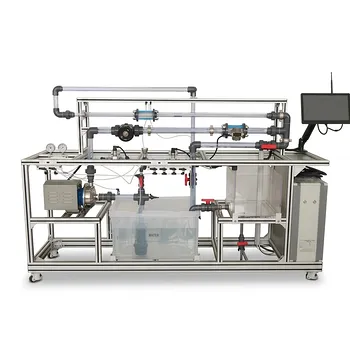
- Centrifugal Pump Performance and Orifice Flowmeter Calibration Educational Pilot Plant
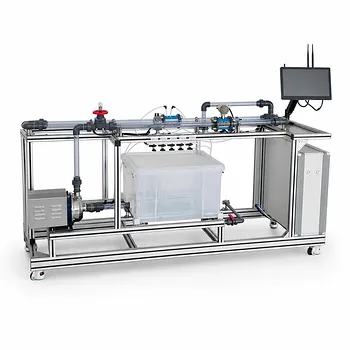
- Orifice and Venturi Flowmeter Calibration Educational Pilot Plant for Fluid Mechanics Laboratory
- Bio-fermentation Ethanol Production Practical Training Unit Operations Pilot Plant
- Educational Unit Operations Pilot Plant for Intraparticle Diffusion Effective Factor Measurement
- Dual-Mode Rectification Pilot Plant for Practical Training Unit Operations
People Also Ask
- What features should instructors look for in pump & flowmeter pilot plants? Key Selection Guide
- Why start a centrifugal pump with a closed outlet valve? Protect your pilot plant motors.
- How to update chemometric calibration models in pilot plants? Best practices for process engineers.
- How can cavitation and slurry erosion be studied and mitigated using fluid transport and centrifugal pump pilot plants?
- How do pilot plants demonstrate siphon pressure variations? Visualizing Bernoulli's Energy Balance