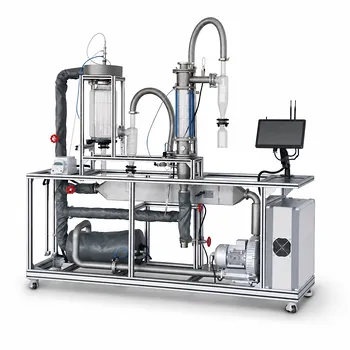
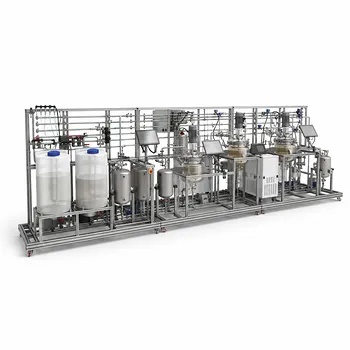
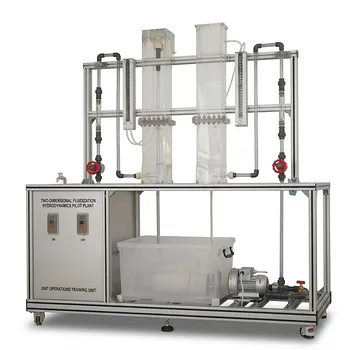
The answer is straightforward: Laboratory unit operations pilot plants determine real thermodynamic properties by letting you physically measure how fluids actually behave. You collect precise pressure-volume-temperature (P-V-T) data under controlled conditions, then apply equations of state to compute the enthalpy, internal energy, and entropy that ideal gas laws can’t capture.
Real fluids refuse to follow ideal rules, especially under the pressures and temperatures common in industrial processes. Pilot plants bridge that gap by turning abstract equations of state into tangible, measured reality. They provide the empirical foundation to verify thermodynamic models and teach engineers exactly where and why non-ideality starts to dictate real-world design and operation.
The Imperative of Moving Beyond Ideality
Ideal gas assumptions are convenient, but they fail the moment you push a fluid outside its safe zone. As soon as pressure rises or temperature drops, molecules interact, volumes become significant, and energy analysis drifts toward dangerous errors.
In real chemical engineering, ignoring these deviations can lead to undersized equipment, unsafe operating windows, or off-spec product. Pilot plants show you the true face of your fluid, turning a theoretical warning into a measurement you can trust.
Where Ideal Assumptions Collapse
Polar mixtures, supercritical components, and even simple gases at high density all stray from the ideal gas law. The phase rule tells you what could happen; the pilot plant tells you what does happen.
For example, a binary system that should be miscible on paper might split into two liquid phases at low temperature, flooding a column. Only a physical test under realistic thermal and hydraulic conditions exposes that.
The Hidden Cost of Guessing
When you assume ideality, you’re guessing at energy balances. You might overestimate a pump’s capacity or underestimate a condenser’s duty. Errors compound quickly in unit operations like distillation or gas absorption.
Pilot plants remove the guesswork. They give you the data to calculate the real enthalpy of a stream, so your heat exchanger isn’t just a hopeful estimate.
The Pilot Plant as a Thermodynamic Laboratory
A modern unit operations pilot plant is purpose-built to gather the genuine volumetric and thermal behavior of substances. It’s not a scaled-down factory; it’s a measurement engine.
You operate at steady state or in carefully designed transient experiments, logging pressure, temperature, level, and flow with research-grade sensors. Every data point feeds into a thermodynamic model that either confirms your assumptions or forces a critical rethink.
Precision PVT Data Collection
The core of the method is collecting P-V-T data—the most fundamental fingerprint of a fluid. You might confine a known mass in a calibrated vessel and vary temperature, recording pressure. Or you pass a stream through a controlled volume and measure flow and density simultaneously.
With accurate measurements, you can calculate the compressibility factor and see exactly how far the fluid deviates from Z=1. That single number unlocks corrections for energy, entropy, and fugacity.
From Measurement to Meaningful Property
Raw pressure, volume, and temperature are necessary but not sufficient. You use a thermodynamic equation of state—like Peng-Robinson or Soave-Redlich-Kwong—to translate those values into internal energy, enthalpy, and entropy.
This step is where pilot plant data becomes a design tool. By fitting equation-of-state parameters or using a reference fluid correspondence, you generate property tables that reflect reality, not textbook assumptions.
Bridging the Gap: Validation and Model Refinement
Process models such as NRTL, UNIQUAC, or UNIFAC are powerful, but they can exhibit erratic behavior, even inside their declared applicable ranges. No simulation should be trusted until it has been confronted with physical evidence.
Pilot plants provide that evidence. They allow you to run a controlled distillation, extraction, or reaction and collect equilibrium data—vapor-liquid compositions, temperature profiles, and phase splits—that either validate the model or expose its weaknesses.
Running the Physical Audit
In practice, you take a mixture and run it through a batch distillation column or a countercurrent absorption tower. You sample phases, log operating conditions, and then compare the results against your simulation’s predictions.
When the model matches the plant, you gain confidence. When it diverges, you’ve uncovered a hidden non-ideality: maybe an azeotrope shifted, or the activity coefficient model isn’t capturing polar interactions well enough. You then adjust binary interaction parameters to align the model with fact.
Solvent Screening and Optimization
Researchers often use thermodynamic models to screen solvents for a new extraction or distillation sequence. Models suggest the best candidate, but only a pilot plant proves whether that solvent really delivers the expected selectivity and recovery.
Running the solvent system at pilot scale reveals the real phase behavior, measures byproduct removal, and quantifies actual solvent losses. This closes the loop between computational optimization and industrial feasibility.
Extending Beyond PVT: Transport Properties and Process Limits
Non-ideal thermodynamics doesn’t stop at equilibrium properties. Viscosity, thermal conductivity, and density directly affect pipe sizing, pump selection, and column hydraulics.
A pilot plant that integrates flow measurement and heat transfer makes these effects visible. You can see a pressure drop curve that no ideal gas correlation would predict, or detect a liquid-liquid split that strangles mass transfer efficiency.
Predicting Transport Properties with Minimal Data
Accurate transport data for mixtures is often scarce. The modified corresponding states approach provides a smart workaround: correction factors for viscosity and thermal conductivity can be derived using only PVT information (like the second virial coefficient) of a reference fluid.
A pilot plant can supply that critical PVT data. Using methane-propane or nitrogen-ethane as a baseline, students can estimate mixture behavior under a range of pressures and temperatures, calibrating flow sensors and heat transfer experiments without a massive property database.
When Excess Molar Volume Threatens the Plant
Highly non-ideal mixtures, especially polar/nonpolar systems, can have significant excess molar volumes. If you mix 50 liters of A with 50 liters of B, you might get 98 or 102 liters, not 100.
If ignored, this leads to incorrect volumetric flow rate calculations. Piping and control valves sized on ideal blending could be undersized, causing fluid velocities that lead to erosion or surge. A pilot plant reveals the real densities and volumes, letting you design hydraulics that don’t fail.
Avoiding Phase Distribution Disasters
Liquid-liquid immiscibility can appear at low temperatures in a gas-liquid contactor, flooding trays or blinding packing. A simulation might not flag this if the model’s binary parameters aren’t tuned for that temperature range.
By operating the pilot plant across a realistic temperature window, you spot the phase split before it destroys a full-scale column’s performance. This operational wisdom is impossible to gain from a purely theoretical exercise.
Understanding the Trade-offs
Pilot plants are indispensable, but they’re not a silver bullet. They demand time, investment, and a careful understanding of scale-down effects.
Measurements are only as good as the sensors and calibration. A systematic error in a pressure transducer can lead to biased compressibility factors and wrong energy balances. Rigorous uncertainty analysis is mandatory.
The Cost and Complexity Barrier
Building and maintaining a pilot plant requires significant capital and skilled personnel. For early-stage research, simpler benchtop PVT cells might suffice, but they can’t replicate the integrated fluid dynamics and mass transfer of a full unit operation.
You trade the elegance of pure thermodynamics for the messiness of real equipment—fouling, heat losses, and imperfect mixing all creep in. The key is to isolate thermodynamic measurements from mechanical noise.
Extrapolation Dangers
A pilot plant operates at one scale and often in a limited range of conditions. Extending its data to larger equipment or different operating points requires a validated model that can interpolate and extrapolate safely.
The pilot plant’s greatest value is as a calibration anchor. Use it to nail down the model parameters at a few critical points, then let the model do the rest—but never trust the model without those anchors.
Making the Right Choice for Your Goal
How you use a pilot plant depends entirely on what you need to learn. Align your experimental design with your deepest uncertainty.
- If your primary focus is engineering education: Use the pilot plant to teach students how real fluids defy ideal laws. Let them see the pressure drop, measure the compressibility factor, and feel the disconnect between textbook prediction and measured outcome.
- If your primary focus is process design validation: Deploy the pilot plant to confront your process simulation with physical data. Adjust binary interaction parameters until the simulated column profile matches the real one, then proceed with confidence.
- If your primary focus is troubleshooting a troublesome separation: Replicate the non-ideal mixture in a pilot-scale column and systematically probe temperature, pressure, and composition. Identify the exact conditions where phase splitting or excess volume becomes a process problem.
- If your primary focus is developing a new solvent or reaction system: Use pilot plant runs to verify the predicted phase behavior, measure actual recovery rates, and capture the kinetic limitations that equilibrium models ignore.
Your pilot plant is the translator between theory and reality. When ideal gas assumptions no longer apply, it becomes the only voice you can trust.
Summary Table:
| Aspect | Ideal Gas Assumption | Real Fluid Behavior (Measured via Pilot Plant) |
|---|---|---|
| P-V-T Data | Assumes Z = 1 (no molecular interactions) | Measures actual Z ≠ 1 under high P & low T |
| Energy Balance | Simple temperature-dependent enthalpy | Captures molecular interactions via Equations of State |
| Phase Behavior | Assumes complete miscibility / ideal mixing | Exposes liquid-liquid splits and shifted azeotropes |
| Volume | Neglects molecular volume | Measures excess molar volume to prevent hydraulic failure |
Bring Real-World Thermodynamics to Your Lab
Don't rely on ideal assumptions when teaching or designing complex chemical processes. LABPARK provides premium Educational and Vocational Unit Operations Pilot Plants in chemical engineering, bioprocess & biotech, and environmental & water treatment.
Specifically engineered for universities, research institutes, and enterprises, our pilot plants help you bridge the gap between thermodynamic theory and physical reality.
Ready to elevate your training and research? Contact LABPARK today to find the ideal pilot plant solution for your facility!
Related Products
- Multi-Functional Drying Educational Unit Operations Pilot Plant
- General Purpose Cosmetics Production Unit Operations Training Pilot Plant
- Dual-Mode Rectification Pilot Plant for Practical Training Unit Operations
- Multi-Reactor Educational Pilot Plant for Reaction Engineering Unit Operations
- Multimodal Absorption and Desorption Pilot Plant for Unit Operations Training
People Also Ask
- How do deviations in estimating latent heat impact pilot plant thermal systems? Avoid hardware mis-sizing.
- How to study gasification in pilot plants? Compare exit gas composition & efficiency
- Why Use PTFE & Hastelloy in Chemical Pilot Plants? Prevent Corrosion & Ensure Safety
- Why is the chemical plant startup schedule crucial? De-risk scale-up with pilot plants.
- When to transition from PID to adaptive control in pilot plants? Key process indicators.