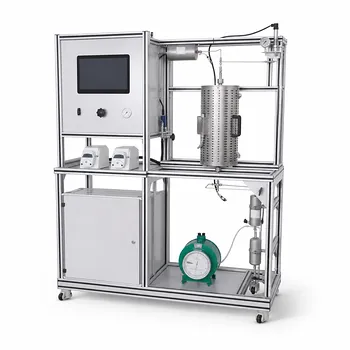
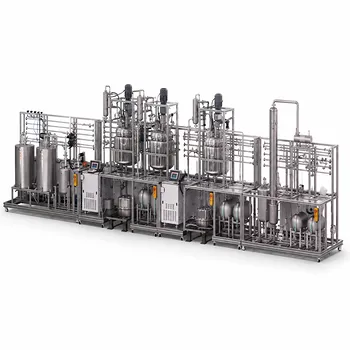
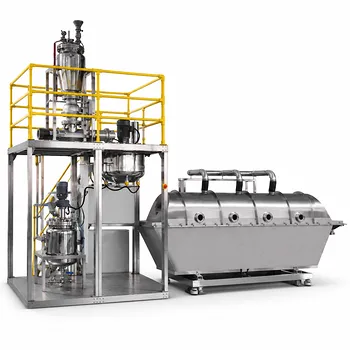
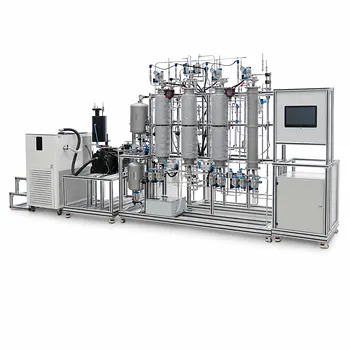
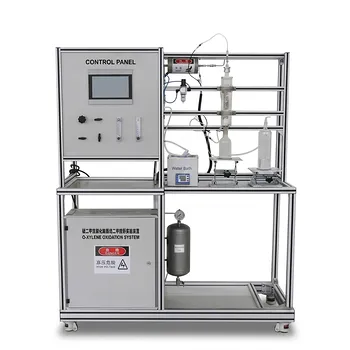
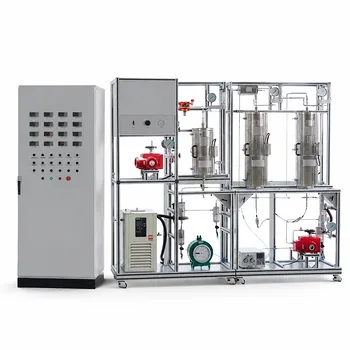
Here is the critical truth about teaching complex chemical synthesis: You can’t learn the intricacies of an industrial process like epichlorohydrin (ECH) production from a diagram—you need a safely scaled, fully integrated sequence of real unit operations that mirrors the plant floor.
An effective pilot plant for teaching ECH synthesis from propylene and chlorine is configured as a modular flow sheet: a high-temperature chlorination reactor feeding an HCl absorption column, an alkaline hypochlorination loop, a saponification reactor, and a three-column distillation train (steam stripper, lights column, heavies column). Operating these modules as one continuous system forces students to confront the real-world challenges of exotherm control, recycle management, hydrolysis prevention, and the tight coupling between reactor yield and purifier performance.
The core educational value isn’t in running each step in isolation—it’s in experiencing how a disturbance in chlorination instantly cascades through the entire train, forcing manual or automated corrections to maintain specification-grade product. A properly configured ECH pilot plant transforms abstract mass balance equations into a tangible, unforgiving system that teaches process integration at a visceral level.
Mimicking the Industrial Epichlorohydrin Process at Pilot Scale
The industrial route to ECH uses a three-stage reaction sequence followed by a specialized separation system. Replicating this at pilot scale demands a specific arrangement of unit operations, each chosen to demonstrate a critical process principle.
The Three-Stage Reaction Sequence
The reactor section is the heart of the plant and the starting point for understanding the chemistry.
- Chlorination Reactor: A tubular or stirred reactor where propylene reacts with chlorine to produce allyl chloride and hydrogen chloride gas. Students learn the importance of molar ratio control and rapid heat removal to suppress over-chlorination byproducts.
- HCl Absorption Column: The hot byproduct HCl is separated and recovered in a packed absorption column. This teaches gas-liquid mass transfer and demonstrates how valuable byproducts are recycled internally—the HCl is often routed to the next step.
- Hypochlorination Loop: Allyl chloride is contacted with an aqueous hypochlorous acid solution (generated from the recovered HCl) in a circulating loop reactor to form dichlorohydrin. This module illustrates two-phase liquid-liquid reactions and the critical role of residence time distribution in achieving high conversion.
- Saponification (Caustic) Reactor: Dichlorohydrin is mixed with a lime slurry or caustic soda to close the epoxide ring and form crude epichlorohydrin. This stirred tank reactor highlights the instantaneous, exothermic reaction that demands precise pH and temperature control to avoid product degradation.
Downstream Separation: A Distillation Train Designed for Stability
Purifying epichlorohydrin is challenging because the product is reactive and forms azeotropes with water. The educational pilot plant must use a specific sequence of columns.
- Steam Stripping Column: Immediately after saponification, crude ECH is stripped from the aqueous salt brine with live steam. This rapid removal is the primary defense against hydrolysis, where ECH reacts with water to form glycerin. Students see how residence time at elevated temperature determines yield loss.
- Light-Ends Distillation Column: The condensed organic phase is fed to a first distillation column to remove low-boiling impurities like unreacted allyl chloride and water. Here students manipulate reflux ratio and pressure to meet overhead purity specs.
- Heavy-Ends Distillation Column: The bottoms stream enters a final vacuum-fractionating column to separate high-purity ECH from high-boiling glycerin and chlorinated polymers. This step teaches the relationship between vacuum level, boiling point reduction, and product quality.
Closed-Loop Integration and Recycle Streams
An isolated reactor teaches chemistry; an integrated plant teaches process economics and controllability.
- Propylene Recycle Loop: Unreacted propylene from the chlorination reactor is compressed and recycled to the feed. Students must balance the purge rate against the buildup of inerts to maintain a safe oxygen-free atmosphere.
- Utilities and Heat Integration: Hot streams from the exothermic reactors preheat cold feeds via miniature heat exchangers. This demonstrates pinch analysis and shows how energy costs shape the design of even a small pilot plant.
- Real-Time Cascading Effects: A deliberate change in chlorination temperature immediately affects the composition of the allyl chloride stream, the loading of the hypochlorination loop, and the fouling rate in the heavy-ends column. Trainees learn that a continuous process is a single dynamic entity, not a collection of independent steps.
Designing for Educational Impact
The physical configuration of the pilot plant determines how much a student can learn from it.
Modularity and Visualization Are Essential
The unit operations must be physically distinct yet quickly connectable via flanges or flexible hoses.
- Glass or Transparent Sections: Sight glasses at phase interfaces (e.g., in the decanter after saponification) and in distillation column downcomers let students directly observe weeping, flooding, and entrainment.
- Skid-Mounted Modules: Mounting each operation on a separate skid allows instructors to reconfigure the plant for different experiments—for example, isolating the hypochlorination loop for a dedicated kinetic study.
Instrumentation That Tells the Story
A training plant must be a data-rich environment where every decision has a measurable consequence.
- Multi-Point Temperature and Pressure Sensors: Thermocouples along the stripping column’s height allow students to plot real-time temperature profiles and adjust the boil-up rate to keep the profile stable.
- Online Composition Analyzers: In-line refractometers or simple gas chromatographs at key streams give immediate feedback on separation efficiency, turning a manual sample-and-wait exercise into a hands-on control loop tuning experience.
Understanding the Trade-offs: Safety, Cost, and Realism
A perfectly faithful ECH pilot plant would be too hazardous and expensive for most teaching labs. Intelligent compromises are part of the design.
- The Safety vs. Authenticity Dilemma: Epichlorohydrin is toxic, flammable, and carcinogenic. Using it requires extensive ventilation, leak containment, and rigorous safety interlocks. Some training programs replace ECH with a chemically similar but less hazardous simulant (e.g., a high-boiling chlorinated solvent) to preserve the separation principles without the same level of risk. This cuts the realism of hazard awareness training but makes the plant accessible.
- Scale-Down Distortion: At pilot scale, heat loss to the environment dominates, and wall effects in small reactors can mask intrinsic kinetics. A 10-litre stirred tank may never behave like its industrial counterpart. The educational value shifts from predicting full-scale performance to learning control strategies and fault diagnosis.
- Complexity Overwhelm: A fully integrated plant with all recycle streams can be unstable if all parameters are changed simultaneously. A wise curriculum starts with each module in isolation, then gradually links them, ensuring students understand the cause-and-effect chain before tackling the entire process.
Making the Right Choice for Your Training Goal
You configure the pilot plant based on the specific skills you need to build, not on a generic idea of completeness.
- If your primary focus is reaction engineering: Prioritize a highly instrumented chlorination-hypochlorination-saponification sequence with multiple ports for kinetic sampling. Keep the downstream separation minimal—perhaps a single batch distillation unit to verify crude product purity.
- If your primary focus is separation system design and heat integration: Invest in the three-column distillation train with full overheat, reflux, and vacuum controls. The reactor section can be simplified using pre-mixed feeds to generate a consistent crude stream for the purification challenge.
- If your primary focus is integrated process control and plant-wide operations: Configure the entire flow sheet with master-slave cascade controllers and a DCS/SCADA interface. Use a safe simulant so students can repeatedly practice cold start-ups, emergency shutdowns, and response to equipment trips without risk.
The power of an integrated unit operations pilot plant lies not in its size, but in its ability to collapse the distance between a textbook and a plant floor—turning a multi-stage chemical synthesis from a sequence of equations into a breathing, humming system that demands respect and understanding.
Summary Table:
| Process Stage | Key Unit Operations | Educational Focus |
|---|---|---|
| Reaction Sequence | Chlorination, HCl Absorption, Hypochlorination, Saponification | Exotherm control, multi-phase reactions, and pH control |
| Purification Train | Steam Stripper, Light-Ends & Heavy-Ends Columns | Distillation columns, vacuum fractionating, and hydrolysis prevention |
| Integration & Recycle | Recycle loops, heat exchangers, DCS/SCADA | Closed-loop control, pinch analysis, and cascading process dynamics |
Bring Industrial Reality to Your Lab with LABPARK
Looking to equip your university, research institute, or enterprise with state-of-the-art training systems? LABPARK designs and manufactures premium Educational and Vocational Unit Operations Pilot Plants in chemical engineering, bioprocess & biotech, and environmental & water treatment.
Whether you need a custom-configured epichlorohydrin synthesis train, modular separation skids, or safe process simulators, we deliver safe, highly instrumented, and realistic systems that bridge the gap between textbook theory and industrial practice.
Contact LABPARK today to build your custom pilot plant solution.
Related Products
- Ethyl Acetate Synthesis Unit Operations Pilot Plant for Practical Training
- Green Anhydrous Ethanol Purification Extractive Distillation Unit Operations Training Pilot Plant
- Ethylbenzene Dehydrogenation Educational Unit Operations Pilot Plant
- Fixed-Bed Chemical Reaction and Gas Dust Tar Removal Unit Operations Pilot Plant
- Aspirin API Synthesis Unit Operations Training Pilot Plant
People Also Ask
- How do pilot plants demonstrate esterification? Visualizing Chemical Engineering Equilibrium
- When to transition from PID to adaptive control in pilot plants? Key process indicators.
- Why is the chemical plant startup schedule crucial? De-risk scale-up with pilot plants.
- Why Use PTFE & Hastelloy in Chemical Pilot Plants? Prevent Corrosion & Ensure Safety
- Why Compare Predicted and Experimental Excess Enthalpy? Key to Accurate Pilot Plant Scale-up