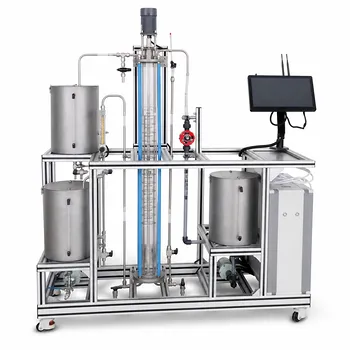
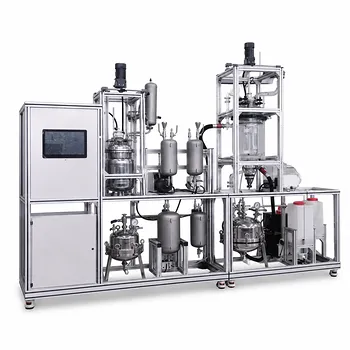
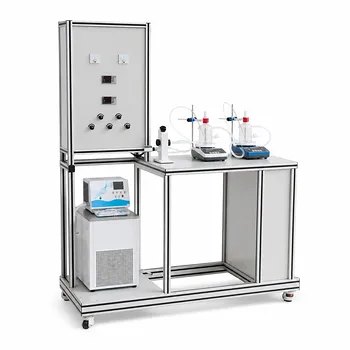
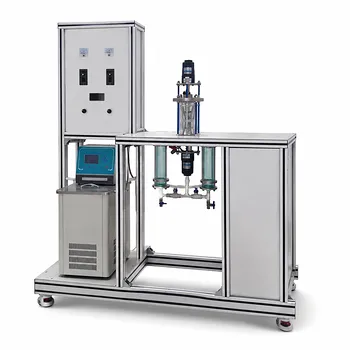
Liquid-liquid extraction is a deceptively simple process—two immiscible liquids are contacted, a solute transfers, and they separate. The surface-level challenge instructors face is demonstrating why that separation stage rarely works as cleanly in reality as it does in a textbook. Chemical engineering unit operation pilot plants provide the answer: they let students visually observe and quantitatively measure how density differences, viscosity, interfacial tension, axial mixing, and emulsification conspire to slow or destabilize phase separation, turning an abstract theory into a tangible engineering problem.
While textbooks often treat phase separation as instantaneous, the practical reality is that slow coalescence, uncontrolled backmixing, and stable emulsions frequently limit extraction efficiency. Pilot plants allow instructors to transform these abstract challenges into visible, measurable phenomena, teaching students to diagnose and solve real-world separation problems.
Visualizing the Physics of Phase Separation
The core of every liquid-liquid extraction is the settling of one liquid phase through another. In a transparent pilot-scale column or mixer-settler, students can watch this struggle unfold—seeing exactly why a simple density difference is not enough.
The Role of Density and Viscosity
The driving force for phase separation is the density difference between the extract and raffinate phases. In many industrial systems, this difference is surprisingly small. When students run pilot-scale extractions, they see for themselves that a small delta leads to a milky, slow-settling dispersion.
High liquid viscosity compounds the problem. A dense, viscous phase resists droplet movement. By switching between different test fluids (e.g., a high-viscosity oil vs. a low-viscosity solvent), students can measure settling rates and directly confirm that low viscosity is essential for rapid coalescence and high mass transfer rates.
Interfacial Tension: A Delicate Balance
Interfacial tension is the skin that holds a droplet together. Instructors can demonstrate that this tension must sit in a moderate sweet spot. If it is too high, liquids refuse to disperse; you get poor phase contact and minimal mass transfer. If it is too low, droplets shatter into a stable emulsion that will not settle.
Pilot plants equipped with variable-speed agitators let students manipulate droplet size distribution. They can observe how a tiny change in surfactant contamination (or solvent composition) suddenly lowers interfacial tension and creates a cloud of sub-micron droplets that simply won't coalesce—a common and costly industrial headache.
Confronting Non-Ideal Flow and Mixing
Beyond the droplet-scale physics, the fluid dynamics inside the extraction vessel itself create separation challenges that ideal stage models ignore.
The Impact of Axial Mixing (Backmixing)
In a continuous extraction column, forward-moving fluids inevitably drag some material backward. This axial mixing—or backmixing—destroys the countercurrent concentration gradient. Students can measure concentration profiles along the column height using sample ports and discover that the actual driving force for mass transfer is much smaller than the theoretical one.
By quantifying this, they learn a critical scale-up lesson: what behaved perfectly in a tiny lab funnel fails in a tall column because backmixing dilutes the extraction’s efficiency. The pilot plant makes this invisible destroyer of purity visible through hard data.
Emulsification: When Droplets Refuse to Coalesce
Perhaps the most dramatic demonstration is the formation of a stable emulsion—a ragged, persistent band of mixed phases that refuses to separate. This often occurs when agitation is too aggressive or when trace impurities stabilize the interface. Instructors can intentionally spike a feed with a small amount of a surface-active agent and let students witness how quickly the sharp phase boundary is replaced by a murky, unbreakable "rag layer."
This teaches a visceral lesson: separation is not just about thermodynamics; it is about defeating the kinetic barrier of coalescence.
Bridging to Industrial Reality: Stage Efficiency
The ultimate symptom of all these practical challenges is a decline in stage efficiency, a concept that pilot plants are uniquely suited to teach.
Measuring Actual vs. Theoretical Performance
An ideal theoretical stage achieves thermodynamic equilibrium. A real stage never does. Using a pilot-scale stage-wise extraction unit, students can sample both phases at each stage, measure actual solute concentrations, and calculate the Murphree efficiency. They will find it is often much lower than 100%, directly because of slow coalescence, axial mixing, and poor dispersion.
This single experiment bridges the gap between process simulation (where stages are often assumed ideal) and physical plant operation. It forces students to respect the role of equipment design and fluid properties in achieving a separation that looks perfect on a flowsheet.
Understanding the Trade-offs
Pilot plant instruction is most valuable when it exposes the inherent contradictions in process operation. Here, the trade-offs become immediately clear.
The Agitation Dilemma
To achieve good mass transfer, you need fine droplets and vigorous mixing. But that same mixing can generate emulsions that refuse to separate. In a pilot plant, students can increase impeller speed, watch the extraction rate initially improve, and then see the settling zone collapse into a stable dispersion. They learn that the optimal agitation speed is a compromise, not a maximum.
The Temperature-Viscosity Trade-off
Heating the system reduces viscosity and speeds up both mass transfer and coalescence—a tempting fix. Yet, raising the temperature can also reduce the density difference, soften interfacial tension into the emulsification danger zone, or even degrade heat-sensitive solutes. A pilot unit with jacketed vessels and temperature control allows students to map these competing effects and discover the true optimum, not just the intuitive one.
Making the Right Choice for Your Learning Objective
How an instructor leverages a pilot plant should align with the core lesson they want to instill. The same hardware can illuminate very different principles.
- If your primary focus is fundamental transport phenomena: Have students measure settling rates and droplet sizes while systematically varying density difference and viscosity. Let them validate Stokes' law extensions and see the limits of theory.
- If your primary focus is scale-up and equipment design: Focus on measuring concentration profiles to quantify axial mixing and calculate stage efficiency. This teaches them to distrust laboratory-ideal assumptions and to design for non-ideality.
- If your primary focus is process optimization and troubleshooting: Challenge students with a Quality by Design (QbD) exercise. Let them map the "failure envelope" by increasing agitation and contaminant levels until an emulsion forms, teaching them to identify control parameters that define a robust operating region.
When used deliberately, a liquid-liquid extraction pilot plant stops being a simple teaching aid. It becomes a truth-telling machine that forces students out of the textbook and into the fluid, messy reality of industrial separation.
Summary Table:
| LLE Challenge | Physical Mechanism | Pilot Plant Demonstration Method |
|---|---|---|
| Low Density Difference | Small driving force | Slow-settling, milky dispersion observation |
| High Viscosity | Droplet movement resistance | Measured reduction in settling rates |
| Low Interfacial Tension | Droplets shatter too easily | Stable emulsion / "rag layer" formation |
| Axial Mixing | Fluids dragged backward | Concentration profile measurements along column |
| Agitation Dilemma | Excessive shear vs. contact | Collapsed settling zone at high impeller speeds |
Bring Industrial Reality to Your Engineering Labs
Bridge the gap between textbook theory and practical process engineering. LABPARK provides state-of-the-art Educational and Vocational Unit Operations Pilot Plants in chemical engineering, bioprocess & biotech, and environmental & water treatment. Engineered specifically for universities, research institutes, and enterprises, our systems empower students and researchers to visualize and solve real-world challenges like phase separation, fluid dynamics, and mass transfer.
Ready to elevate your laboratory training and research? Contact us today to discuss your specific curriculum needs and discover how LABPARK can customize the perfect pilot plant for your institution.
Related Products
- Educational Rotary Disc Liquid-Liquid Extraction Pilot Plant
- Comprehensive Liquid-Liquid Extraction Pilot Plant for Engineering Education
- Gallium and Indium Selective Extraction Educational Pilot Plant
- Ternary Liquid-Liquid Equilibrium Educational Pilot Plant
- Liquid-Liquid Mass Transfer Coefficient Determination Educational Pilot Plant
People Also Ask
- How do density and IFT affect liquid-liquid extraction pilot plants? Optimize Column Performance
- In a liquid-liquid extraction pilot plant, how is a ternary-phase diagram utilized to determine solvent feed requirements?
- How are ternary phase diagrams and LLE data applied in extraction experiments? Optimize Pilot Plant Scale-up
- How Do Selectivity & Distribution Coefficients Influence LLE Pilot Plant Solvent Choice?
- How to Validate BIPs for LLE Pilot Plants? Steps to Align Simulations with Reality