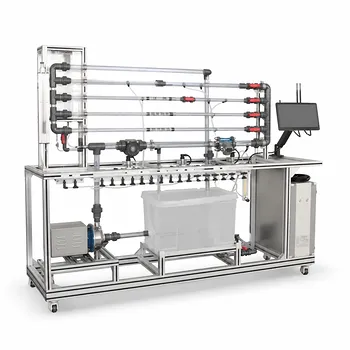
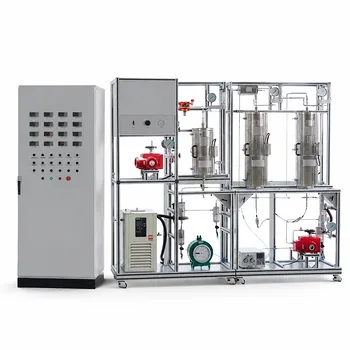
Inline spectrometers transform fluid blending pilot plants into living laboratories where real-time fuel quality control becomes a visible, interactive process. By equipping a pilot blending unit with an inline nuclear magnetic resonance (NMR) spectrometer, operators can monitor the aromatic proton signals in the flowing blend—a spectral fingerprint that correlates directly with Research Octane Number (RON). As students or engineers adjust flow rates of blend components like reformate, alkylate, or naphtha, the system instantly updates the estimated octane rating, benzene content, and total aromatics, demonstrating exactly how a blending recipe dictates the final fuel properties. This closed‑loop demonstration mirrors the industrial practice of blend property certification, where real‑time analytics guide recipe adjustments to meet product specifications with minimal giveaway.
The key insight is that by embedding a process analytical technology (PAT) sensor—such as an NMR spectrometer—directly into the pilot plant’s blending line, the unit becomes a transparent, responsive system. The chemical fingerprint of the fuel is converted into a real‑time quality indicator like RON, allowing observers to instantly witness cause‑and‑effect relationships between recipe changes and product quality. This bridges the gap between theoretical blending models and the practical, economically critical task of fuel certification.
The Instrumentation Behind Real‑Time Octane Monitoring
The core enabler is the integration of a spectrometer that operates directly in the process line, without sample extraction or manual lab analysis. This creates a continuous stream of compositional data that a chemometric model translates into fuel properties.
Inline NMR: Reading the Aromatic Fingerprint
Proton NMR spectroscopy excels at detecting aromatic hydrocarbons. The hydrogen atoms attached to aromatic rings produce signals in a distinct chemical shift region (roughly 6–9 ppm) that can be cleanly integrated. Because high‑octane blendstocks like reformate are rich in aromatics, the intensity of this aromatic proton signal carries a strong correlation with RON. The spectrometer continuously collects spectra of the moving blend, and the integrated aromatic signal becomes a real‑time proxy for the blend’s knock resistance.
From Spectrum to Octane Number: Chemometric Models
A raw NMR spectrum is not a RON value—it must be transformed through a multivariate calibration model. Before the pilot plant is used for teaching or research, a set of blends with known RON (measured by the ASTM D2699 laboratory engine method) is analyzed by the inline spectrometer. Statistical techniques like partial least squares (PLS) regression build a model that predicts RON from the spectral profile. Once deployed, the model outputs an estimated RON every few seconds, turning a complex spectrum into a single, actionable quality metric.
Dynamic Flow Control Closes the Loop
The pilot plant’s flow controllers regulate the ratios of individual feedstocks. When an operator changes a setpoint—say, increasing the reformate fraction from 20% to 30%—the blend composition shifts almost immediately. The inline spectrometer detects the rise in aromatic protons, the chemometric model updates the predicted RON, and the display reveals the effect within the residence time of the system. This closed‑loop demonstration shows how automated quality control systems in refineries continuously optimize blend recipes.
Demonstrating How Blend Recipes Influence Fuel Quality
With the instrumentation in place, the pilot plant becomes an educational tool that makes blending theory tangible. The real‑time feedback turns abstract equations into intuitive observations.
Observing the Immediate Impact on RON
Students can deliberately manipulate the recipe and watch the RON trend line. Adding more reformate (aromatic‑rich) causes the octane estimate to climb; adding more light straight‑run naphtha (mostly paraffinic, low octane) pulls it down. They see that the relationship is not always linear—blending octane numbers can exhibit non‑ideal behavior due to synergistic or antagonistic interactions between components. The spectrometer captures these effects without waiting for a lab test, compressing a lesson in refinery economics into minutes.
Multivariate Quality: Benzene and Aromatics
Octane is only one property. The same NMR spectrum can simultaneously predict benzene concentration and total aromatic content. These are critical because environmental regulations cap benzene at 1% or lower and limit total aromatics. The pilot plant thus shows that a single real‑time analyzer can track multiple quality specifications at once. When a recipe change boosts RON but pushes benzene above the allowed limit, the conflict becomes visible immediately—a powerful lesson in blend constraint management.
Teaching Product Specification Certification
A classic industrial exercise is to blend to a target RON specification (say, 95 RON) while minimizing “giveaway” (exceeding spec). In the pilot plant, operators can adjust flows until the predicted RON stabilizes just above the target, then view the real‑time trend to see if the blend remains on‑spec over time. This mirrors how refineries certify gasoline batches before they leave the tank farm, connecting pilot‑scale operations directly to commercial quality assurance.
Understanding the Trade‑offs and Limitations
While the demonstration is powerful, it relies on assumptions and technologies that come with inherent limitations. Acknowledge these trade‑offs to maintain trust and realism.
Model Robustness and Calibration Boundaries
The chemometric model is an interpolation tool. It works well within the range of blend compositions used during calibration, but predictions become unreliable if a student adds an unusual component that was not in the calibration set—for example, a high‑olefin stream from a different process. Users must understand that the predicted RON is an estimate, not a primary measurement, and that periodic offline ASTM D2699 verification is required to keep the model trustworthy.
Spectrometer Maintenance and Drift
Inline NMR magnets need temperature stabilization and periodic “shimming” to maintain spectral resolution. Electronic drift or sample temperature changes can cause gradual prediction errors. In a teaching pilot plant, this means the system must be re‑validated at regular intervals, teaching students that real‑time sensors are not “set and forget”—they demand ongoing quality assurance just like the product they measure.
Cost and Complexity vs. Simplicity
An NMR‑equipped pilot blending unit is a sophisticated investment, both in capital and in user training. For programs focused only on basic mass‑balance blending without quality feedback, a simpler setup with manual sampling and laboratory octane testing may suffice. However, the educational return on investment is high for those who need to demonstrate closed‑loop quality control, data‑driven decision‑making, and modern refinery automation—competencies that are increasingly expected of process engineers.
Making the Right Choice for Your Educational or R&D Goal
How you configure and operate the pilot plant depends on what you want to teach or achieve. The real‑time quality‑control capability is a flexible platform.
- If your primary focus is teaching fundamental blending dynamics: Use the inline spectrometer as a black‑box RON display, and let students explore recipe changes to build intuition about component interactions and non‑linear blending behavior.
- If your primary focus is developing transferable skills for industry: Incorporate a chemometrics module where students collect spectra, build their own PLS calibration models, and learn the discipline of model validation—bridging hands‑on plant operation with data science.
- If your primary focus is optimizing blend economics: Program the system to run a simple closed‑loop controller that automatically adjusts flow rates to meet a RON target while minimizing high‑cost components, demonstrating the principles of blend property optimization and specification giveaway.
- If your primary focus is multi‑property quality control: Expand the model to predict benzene, aromatics, and RVP (vapor pressure) simultaneously, then challenge users to find blend recipes that satisfy all constraints at once—a realistic test of refinery blending strategy.
By turning a fluid blending pilot plant into a real‑time quality monitor, you give learners and researchers a direct line of sight into the chemistry, economics, and control philosophy that govern every gallon of gasoline produced. That clarity is the difference between merely memorizing blending rules and truly understanding how to certify fuel quality in a dynamic, automated world.
Summary Table:
| Component | Role in Real-Time QC | Key Benefit |
|---|---|---|
| Inline NMR Spectrometer | Detects aromatic proton signals continuously | Eliminates manual sampling & lab delays |
| Chemometric Models (PLS) | Translates spectral data into estimated RON | Provides instant, actionable quality metrics |
| Dynamic Flow Control | Adjusts blend component ratios in real time | Demonstrates closed-loop recipe optimization |
Elevate Your Practical Training with LABPARK
Bring industrial-grade process automation and real-time quality control directly into your curriculum. LABPARK provides state-of-the-art Educational and Vocational Unit Operations Pilot Plants in chemical engineering, bioprocess & biotech, and environmental & water treatment for universities, research institutes, and enterprises.
Help your students, researchers, and engineers bridge the gap between theoretical chemistry and real-world industrial optimization.
👉 Contact LABPARK today to discuss your laboratory's training needs!
Related Products
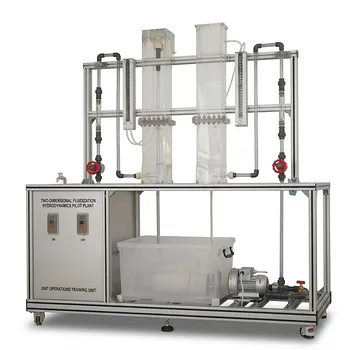
- Two-Dimensional Fluidization Hydrodynamics Educational Pilot Plant for Unit Operations Training
- Multi-Reactor Educational Pilot Plant for Reaction Engineering Unit Operations
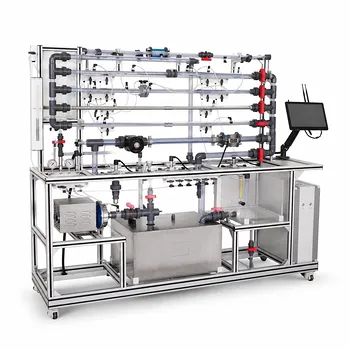
- Multi Pump Fluid Transport Process Piping Unit Operations Training Pilot Plant
- Comprehensive Fluid Mechanics Educational Unit Operations Pilot Plant
- Quantitative Dosing and Liquid Flow Control Educational Unit Operations Pilot Plant
People Also Ask
- What pressure drop characteristics should students & researchers monitor in a fluidization pilot plant?
- How does active time pulsing mixing enhance fluid homogenization? Configuration Guide for Educational Pilot Plants
- How can acoustic chemometrics prevent reactor clogging in educational fluidized bed pilot plants?
- What is the operational significance of solids feed rate on emulsion phase dynamics in fluidized bed pilot plants?
- How can inline NIR & microwave sensors study fluidized bed drying dynamics? A Real-Time Guide