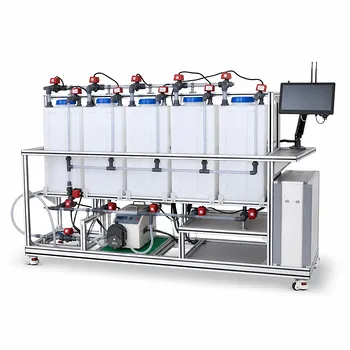
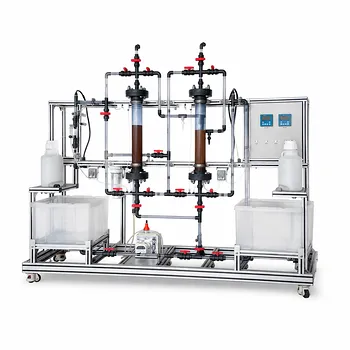
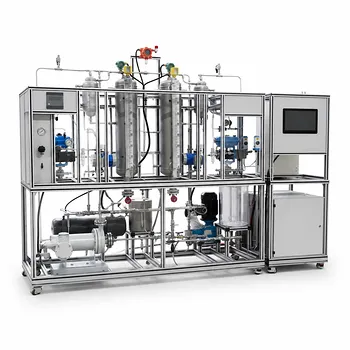
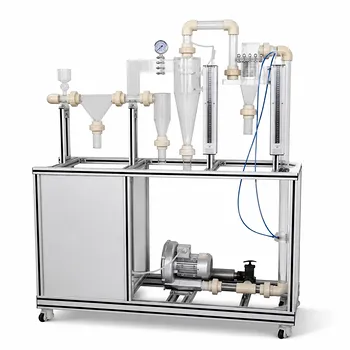
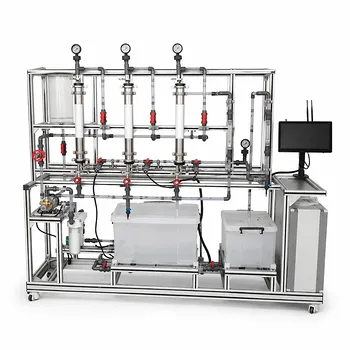
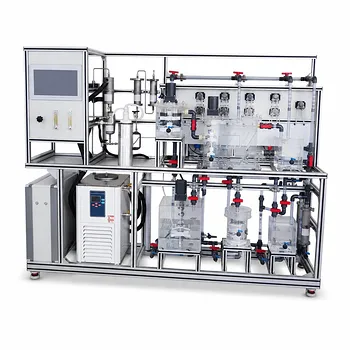
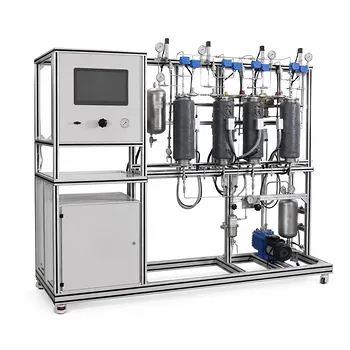
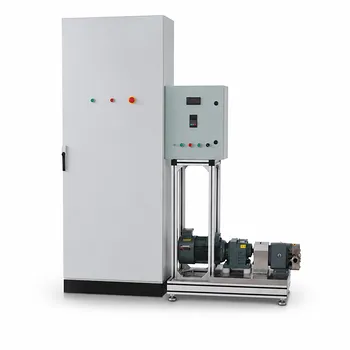
The most powerful way to train sustainability-minded engineers is to put them in front of a working water treatment pilot plant.
Environmental and water treatment unit operations pilot plants address the educational need for sustainable resource recovery and wastewater management by allowing students to simulate real purification, separation, and conversion processes at a tangible scale. They enable hands‑on evaluation of pollutant removal efficiency, mass transfer dynamics, and energy consumption, directly bridging the gap between textbook theory and the practical design of resource‑efficient treatment trains. In doing so, they build the vocational and engineering skills necessary to operate, troubleshoot, and scale green technologies for a circular water economy.
Pilot plants turn abstract sustainability goals into actionable competence by replicating the physical, chemical, and biological processes found in full‑scale water and resource recovery facilities—giving learners an irreplaceable sandbox to test ideas, measure performance, and internalize the real‑world constraints of cost, energy, and materials.
Why Pilot Plants Are the Educational Backbone of Sustainable Water Management
Building Operational Muscle Memory for Unit Operations
Environmental protection demands proficiency in sedimentation, filtration, adsorption, ion exchange, membrane separation, and advanced oxidation.
A pilot plant condenses these unit operations into a single interactive learning station.
Students physically adjust flow rates, backwash filters, regenerate ion‑exchange resins, and switch between treatment modes, transforming abstract concepts into tactile engineering judgement.
This repetition builds the kind of muscle memory that lecture slides cannot replicate—essential when graduates move into municipal plants or industrial compliance roles.
Visualizing Mass Transfer and Reaction Engineering in Real Time
Textbook discussions of breakthrough curves, mass transfer zones, and chemical kinetics often feel disconnected from practice.
In a pilot plant, learners deliberately run an adsorption column until breakthrough, sample effluent concentrations over time, and directly correlate feed characteristics with bed performance.
They observe how ion exchange resins become exhausted, how catalyst beds in a hydrofining unit convert sulfur to hydrogen sulfide, and how multiphase gas‑liquid‑solid reactors behave under high pressure.
This direct visualization cements an intuitive understanding of the dynamic, rate‑governed nature of sustainable treatment—knowledge that is critical for optimizing resource consumption and waste generation.
Embedding Circular Economy Principles from Day One
Sustainable resource recovery is not an add‑on; it is the system design.
Modern educational pilot plants integrate closed‑loop water and solvent recycling, heat recovery heat exchangers, and real‑time monitoring of energy, carbon, and material flows.
Students see how condensing, stripping, and re‑using streams turns a linear “treat‑and‑discharge” mindset into a circular resource management strategy.
For example, a pilot that recycles process water while recovering coagulants teaches that waste is a design flaw, not a disposal problem—embedding green chemistry and industrial symbiosis directly into the training experience.
How Pilot Plants Serve Different Educational Needs
Municipal and Drinking Water Reclamation
To address global water scarcity, training must cover the entire purification chain.
A pilot plant configured with sedimentation basins, membrane filtration units, and chemical oxidation reactors lets students test removal of microscopic pathogens, trace organics, and emerging contaminants.
By analyzing parameters like turbidity, TOC, and disinfection by‑product formation, they learn to design multi‑barrier treatment sequences that turn non‑fresh water sources into safe, reusable resources—preparing them for roles in advanced wastewater reuse and direct potable reuse projects.
Industrial Wastewater from Fine Chemicals and Petroleum
Complex industrial effluents contain heavy metals, phenols, oils, and sulfur‑nitrogen compounds that demand integrated solutions.
A pilot plant equipped with ion exchange columns, adsorption beds, and gas stripping units mimics the treatment of gas liquor (ammonia, hydrogen sulfide, tarry organics) or the spent streams from fine chemical synthesis.
Students experimentally map breakthrough and regeneration cycles, quantify resin capacity, and witness how interfacial tension governs gravity separation of light and heavy organics.
In a hydrofining pilot, they also learn high‑pressure hydrogen handling and the catalytic removal of sulfur and nitrogen to minimize downstream SO₂ and NOₓ emissions—critical for environmental compliance in the fuels industry.
Resource Recovery and Energy Efficiency
Sustainable engineering education must teach that treatment is also manufacturing.
Pilot plants that recirculate steam condensate, recover heat via exchangers, and recover solvents through distillation or pervaporation demonstrate energy integration and resource valorization.
Students track key performance indicators ( kWh/m³, kg‑CO₂/m³) under different operating regimes, gaining the ability to propose retrofit projects and carbon‑reduction strategies—a skill set central to the modern environmental engineer’s role in decarbonizing industrial processes.
Recognizing the Limitations and Trade‑offs
The Scaling Gap: Pilot vs. Full‑Scale Reality
A pilot plant is not a miniature version of reality—it deliberately operates at a scale where wall effects, faster mixing times, and simplified hydrodynamics can alter performance.
Students who only train on pilots may overestimate removal efficiencies or underestimate fouling rates when facing a municipal‑scale membrane array.
For this reason, pilot training must always be paired with scale‑up theory, dimensional analysis, and computational modeling to prevent overconfidence.
Cost, Complexity, and Safety Demands
Despite their educational power, pilot plants are resource‑intensive.
They require capital investment, skilled maintenance, and consumables (catalysts, resins, chemicals).
High‑pressure hydrogen units like hydrofining pilots demand rigorous safety protocols, gas detection systems, and trained supervision.
If budget or expertise is lacking, a poorly maintained pilot can become a source of hazardous distraction rather than a learning tool.
Avoiding the “Black Box” Mindset
Sophisticated, pre‑assembled pilot skids can be so automated that students merely press “start” and watch a screen.
To truly build engineering understanding, units must be partially transparent—exposing valves, sensors, and piping—and accompanied by manual sampling and open‑ended troubleshooting assignments.
The goal is to learn why a pressure drop across a filter matters, not simply to produce treated water.
Tailoring Your Pilot Plant Investment to Educational Outcomes
The right pilot‑plant configuration depends entirely on the specific competencies you need to build. Use these goal‑driven guidelines to choose your focal points.
- If your primary focus is fundamental mass transfer and reaction engineering: Select a system centred on adsorption and ion exchange columns with integrated data logging, and run breakthrough and regeneration experiments to solidify kinetics and equilibrium concepts.
- If your primary focus is preparing students for municipal water reclamation: Prioritize a train with sedimentation, multimedia filtration, and membrane (UF/RO) units, complemented by disinfection steps, so learners practice the multi‑barrier logic of direct reuse.
- If your primary focus is industrial wastewater and environmental compliance: Include advanced oxidation reactors, chemical precipitation, and gas stripping/stripping columns to simulate the complex, high‑strength streams found in fine chemicals and petroleum processing.
- If your primary focus is embedding circular economy and energy efficiency: Insist on closed‑loop water/solvent circuits, heat recovery heat exchangers, and online energy meters, making resource conservation not an afterthought but the primary measurable outcome.
- If your primary focus is high‑pressure safety and emission control: Deploy a hydrofining pilot plant that teaches gas‑liquid‑solid multiphase reactor operation, hydrogen management, and catalytic removal of sulfur/nitrogen to reduce downstream air pollutants.
When the equipment aligns with the learning objective, the pilot plant stops being a costly demonstration and transforms into the most honest teacher a future sustainability engineer will ever have.
Summary Table:
| Focus Area | Key Unit Operations | Educational & Training Value |
|---|---|---|
| Municipal Reclamation | Sedimentation, membranes (UF/RO), oxidation | Design multi-barrier sequences for safe reuse |
| Industrial Wastewater | Ion exchange, adsorption, gas stripping, hydrofining | Process complex toxic streams & manage high-pressure safety |
| Resource Recovery | Closed-loop circuits, heat recovery exchangers | Master circular economy principles & track energy metrics |
Bring Industry-Scale Learning to Your Institution with LABPARK
Empower your students and researchers to master sustainable engineering. LABPARK provides high-quality Educational and Vocational Unit Operations Pilot Plants specializing in:
- Chemical Engineering
- Bioprocess & Biotech
- Environmental & Water Treatment
Tailored for universities, research institutes, and enterprises, our systems bridge the gap between textbook theory and industrial practice. Contact us today to configure your custom pilot plant solution.
Related Products
- Electrochemical Water Treatment Educational Unit Operations Pilot Plant
- Dual-Mode Rectification Pilot Plant for Practical Training Unit Operations
- Ion Exchange Water Purification Educational Pilot Plant for Engineering Unit Operations
- Multi-Functional Membrane Separation Educational Pilot Plant for Unit Operations Lab
- Solid Waste Pyrolysis and Refining Educational Pilot Plant for Unit Operations
People Also Ask
- What design features do educational electrochemical pilot plants utilize to manage gas liberation and water loss?
- How can unit operations pilot plants show lead-acid concentration vs state of charge? Real-time monitoring guide.
- How do educational electrochemical pilot plants scale up electrolysis? Master industrial engineering.
- How to Estimate Sulfate in Water Treatment Pilot Plant Deposits: Gravimetric Guide
- How can foaming be managed during steam generation experiments in water treatment unit operations pilot plants? Tips