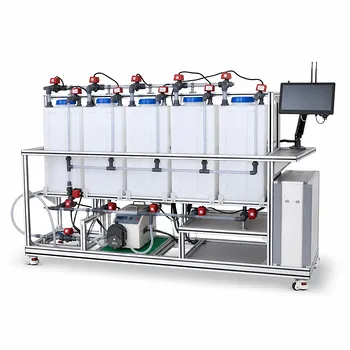
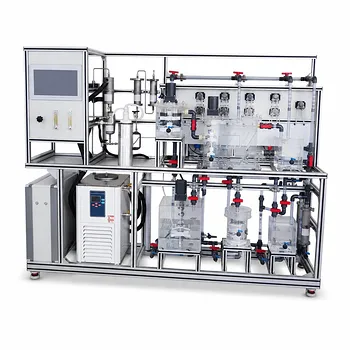
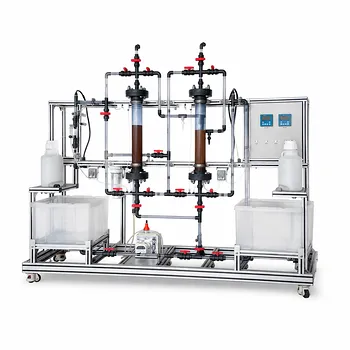
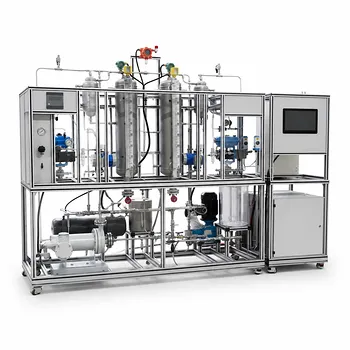
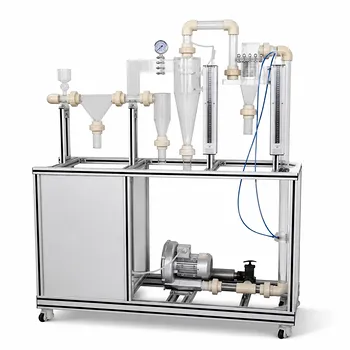
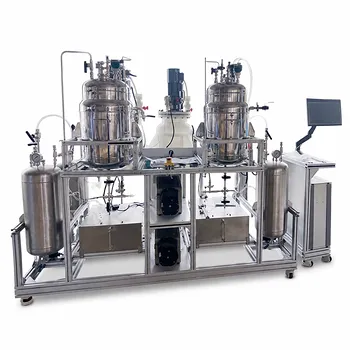
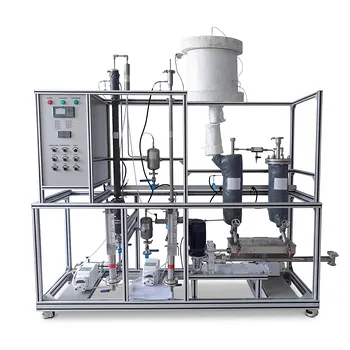
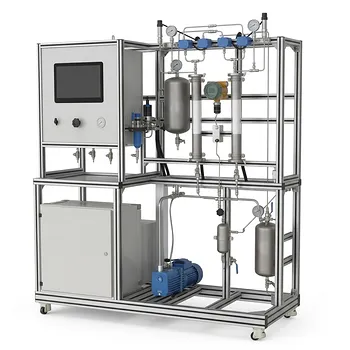
The key is closing the gap between theoretical chemistry and the balance sheet. Environmental pilot plants are not just about bringing pH to 7; they are dynamic simulators that teach the economic drivers of neutralization by forcing students to manage chemical procurement, sludge disposal, and real-time process control simultaneously. By shifting from a beaker to a pilot-scale continuous reactor, the lesson transforms from a simple acid-base reaction into a comprehensive course on operational viability.
While classic thermodynamics dictates the reaction, industrial reality dictates the chemistry. The core lesson of a pilot plant is that the optimal neutralizing agent—such as lime versus caustic soda—is chosen not just for its reactivity, but for the cost of the raw material minus the potential resale value of the resulting byproduct (like gypsum). The pilot plant turns neutralization into a profitability calculation rather than a textbook exercise.
Simulating the Mechanics of Continuous Neutralization
Industrial wastewater isn't treated in batches of beakers; it flows continuously with fluctuating loads. A pilot plant allows students to wrestle with the mechanical realities of maintaining stability in a dynamic system.
Mastering Feedback Control Loops
In a beaker, you manually add a few drops of base. In a plant, this is a high-stakes game of automated response. Pilot plants are equipped with real-time pH probes and dosing pumps.
Students learn that without proper loop tuning, a system can oscillate wildly—wasting chemicals by overshooting the target pH or risking permit violations. By adjusting Proportional-Integral (PI) control parameters, they physically witness the "lag time" between chemical injection and sensor detection, bridging the gap between abstract control theory and practical instrumentation.
Visualizing Precipitation Kinetics
Neutralization is rarely just a liquid reaction; it’s often about managing solids. When students neutralize sulfuric acid with lime, they don't just see a color change—they see the immediate formation of calcium sulfate (gypsum) . The pilot plant makes the concept of precipitation kinetics tangible.
Users must adjust residence time in the reactor to ensure crystal formation is complete. Too short a time, and post-precipitation fouls downstream pipes. This teaches a critical mechanical lesson: reaction stoichiometry is instantaneous, but solid-liquid separation requires sufficient hydraulic retention time.
Unlocking the Economics of Chemical Selection
The deep need in industrial wastewater treatment is cost optimization. A pilot plant provides the data to make an economic model real.
Calculating the True Cost of Raw Materials
Textbooks list standard heats of neutralization, but they don't mention current bulk pricing. In a pilot run, students calculate the cost per gallon of treated effluent using lime (CaO) versus 50% sodium hydroxide (NaOH) . They quickly realize that while NaOH is mechanically simpler to pump, lime is often orders of magnitude cheaper per mole of hydroxide.
The pilot plant generates real-time consumption data. Students measure the total mass of neutralizing agent consumed to treat a specific volume of variable-strength waste, moving from a theoretical $/mol calculation to a concrete operating expense (OPEX) forecast.
From Waste Sludge to Revenue Stream
The most profound economic lesson comes from the solids. When a pilot plant neutralizes sulfuric acid with ammonia, it produces ammonium sulfate, a fertilizer component. With a lime process, it creates gypsum for wallboard.
Students can perform a mass balance to determine the sludge volume. If the sludge is a hazardous liability, they calculate dewatering and landfill costs. If it's pure enough to sell (like commercial-grade gypsum), they project a revenue stream that offsets the chemical cost. This turns the environmental unit from a cost center into a potential profit center.
Understanding the Trade-offs
Blindly pursuing the cheapest base often causes catastrophic maintenance failures. The pilot plant serves as a safe environment to encounter these trade-offs.
The Hidden Cost of Lime Handling
While lime is cheap, pilot-scale handling teaches a painful reality of lime silo maintenance. Students often struggle with clogged screw feeders and the "mud" that forms in pipes due to calcium carbonate scaling. The pilot plant reveals that the mechanical complexity and labor required to keep a lime slurry system running can negate the savings from the chemical itself.
Total Dissolved Solids (TDS) Limits
A purely soluble reaction, like using HCl and NaOH, produces saltwater (NaCl) that passes straight through the plant. Students evaluating discharge permits learn that increasing Total Dissolved Solids might violate the plant’s water quality limits. The pilot plant teaches that lime's advantage is not just cost, but that it precipitates sulfate out of solution, lowering the TDS load on the receiving water. This introduces the economic concept of "saving" downstream reverse osmosis membranes from fouling.
The E-Factor Efficiency
When simulating tertiary treatment of fine chemical effluents, pilot plants allow for E-factor analysis (kg waste/kg product). By running a neutralization/precipitation sequence with inorganic catalysts versus a membrane separation or zeolite process, students can measure the volume of toxic sludge generated. The lesson is clear: green chemistry reduces waste at the source, and the true cost of neutralization includes the long-term liability of landfilling that sludge.
Making the Right Choice for Your Goal
The design of a neutralization curriculum should be tailored to the specific skill gap being addressed. Use the pilot plant to test scenarios based on business objectives.
- If your primary focus is Operator Training: Focus on the mechanical reality. Invert the plot on the pH controller and watch the system crash. These hard lessons in troubleshooting control loops and unclogging lime slurry valves are invaluable.
- If your primary focus is Engineering Economics: Task students with sourcing real bulk pricing for three neutralizers (NaOH, Lime, Mg(OH)2) and run identical waste streams. The resulting cost/volume analysis, combined with the generated sludge weight, will redefine their understanding of "cheap."
- If your primary focus is Sustainability and Green Chemistry: Run a side-by-side comparison of a traditional neutralization-precipitation process against an ion-exchange recovery system to demonstrate the E-factor. Show that the most economical neutralization is the one you don't have to perform.
The pilot plant ultimately teaches that a neutralization curve is an economic decision. By letting students make buying mistakes and suffer mechanical failures on a small scale, you equip them to design processes on an industrial scale where the byproduct isn't just salt or sludge, but profit.
Summary Table:
| Parameter | Lime (CaO) | Caustic Soda (NaOH) |
|---|---|---|
| Raw Material Cost | Low | High |
| Mechanical Complexity | High (scaling & clogging risk) | Low (easy to pump) |
| Byproduct / Sludge | High (gypsum - potential revenue/waste) | Minimal (soluble salts) |
| TDS Impact | Low (precipitates out) | High (increases TDS) |
Take Your Wastewater & Process Engineering Curriculum to the Next Level
Bridge the gap between textbook chemistry and industrial reality. LABPARK provides advanced Educational and Vocational Unit Operations Pilot Plants in chemical engineering, bioprocess & biotech, and environmental & water treatment.
Designed specifically for universities, research institutes, and enterprises, our pilot plants empower students and researchers to master real-world process control, chemical economics, and system maintenance.
Ready to elevate your training facilities? Contact LABPARK today to discuss your laboratory requirements!
Related Products
- Solid Waste Pyrolysis and Refining Educational Pilot Plant for Unit Operations
- Multi-Functional Special Distillation Educational Pilot Plant
- Fixed-Bed Chemical Reaction and Gas Dust Tar Removal Unit Operations Pilot Plant
- Multifunctional Membrane Separation Educational Pilot Plant with Ultrafiltration, Nanofiltration, Reverse Osmosis
- Natural Product Extraction Unit Operations Training Pilot Plant
People Also Ask
- How do educational unit operations pilot plants bridge theory and design? Bridge the Engineering Gap
- How do educational unit operations pilot plants address safety and waste management when scaling up?
- When to transition from PID to adaptive control in pilot plants? Key process indicators.
- Why is the chemical plant startup schedule crucial? De-risk scale-up with pilot plants.
- Why Use PTFE & Hastelloy in Chemical Pilot Plants? Prevent Corrosion & Ensure Safety