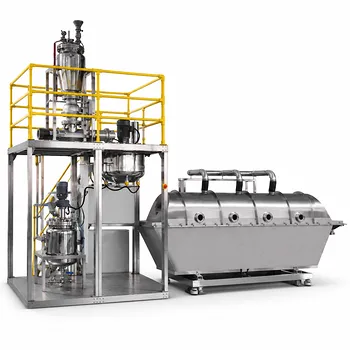
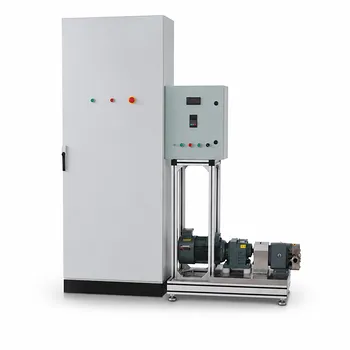
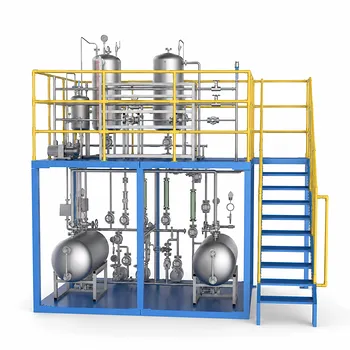
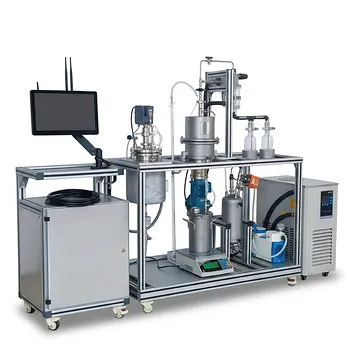
Pilot plants don’t just explain the difference between batch and continuous processing—they let you feel it.
By operating a batch reactor, students manually charge ingredients, manage heating/cooling ramps, and drain the vessel after a cycle; in a continuous system, they maintain steady feed rates, monitor real-time temperatures along a tube, and watch product emerge nonstop. This tactile, side-by-side experience cements the core distinction: batch processing is event-driven and recipe-based, while continuous processing is flow-driven and equilibrium-based. Educational unit operations pilot plants provide the safe, controlled environment to run both, turning abstract textbook concepts into visceral, memorable learning.
The central insight: Physically switching between batch and continuous modes in a pilot plant gives students a direct, intuitive grasp of the operational, control, and economic trade-offs that define each approach. It transforms theoretical definitions into practiced judgment—the kind of knowing that can’t come from a lecture alone.
Building Intuition Through Hands-on Operation
The Core Sensory Divide: Event-Driven vs. Flow-Driven
In a batch pilot plant, every step is a deliberate event. Students add reagents, set jacket temperatures, and wait for a reaction to complete. The process has a clear start and end, and the product is discharged as a whole. In contrast, a continuous pilot plant runs as an unbroken stream. Students adjust pump speeds to control residence time, observe steady-state temperature profiles, and collect product continuously. This fundamental difference in rhythm and control logic becomes instantly apparent when they stand at the equipment.
A student who has only read about “steady state” will truly understand it after watching a continuous distillation column stabilize—the temperature at each tray staying constant, the top and bottom compositions holding steady. That moment is the bridge between theory and reality.
Tangible Consequences of Process Choice
Running a batch filtration setup—like a plate and frame press—forces students to account for total cycle time. They measure not just the filtration itself ($\theta$), but also the auxiliary steps: washing ($\theta_w$), cake discharge, and reassembly ($\theta_d$). Only then does the hourly productivity equation ($Q = 3600V/T$) make sense. When they then switch to a continuous rotary drum vacuum filter and adjust drum speed ($n$) and submergence ($\psi$), they directly see the trade-off: higher speed boosts $Q$ but yields thinner, harder-to-discharge cakes. The equations leap off the page.
Teaching the Two Operational Philosophies
Mastering the Batch Mindset: Flexibility, Scheduling, and Cleanability
Batch pilot plants are the ideal training ground for multipurpose plant thinking. Because the same vessel can run completely different recipes consecutively, students learn the discipline of cleaning validation, batch records, and recipe management. They experience the idle times between batches and can map out a Gantt chart by physically tracking when each unit is occupied. This reveals the bottleneck—the piece of equipment with the least idle time that limits overall throughput. Adding a second reactor or an extra filter in the pilot plant immediately shows how cycle times shrink, a lesson in debottlenecking that sticks far better than any simulation.
Mastering the Continuous Mindset: Steady State, Control Loops, and 24/7 Operation
A continuous pilot plant trains a different muscle: the ability to think in terms of residence time distribution and process control. Students learn to tune a PID loop to maintain a constant level in a reboiler or a fixed temperature in a tubular reactor. They see that a disturbance upstream propagates smoothly through the train, unlike the contained deviation in a batch. The concept of work-in-process inventory becomes physical—material is always inside the system, not sitting in a drum. This hands-on exposure is invaluable for preparing operators for the realities of a high-utilization, continuous manufacturing line where the plant runs 90–95% of the time.
Visualizing Mass Transfer and Reaction Dynamics
The Power of a Reconfigurable Distillation Column
One of the most powerful teaching moments comes from a single column designed with flexible piping and multiple feeding points. In continuous rectification, students pump the raw feed to a middle tray, creating a rectifying section above and a stripping section below. The composition profile is fixed. Then, by closing the feed pump and charging the reboiler, the same column becomes a batch rectification system with only a rectifying section—and the pot composition changes continuously over time. Seeing the temperature profile evolve dynamically in batch versus holding static in continuous makes the theory of distillation unforgettable.
Reaction Kinetics and Mixing Intensity
For fast, exothermic reactions, the difference appears instantly. In a batch vessel, a poorly controlled addition can cause a temperature spike. In a continuous tubular reactor with an in-line static mixer, the same chemistry can be tamed. Students can inject a tracer to measure residence time distribution in each system, quantifying how much closer a plug-flow reactor gets to ideal behavior. This direct, physical comparison is what turns “mixing intensity” from jargon into a design variable they can feel and optimize.
Understanding the Trade-offs
When Batch Wins the Day
Batch systems excel where flexibility and containment are paramount. They handle high-value, low-volume products like pharmaceutical intermediates or specialty polymers. Because the vessel can be thoroughly cleaned and sterilized between campaigns, cross-contamination risks are manageable. For a teaching lab, a batch reactor can run a dozen different experiments in a semester, giving students broad exposure at a lower initial capital cost.
When Continuous Takes the Lead
Continuous units demonstrate the relentless logic of economy. They shrink equipment footprint, minimize intermediates inventory, and cut operating costs once steady state is reached. For high-volume commodity chemicals, the efficiency gains are undeniable. In training, continuous equipment lets students work with real-time analytics and automated control strategies that are the backbone of modern Industry 4.0 plants.
The Hidden Lesson: Neither Is Perfect
A batch pilot plant teaches patience—the idle time between batches, the cleaning downtime, the scaling challenges from kettle to production. A continuous pilot plant reveals vulnerability to feed disturbances and the difficulty of startup and shutdown. When students map the total cycle time of a batch filter or struggle to keep a continuous crystallizer from fouling, they learn the practical constraints that no idealized model can convey. That struggle is the point.
Making the Right Choice for Your Educational Goal
Pilot plant selection should align with the core competencies you want to build. Some programs need deep batch specialization; others need a fluid transition between worlds.
- If your primary focus is vocational training for fine chemicals or bioprocessing: Prioritize a multipurpose batch system with reactors, Nutsche filters, and batch distillation columns. Students will master recipe handling, cleaning protocols, and batch-to-batch quality control.
- If your primary focus is bulk chemical or continuous API manufacturing: Invest in a continuous flow line—tubular reactors, continuous distillation, and rotary vacuum filters—to teach steady-state operation, PID tuning, and residence time analysis.
- If you aim to produce the most adaptable chemical operators: Choose a hybrid pilot plant that pairs batch reactors with continuous downstream units (like a continuous distillation column fed from a batch reboiler). This juxtaposition builds the deepest operational intuition, allowing trainees to physically switch between modes and directly compare their behavior.
A unit operations pilot plant is more than a teaching tool; it is a time compressor. It allows a student to live through the distinct, challenging, and rewarding mindsets of batch and continuous processing in a single lab session, building the hard-won intuition that a career in chemical manufacturing demands.
Summary Table:
| Feature | Batch Pilot Plants | Continuous Pilot Plants |
|---|---|---|
| Operation Rhythm | Event-driven & recipe-based | Flow-driven & steady-state |
| Key Learning Focus | Cycle time, scheduling, cleaning | PID tuning, residence time distribution |
| Best Suited For | High-value, low-volume products | High-volume commodity chemicals |
Empower Your Trainees with Hands-on Engineering
Bring chemical engineering concepts to life. LABPARK provides state-of-the-art Educational and Vocational Unit Operations Pilot Plants in chemical engineering, bioprocess & biotech, and environmental & water treatment. Designed specifically for universities, research institutes, and enterprises, our equipment bridges the gap between theory and real-world operation.
Ready to upgrade your lab? Contact LABPARK today to discuss your custom training solutions!
Related Products
- Continuous Sieve-Plate Distillation Pilot Plant for Unit Operations Laboratory Education
- Carbon Dioxide Hydrogen Methanol Synthesis Educational Unit Operations Pilot Plant
- Polymerization Granulation and Pellet Processing Educational Unit Operations Pilot Plant
- Multi-Functional Special Distillation Educational Pilot Plant
- Continuous Batch Extractive Distillation Educational Pilot Plant
People Also Ask
- Why is vacuum operation capability an essential feature for a distillation unit operations pilot plant? Unlock Efficiency
- What are the primary reflux ratio control strategies? Master Distillation Unit Operations
- How to select the right activity coefficient model (Wilson, NRTL, UNIQUAC) for distillation pilot plants?
- How does catalyst water concentration affect distillation pilot plant design? Key separation train choices.
- How can real-time carbon number prediction improve distillation pilot plants? Optimize control.