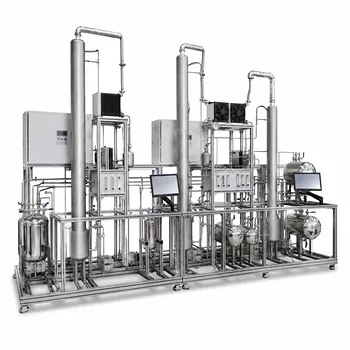
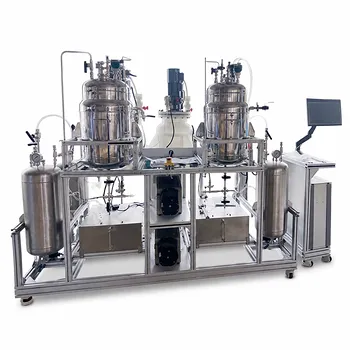
Modular reconfiguration is the key. A single educational unit operations pilot plant can be physically re‑plumbed to operate first as a conventional, energy‑intensive distillation sequence—such as an entrainer‑based azeotropic distillation with a separate solvent‑recovery column—and then as an energy‑saving alternative, like a heat‑pump‑assisted column or a dividing‑wall column. This hands‑on reconfiguration allows students to measure and compare temperature profiles, reflux ratios, utility consumption, and product purity for both modes, transforming abstract energy‑saving concepts into tangible experimental evidence.
The central insight is that a well‑designed modular distillation pilot plant acts as a configurable platform. By changing feed points, coupling columns, and engaging heat‑pump loops or dividing‑wall inserts, students directly observe how process intensification slashes energy usage—without losing sight of the fundamental MESH (Material, Equilibrium, Summation, Heat) principles they learn in the classroom.
Building the Comparative Platform: Modular Column Design
The heart of any comparative distillation study is a pilot plant that can be physically rearranged. Conventional and energy‑saving configurations must be demonstrable in the same session, on the same hardware.
Adjustable Feed Points and Reflux Control
Start with a column that offers multiple feed nozzles at different heights and a precision reflux‑splitter. By altering the feed stage and the reflux‑to‑distillate ratio, students can emulate everything from a simple binary separation to a complex multi‑product sidestream setup.
Flexible infrastructure is what makes direct comparison possible. The same column that runs a conventional sequence—relying on high reflux and external heating—can later be reconfigured with an intermediate heat pump to show that lowering the reflux requirement directly cuts energy demand.
Introducing Entrainers for Azeotropic Systems
For conventional azeotropic distillation, the pilot plant must integrate an entrainer feed and a second column (or a side‑draw decanter) to recover the entrainer. This setup lets students physically observe the liquid‑liquid phase split that occurs when the azeotrope is broken.
The entrainer loop is deliberately energy‑hungry: the recovery column re‑boils and condenses large solvent flows. Running this conventional configuration first establishes a baseline energy consumption against which any energy‑saving alternative can be measured.
Switching to Non‑Azeotropic, Energy‑Saving Routes
The “non‑azeotropic” demonstration does not necessarily mean the mixture has no azeotrope; it means the process avoids the entrainer‑recycle penalty. For example, pressure‑swing distillation can be mimicked by running two columns at different pressures, or by using a single column with a heat pump that shuttles heat from the condenser to the reboiler.
In a well‑designed pilot plant, the same hardware that ran the entrainer sequence can be re‑piped to close a heat‑pump loop, instantly transforming the experiment into a direct energy‑efficiency comparison.
Integrating Energy‑Saving Technologies into the Pilot Plant
Supplementary configurations bring the curriculum into alignment with modern industrial practice. The goal is to show students that energy savings are not just theoretical—they arise from deliberate process and equipment choices.
Dividing Wall Columns for Process Intensification
A dividing wall column (DWC) replaces two conventional columns with a single shell and a vertical partition. Students can simulate this by inserting a dividing‑wall segment into a fractionation column or by re‑piping two adjacent columns to function as a thermally coupled Petlyuk arrangement.
The DWC demonstration immediately cuts energy use because it eliminates the remixing inherent in sequential columns. By comparing the product purities and reboiler duties of the conventional two‑column sequence with the DWC setup, students quantify the intensification benefit.
Heat Pump Integration for Direct Energy Comparison
A pilot plant equipped with a heat pump offers the most transparent energy‑saving lesson. Two configurations are possible:
- External refrigerant cycle: A separate working fluid absorbs heat from the overhead condenser, is compressed, and then releases that heat in the bottom reboiler.
- Process fluid cycle: The overhead vapor itself is compressed and fed to the reboiler, or the high‑pressure bottoms liquid is flashed to provide cooling.
In either case, students record the Coefficient of Performance (COP) and the compressor power, then compare these to the steam (or electric heating) load required in the conventional mode. The numbers tell the story: moving heat is far cheaper than generating it from scratch.
Vacuum Distillation and Heat‑Sensitive Materials
When demonstrating the separation of heat‑sensitive materials (e.g., fatty acids or monomers), vacuum capability becomes essential. A pilot plant with vacuum‑rated seals, a vacuum pump, and pressure sensors allows operation at lower temperatures, preventing thermal degradation.
This configuration highlights another dimension of energy saving: avoiding unnecessary heating altogether. Students correlate boiling‑point curves under vacuum with the energy required to maintain sub‑atmospheric pressure, building an intuition for the trade‑offs between thermal and electrical energy.
Bridging Theory and Practice Through Advanced Controls
Modern pilot plants do not just demonstrate equipment—they embed the automation and optimization tools that industry uses.
Model Predictive Control and Real‑Time Optimization
By integrating Model Predictive Control (MPC) and Real‑Time Optimization (RTO) software, the pilot plant becomes a testbed for advanced process control. Students can run a conventional sequence under basic feedback control, then switch to MPC to dynamically minimize energy use while respecting product specifications.
The contrast between a manually operated reflux ratio and an MPC‑driven setpoint that continuously adjusts to feed disturbances turns the energy‑saving discussion into a control and optimization problem—exactly what they will encounter in a modern plant.
Combining Shortcut Design and Rigorous Simulation
The educational loop closes when students compare their measured pilot‑plant data with theoretical predictions:
- Shortcut methods (Fenske‑Underwood‑Gilliland):
They first estimate the minimum reflux ratio, feed stage, and theoretical stages for both the conventional and energy‑saving configurations. - Rigorous simulation (Naphtali‑Sandholm MESH equations):
They then solve the full heat and material balances and validate them against real‑time temperature profiles, flow rates, and compositions from the pilot plant.
This side‑by‑side comparison of predicted vs. actual energy consumption grounds the energy‑saving claims in hard, student‑generated data.
Understanding the Trade‑offs and Common Pitfalls
While energy‑saving configurations are compelling, an honest curriculum must also address their limitations and the challenges of implementation.
Capital vs. Operating Cost Tension
Heat pumps and dividing wall columns save energy, but they increase capital cost and complexity. A pilot plant that requires frequent reconfiguration to demonstrate both modes can help students internalize why a simple two‑column entrainer loop still dominates in some low‑cost utility environments.
Operational Complexity and Control Challenges
Energy‑saving designs often reduce the number of degrees of freedom, making the process more difficult to control. Students who experience unstable operation during the DWC or heat‑pump experiments learn that steady‑state energy savings can be erased by dynamic upsets if the control strategy is not carefully designed.
Scalability and Measurement Fidelity
Pilot‑scale columns (typically 50–4,000 L) behave differently from manufacturing‑scale columns (400–12,000 L) due to wall effects, automation constraints, and limited run time. Students must be taught to critically assess scaling rules—the energy savings they prove on the pilot plant will not scale linearly, and this insight is as valuable as the savings themselves.
Making the Right Choice for Your Educational Goals
The optimal pilot‑plant configuration depends on which learning outcome you prioritize. Use the following guidelines to tailor the installation.
- If your primary focus is teaching fundamental energy‑saving principles: Start with a heat‑pump loop added to a flexible base column, and require students to calculate COP and compare duties against a conventional run.
- If your primary focus is demonstrating process intensification: Invest in a dividing‑wall insert (or reconfigure two columns) so students can directly measure the duty reduction achieved by eliminating remixing.
- If your primary focus is bridging simulation and reality: Ensure the pilot plant is instrumented with flow, temperature, and composition sensors that feed data to a rigorous MESH solver, allowing students to reconcile shortcut estimates with live plant data.
- If your primary focus is control and automation: Integrate MPC and RTO software, and have students compare energy consumption under basic PID control versus real‑time optimization for the same separation.
A single, modular pilot plant that can transition from conventional to energy‑saving configurations turns the curriculum into a discovery process—students do not just learn that energy can be saved; they measure, control, and optimize those savings for themselves.
Summary Table:
| Configuration Type | Core Technology | Primary Advantage | Key Learning Outcome |
|---|---|---|---|
| Conventional | Entrainer-based azeotropic loop | Establishes baseline energy consumption | Understanding MESH principles |
| Energy-Saving | Dividing-Wall Columns (DWC) | Eliminates remixing, slashes energy use | Process intensification in practice |
| Energy-Saving | Heat Pump Integration | Recycles thermal energy (latent heat) | COP calculation & utility savings |
| Advanced Control | MPC & RTO Software | Optimizes energy use dynamically | Real-time optimization & automation |
Empower Your Students with LABPARK Pilot Plants
At LABPARK, we provide state-of-the-art Educational and Vocational Unit Operations Pilot Plants in chemical engineering, bioprocess & biotech, and environmental & water treatment. Designed specifically for universities, research institutes, and enterprises, our modular platforms allow you to easily reconfigure experiments to demonstrate advanced processes like energy-saving distillation, heat pump integration, and process intensification.
Help your students bridge the gap between simulation and real-world industrial practice. Contact LABPARK today to customize the ideal pilot plant for your laboratory!
Related Products
- Continuous Sieve-Plate Distillation Pilot Plant for Unit Operations Laboratory Education
- Multi-Functional Special Distillation Educational Pilot Plant
- Continuous Batch Extractive Distillation Educational Pilot Plant
- Multi-Modal Distillation Unit Operations Training Pilot Plant
- Electrolyte Distillation Purification and Formulation Educational Pilot Plant
People Also Ask
- What are the primary reflux ratio control strategies? Master Distillation Unit Operations
- Why is vacuum operation capability an essential feature for a distillation unit operations pilot plant? Unlock Efficiency
- How can real-time carbon number prediction improve distillation pilot plants? Optimize control.
- How does catalyst water concentration affect distillation pilot plant design? Key separation train choices.
- How to select the right activity coefficient model (Wilson, NRTL, UNIQUAC) for distillation pilot plants?