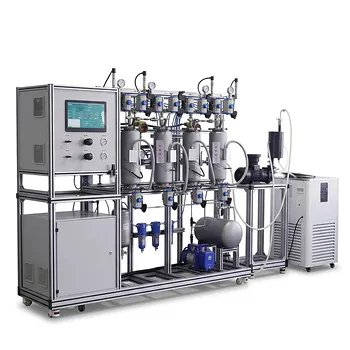
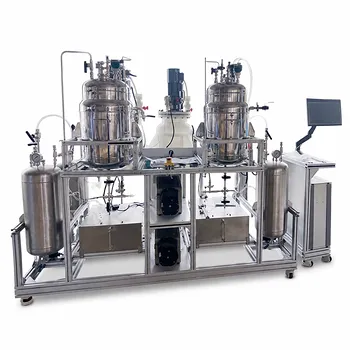
Pervaporation doesn’t just break azeotropes—it sidesteps the very thermodynamic rules that handcuff traditional distillation.
In a conventional distillation pilot plant, the ethanol-water mixture hits an azeotropic ceiling where vapor and liquid compositions become identical, and no amount of additional heat can cross it without a chemical entrainer. An educational membrane pervaporation unit, however, demonstrates that separation can be driven by solubility and diffusivity differences through a dense selective layer, not by relative volatility. Students observe how water molecules preferentially sorb, diffuse, and desorb across a hydrophilic membrane—producing ethanol purities up to 99.8% with 30–40% less energy than azeotropic distillation.
While a traditional distillation pilot plant forces students into the dead end of the ethanol-water azeotrope, a membrane pervaporation unit teaches a fundamental workaround: separation by molecular affinity replaces separation by boiling point, eliminating entrainers and slashing energy consumption in a safe, hands-on demonstration.
The Thermodynamic Limit That Defeats Distillation
Why Distillation Pilot Plants Hit a Wall
Conventional distillation relies on vapor-liquid equilibrium (VLE) —the relationship between the composition of a boiling liquid and its vapor. For an azeotrope like ethanol-water at 95.6% ethanol, the bubble-point and dew-point curves touch. Liquid and vapor become identical; no driving force for further enrichment remains.
In a teaching distillation column, this manifests as a frustrating plateau. Increasing reflux or tray count cannot shift the purity past the azeotrope. The lesson becomes clear: thermodynamics, not hardware, is the barrier.
The Cost of Forcing a Breakthrough
Industry crosses this barrier by adding a third component—an entrainer like benzene or cyclohexane. A pilot plant simulating azeotropic extraction teaches students that this route introduces complexity: extra solvent recovery towers, toxic chemical handling, and higher energy demands. The educational takeaway is that breaking an azeotrope by distillation is a fight against nature, one that demands chemical and energetic compromise.
How a Membrane Pilot Plant Bypasses the VLE Barrier
Replacing Volatility with Affinity
A membrane pervaporation pilot plant demonstrates that separation can be built on a completely different physical property: chemical affinity and diffusivity through a nonporous membrane. No boiling occurs across the selective layer. Instead, a liquid feed contacts the membrane, and a vacuum or sweep gas on the permeate side creates a chemical potential gradient.
The primary reference distills this into a three-step sequence that students can track directly:
- Preferential sorption – the target component (water, in ethanol dehydration) accumulates on the membrane surface.
- Selective diffusion – the absorbed molecules migrate through the dense film at a rate determined by size, shape, and interaction with the polymer.
- Desorption – the permeate evaporates into the low-pressure side, renewing the driving force.
Because solubility and diffusivity, not relative volatility, govern the process, the ethanol-water azeotrope becomes irrelevant. Students measure permeate compositions that exceed the azeotropic limit, often reaching >99 wt% ethanol in the retentate with a single membrane module.
The Hydrophilic Membrane as a Molecular Gate
In educational units, a polyvinyl alcohol (PVA) membrane is frequently used. Its hydroxyl-rich structure forms strong hydrogen bonds with water, enabling water to dissolve into the polymer and diffuse orders of magnitude faster than ethanol. The membrane acts as a molecular filter that discriminates by chemical affinity, not boiling point.
Supplementary references confirm that this approach not only breaks the azeotrope but does so at lower temperatures, vaporizing only the permeating fraction. This slashes thermal energy consumption by 30–40% compared to azeotropic distillation and eliminates the carbon footprint of entrainer manufacture and recovery.
Educational Value: Seeing the Breakthrough in Real Time
Demonstrating the Three-Step Mechanism
A bench-scale pervaporation rig allows students to manipulate each element of the mechanism. By varying feed temperature, they observe increased diffusion rates without altering selectivity. By swapping membrane materials (from hydrophilic PVA to hydrophobic PDMS for organic removal), they see how solubility selectivity reverses the separation direction. Gas chromatography samples from retentate and permeate prove that the azeotrope has been shattered—without any entrainer in the loop.
Turning a Thermodynamic Wall into a Teachable Moment
The pilot plant makes abstract phase thermodynamics tangible. Students compare a distillation column’s McCabe-Thiele diagram—where the operating line crosses the equilibrium curve at the azeotropic point—with the pervaporation unit’s response surface that has no pinch point. The direct side-by-side operation reinforces why membrane processes are classified as non-equilibrium, rate-governed separations, a core concept in advanced mass transfer.
Green Chemistry and Process Intensification
Beyond the basic principle, the pervaporation pilot plant embeds modern process metrics. Energy monitors quantify the heat load only for the permeate vaporization. No toxic entrainer means no secondary purification waste streams. The smaller footprint and simple scale-up logic (adding membrane area) give students a glimpse of process intensification—a counterpoint to the tall, energy-hungry distillation towers.
Understanding the Trade-offs in an Educational Setting
Where Pervaporation Falls Short of the Ideal
While powerful, a membrane pilot plant is no universal replacement. The process is rate-limited by diffusion; throughput per unit area is modest, making it best suited for removing minor components near the azeotrope rather than bulk separation. Students see that a dilute ethanol stream must first be concentrated by distillation to near-azeotropic levels before pervaporation becomes efficient—a lesson in hybrid process design.
Membrane Stability and Fouling
Real feeds can contain particulate foulants or reactive species that degrade the membrane. In a pilot plant using clean model mixtures, students miss the operational headaches of membrane cleaning and replacement, but the concept can be introduced by deliberately introducing a fouling challenge. Moreover, temperature and pressure sensitivity teach students that pervaporation operates within a narrow window; excessive swelling or plasticization can collapse selectivity.
Cost and Scale Perception
A teaching unit’s small-scale economics don’t always translate linearly. Students learn that membrane modules have a capital cost and limited lifetime, and that the vacuum permeate condensation step adds energy. The balance against entrainer costs is nuanced. The pilot plant should therefore be framed as an efficiency tool for azeotropic breaking, not a wholesale replacement for distillation in all bulk separations.
Making the Right Choice for Your Educational Goal
The ideal teaching sequence depends on what you want students to internalize. Use the pilot plant that matches the core learning outcome.
- If your primary focus is illustrating thermodynamic limitations: Start with a conventional distillation column to let students hit the azeotropic wall firsthand, then pivot to the membrane unit to show how a rate-based process circumvents VLE.
- If your primary focus is modern green separations and energy efficiency: Center the pervaporation pilot plant, using ethanol dehydration as a case study to quantify energy savings, entrainer elimination, and the three-step sorption-diffusion-desorption mechanism.
- If your primary focus is integrated process design: Combine distillation and pervaporation in a single experiment. Have students concentrate the feed to the azeotrope by distillation, then route the overhead to a membrane module for dehydration—demonstrating how hybrid systems solve what neither unit can alone.
- If your primary focus is scalability and industrial context: Use the pervaporation unit alongside a liquid-liquid extraction pilot plant to show that different azeotrope-breaking strategies (membrane affinity vs. solvent extraction) suit different chemistries and economic constraints.
By selecting the right pilot-plant tool, you transform a thermodynamic dead end into a clear, hands-on lesson in how chemical engineering principles evolve beyond equilibrium to deliver practical, energy-conscious solutions.
Summary Table:
| Feature | Traditional Distillation Column | Membrane Pervaporation Pilot Plant |
|---|---|---|
| Driving Force | Relative volatility (VLE) | Molecular solubility & diffusivity |
| Azeotropic Barrier | Cannot cross without entrainers | Bypassed naturally |
| Energy Demand | High (bulk thermal energy) | 30%–40% lower energy consumption |
| Chemical Safety | Requires toxic solvents (benzene) | Zero chemical entrainers required |
| Product Purity | Limited by VLE thermodynamic wall | Up to 99.8% purity achievable |
Enhance Your Engineering Curriculum with LABPARK
Bring advanced separation technology to your classrooms and laboratories. LABPARK provides high-quality Educational and Vocational Unit Operations Pilot Plants in chemical engineering, bioprocess & biotech, and environmental & water treatment for universities, research institutes, and enterprises.
Help your students visualize complex thermodynamic workarounds, green chemistry, and process intensification with hands-on pervaporation and distillation rigs.
Contact our technical experts today to find the perfect pilot plant setup for your institution!
Related Products
- Multi-Functional Special Distillation Educational Pilot Plant
- Multifunctional Membrane Separation Educational Pilot Plant with Ultrafiltration, Nanofiltration, Reverse Osmosis
- Multi-Functional Membrane Separation Educational Pilot Plant for Unit Operations Lab
- Ultrafiltration Membrane Separation Educational Pilot Plant
- Hollow Fiber Ultrafiltration Membrane Separation Educational Pilot Plant
People Also Ask
- Why does simple distillation yield higher efficiency than flash distillation? Key thermodynamic differences.
- How to Estimate Distillation Pilot Plant Tray Efficiency? O'Connell's Correlation Guide
- How to Verify Distillation Boundary Lines & Composition Regions with Pilot Plants
- Why is the acentric factor important in pilot plants? Fluid property prediction.
- How to Integrate Spectroscopy in Distillation Pilot Plants for Advanced Process Control