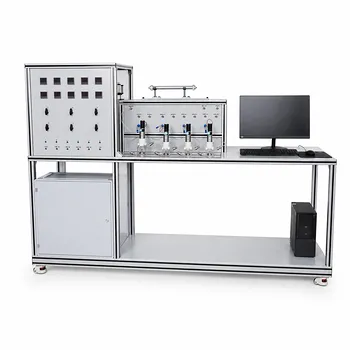
You can demonstrate bifurcation and chaotic behavior in a CSTR by systematically manipulating heat removal, feed flow rate, or cooling temperature, then watching the reactor’s dynamic state shift from a stable operating point to self-sustained oscillations and eventually into non-repeating, chaotic patterns. Real-time sensors in an educational pilot plant capture temperature and concentration transients, while stability tools like Floquet multipliers and autocorrelation analysis convert raw data into a rigorous narrative of nonlinear dynamics. This approach closes the gap between abstract reactor stability models and the tangible, sometimes unpredictable, physical world.
Core takeaway: An exothermic CSTR is a perfect physical platform for nonlinear dynamics because its heat and mass balances create the feedback loops necessary for multiple steady states, limit cycles, period doubling, and chaos. By using a pilot plant to change dimensionless parameters like the Damköhler number and the heat transfer coefficient, you experimentally build the same bifurcation diagrams you study in theory—making abstract concepts visible, measurable, and safe to explore.
The Physics of Nonlinearity in an Exothermic CSTR
The foundation of any bifurcation study is the reactor’s heat balance. An exothermic reaction generates heat faster as temperature rises—an exponential, unstable self-heating tendency. At the same time, the cooling system removes heat roughly linearly with temperature. The intersection of these two curves defines the possible steady states.
The Heat Balance Dance
When the heat generation curve and the heat removal line cross, you find an operating point. Because generation is a nonlinear sigmoidal function, the two curves can intersect multiple times. This is steady-state multiplicity, the first critical bifurcation a student witnesses. A single, exothermic reaction in a continuous stirred tank can settle into a low-temperature (stable) or high-temperature (stable) steady state, separated by an unstable intermediate.
Steady-State Multiplicity as the First Bifurcation
By plotting real-time pilot plant data—dimensionless temperature θ versus reaction rate—students can visualize the van Heerden stability criterion. The slopes of generation and removal lines at each intersection determine stability. When the slope of heat generation exceeds the slope of heat removal, the state is unstable; otherwise it is stable. Changing a parameter like coolant flow shifts the removal line, causing steady states to appear or disappear in a saddle-node bifurcation. This is the gateway to richer dynamics.
Tuning Parameters to Trigger Dynamic Transitions
The beauty of a well-instrumented pilot plant is that you hold the system right at a bifurcation point and watch it react in real time.
Manipulating Damköhler and Heat Transfer Numbers
You directly control the dimensionless groups that govern stability.
- Damköhler number (Da): Adjusted via the feed flow rate. A higher Da means longer residence time, more reaction, and a steeper heat generation curve.
- Dimensionless heat transfer parameter (δ): Altered by changing the cooling jacket flow rate or coolant temperature. It shifts the slope and intercept of the heat removal line. By stepping these parameters while logging temperature and concentration, students can trace the reactor’s dynamic evolution from a single stable state to an oscillatory limit cycle—the onset of a Hopf bifurcation.
Visualizing Stability with Van Heerden Plots
Modern pilot plants let you generate these plots on-the-fly. Students collect steady-state data at different flow rates or cooling conditions, then overlay the measured generation and removal curves. Where the curves touch and separate, bifurcations occur. This hands-on exercise cements the link between abstract bifurcation theory and physical operation, and it teaches why the intermediate steady state is impossible to maintain in an open loop.
From Oscillations to Chaos: The Experimental Roadmap
Once sustained oscillations appear, the reactor is primed to demonstrate the signature route to deterministic chaos.
The Period-Doubling Cascade and Feigenbaum’s Constant
For many exothermic systems—especially those running consecutive or autocatalytic reactions—smooth periodic oscillations morph into chaos through a Feigenbaum cascade. When you increment a control parameter like the heat transfer coefficient, the period of oscillation doubles at successively narrower intervals. Students can capture these regimes with high-frequency temperature probes. Plotting the period ratio yields an experimental value near the universal constant 4.669, directly verifying a cornerstone of nonlinear dynamics.
In pilot plants with consecutive reactions (one exothermic, one endothermic), the cascade is particularly clean. As coolant flow is gradually reduced, the single-period orbit splits into a two-period cycle, then four, eight, and eventually a broadband, non-repeating chaotic attractor. Watching this unfold on a live trend chart transforms a mathematical curiosity into a visceral, unforgettable experience.
Data Signatures – Floquet Multipliers and Autocorrelation
Real-time data analysis closes the loop. Floquet multipliers computed from consecutive oscillation peaks quantify stability: crossing the unit circle signals a bifurcation. Autocorrelation analysis distinguishes periodic from chaotic behavior—a periodic signal shows strong correlations at lag intervals equal to the period, while chaotic data decorrelates rapidly. These tools, applied to pilot plant data, teach students how to diagnose reactor stability in both research and industrial safety contexts.
Beyond the Single Vessel – Coupled Reactors and Complex Reactions
A single CSTR is a rich testbed, but CSTR cascades unlock even deeper phenomena. In a series configuration, oscillations in the first reactor can force the downstream reactors into limit cycles, even when each would remain stable on its own. By adjusting individual stage residence times, students map forced bifurcation diagrams and observe how coupling shifts the stability landscape—crucial knowledge for designing inherently safe multi-stage processes.
Similarly, pairing exothermic and endothermic reactions in a single CSTR expands the phase space to observe hyperchaos or intermittent routes, beyond the standard period-doubling road. The pilot plant becomes a miniature laboratory for exploring the boundaries of safe operation.
Pitfalls and Safety Considerations
Practical demonstration of chaos demands rigorous attention to real-world constraints.
- Thermal runaway risk: Near bifurcation points, a tiny parameter nudge can send the reactor to a high-temperature steady state beyond design limits. Robust over-temperature interlocks and independent cooling capacity are non-negotiable.
- Sensor noise and time lag: Chaotic signals are sensitive; measurement noise can be misread as deterministic chaos. Use high-resolution, fast-response probes and validate with phase-space reconstruction.
- Limited operating range: Physical equipment may not sustain the extreme Damköhler or δ values required for some exotic bifurcations. Pre-screen target parameters with simulation before live runs.
- Startup transients: The path to a chaotic attractor may depend on initial conditions. Document and repeat runs to separate transient artifacts from true asymptotic behavior.
Making Nonlinear Dynamics Tangible in the Lab
Your experimental design should match your educational or research objective. Here is how to prioritize.
- If your primary goal is teaching reactor stability fundamentals: Focus on steady-state multiplicity and Hopf bifurcations using van Heerden plots. Use simple exothermic reactions and slow parameter sweeps.
- If your main focus is demonstrating deterministic chaos: Select a reaction system with consecutive steps or autocatalysis. Gradually change the heat transfer coefficient and capture the period-doubling cascade with high-frequency data logging.
- If you want to connect theory to advanced control: Equip the pilot plant with real-time computation of Floquet multipliers and autocorrelation. Use the data to design feedback controllers that suppress oscillations or prevent bifurcations.
- If your interest is process safety and industrial relevance: Map the bifurcation boundaries in terms of operational parameters (flow rate, jacket temperature) and define safe operating envelopes that students can physically verify.
An exothermic CSTR pilot plant is not just a reactor—it is a living bifurcation diagram. By guiding it through its nonlinear repertoire, you turn the abstract mathematics of chaos into a concrete, measurable, and thoroughly instructive reality.
Summary Table:
| Key Parameter | Resulting Dynamic Phenomenon | Key Diagnostic / Analysis Tool |
|---|---|---|
| Damköhler Number ($Da$) | Steady-state multiplicity & Saddle-node bifurcation | van Heerden stability plots |
| Heat Transfer Coefficient ($\delta$) | Oscillatory limit cycles & Hopf bifurcation | Real-time temperature transients |
| Coolant Temp / Flow Steps | Period-doubling cascade & deterministic chaos | Floquet multipliers & Autocorrelation |
Bring advanced chemical reactor dynamics to life in your laboratory. LABPARK provides state-of-the-art Educational and Vocational Unit Operations Pilot Plants in chemical engineering, bioprocess & biotech, and environmental & water treatment tailored for universities, research institutes, and enterprises.
Ready to equip your facility with safe, high-precision CSTR systems that make complex thermodynamics tangible? Contact LABPARK today to explore our custom pilot plant solutions and request a quote!
Related Products
- Multi-Stage Stirred Tanks in Series Residence Time Distribution and Mixing Performance Determination Educational Pilot Plant
- Multi-Reactor Educational Pilot Plant for Reaction Engineering Unit Operations
- Multi Functional Catalytic Reaction and Reactor Evaluation Educational Unit Operations Pilot Plant
- Residence Time Distribution and Reactor Flow Characteristics Determination Educational Pilot Plant
- 100L Continuous Loop Hydrogenation Educational Unit Operations Pilot Plant
People Also Ask
- CSTR Multiplicity: Which physical variables map to universal unfolding?
- How does impeller configuration affect RTD & reactor performance? Optimize mixing and conversion in pilot plants.
- How do multiple CSTRs in series affect stability? Master Complex Pilot Plant Dynamics
- How does MRF model impeller rotation in CFD? Key Boundary Conditions Explained
- How can a CSTR pilot plant demonstrate reactor staging? Visualize volume savings.