The gap between a textbook recycle calculation and a real chemical process is bridged one flowmeter reading at a time.
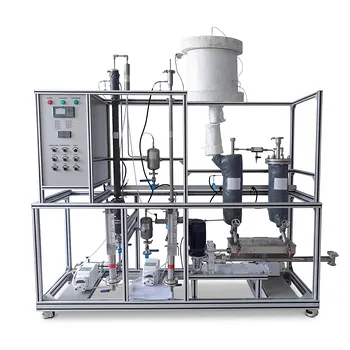
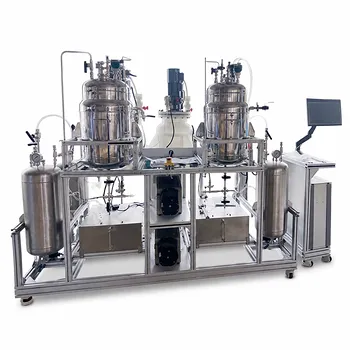
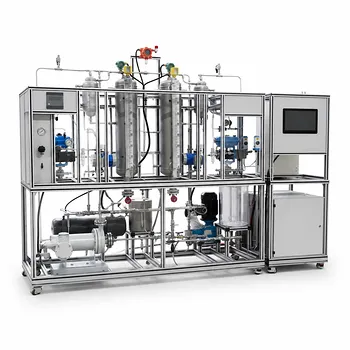
Chemical engineering unit operations pilot plants let students physically set feed flow rates (FF) and recycle flow rates (RC), measure stream compositions with inline sensors, and instantly compute the recycle ratio (RC/FF). By doing this, they move from solving idealized mass balances to confronting real phenomena like incomplete separation, inert accumulation, and dynamic heat effects—exactly what makes recycle calculations so complex in catalytic hydrogenation processes.
The true power of a pilot plant lies in making the recycle ratio a physical, adjustable lever. Students no longer just solve for RC/FF; they see, measure, and feel how changing that single number alters single-pass conversion, product selectivity, and the entire economic viability of a hydrogenation process. This transforms a mathematical abstraction into a lived engineering reality.
From Algebraic Loops to Physical Flow
The Recycle Ratio as a Process Lever
The recycle ratio (RC/FF) is the blood flow of a hydrogenation loop. It determines how many times unreacted feedstock passes through the reactor. In textbook problems, its value is often assumed or solved iteratively; in a pilot plant, students turn a valve to change it directly.
That physical act immediately reveals why the ratio matters. Raising RC/FF can push single-pass conversion higher by giving the catalyst more contact time with fresh feed. But it also risks building up inerts like methane or nitrogen that poison the catalyst over time. Seeing the real-time composition shift on a gas chromatograph is far more instructive than any graph on a slide.
The Difference Between Overall and Single-Pass Conversion
Pilot plants force students to distinguish between two often-confused terms.
Single-pass conversion is what happens inside the reactor in one trip:
(Reactant into reactor – Reactant out of reactor) / Reactant into reactor.
Overall conversion accounts for the entire process, including the recycle loop:
(Reactant input to process – Reactant output from process) / Reactant input to process.
With a physical unit running, students can sample the reactor feed (which now includes fresh feed plus recycle) and the process outlet separately. The RC/FF ratio directly links these two conversions. When they see that a single-pass conversion of only 20% can still deliver an overall conversion above 95% thanks to a high recycle ratio, the concept of “waste minimisation through recycling” becomes visceral.
Verifying the Recycle Loop Mass Balance
Recycle calculations are notoriously difficult because the recycle stream’s composition depends on downstream separation, which in turn depends on what the reactor produces. This circular dependency requires tearing (iteration) methods or simultaneous equations to solve theoretically.
In a pilot plant, students can physically sample the recycle line between the separator and the reactor. They measure the actual recycle composition, then compare it with their iterative solution. When the two numbers diverge—perhaps because of a small side reaction the model ignored—they learn the engineer’s most important lesson: every simulation is a hypothesis that must be tested against reality.
Demystifying Inert Accumulation
One of the most dangerous blind spots in recycle design is inert accumulation. In hydrogenation, for example, trace nitrogen enters with the hydrogen feed and has no reaction path out. If no purge exists, that inert will build up, slowly killing reactor productivity. A pilot plant makes this silent killer visible. Students can operate the unit at a high RC/FF ratio for an hour, watch the recycle stream’s nitrogen concentration creep up on the readout, and then calculate the minimum purge rate required to stabilise the system. No textbook problem ever captures that slow, steady threat quite as well.
Bridging the Gap Between Simulation and Reality
Using Physical Data to Calibrate Digital Models
Process simulators are powerful, but initial simulation yields rarely match real pilot plant data. The culprit is often the recycle loop: tiny errors in separation efficiency or reaction kinetics get amplified with each pass until the simulation and reality diverge drastically.
Students who operate a pilot plant can gather empirical mass and energy balance data—real flow rates, real compositions, real heat duties. They then use those data points to adjust key simulation parameters, like catalyst activity or separator split fractions. This teaches a critical skill: digital twin validation. Without the pilot plant’s physical truth, the simulator remains a calculator; with it, the simulator becomes a trustworthy scale-up tool.
The Economic Lens: From Yield to Cash Flow
When students calculate the pre-tax ROI of a hydrogenation process, the single most sensitive variable is often actual yield. The difference between a 70% and 75% overall yield changes raw material costs dramatically. A pilot plant allows them to measure that yield directly and then vary the RC/FF ratio to see the economic impact in real time.
For example, increasing the recycle ratio may boost yield but also increase recompression utility cost. Students can log the incremental electricity consumption and catalyst deactivation rate, then compute the simple payback of operating at a higher ratio. This transforms RC/FF from a dimensionless number into a knobs-on, dollars-and-cents decision.
Understanding the Trade-offs and Common Pitfalls
The Inert Accumulation Trap
A high RC/FF ratio often looks attractive because it maximises single-pass conversion. But it can silently strangle the process. In a pilot plant, students observe that above a certain threshold, the reactor partial pressure of inerts rises so much that the catalyst active sites are effectively poisoned. The unit’s performance drops—even though the fresh feed rate hasn’t changed. This teaches that recycle is always a balance between recovery and purge, not a one-direction optimisation.
Sensor Trust vs. Physical Sampling
Inline sensors provide immediate data, but they can drift or suffer from matrix effects. In a teaching pilot plant, students often find that the online analyser’s RC/FF value deviates from the one calculated from manual sample analysis. Reconciling these discrepancies ingrains the habit of analytical cross-checking—an essential safety and accuracy practice for any process engineer.
Scale-Down Distortions
A pilot plant is not a perfect miniature of an industrial reactor. Wall effects, higher heat losses, and different residence time distributions mean that a 1:10 scale recycle loop behaves differently. Students who simply assume their pilot-derived RC/FF ratio will map linearly to a commercial unit learn a hard lesson. The pilot plant’s true value is in validating the fundamental mechanisms and the simulation model, not in directly copying a single number.
The Bypass Complexity
Recycle loops sometimes incorporate bypass streams to control reactor inlet temperature or composition. Pilot plants let students route a portion of the fresh feed around the reactor and mix it with the exit stream. They can then observe how bypass fraction interacts with the recycle ratio to stabilise operating conditions, adding another layer of real-world complexity that no textbook problem fully captures.
Making the Right Choice for Your Learning Goal
- If your primary focus is mastering the recycle ratio computation: Insist on operating the pilot plant at multiple steady-state RC/FF values, sample each relevant stream, and reconcile your iterative mass balance calculations with the empirical data. This closes the gap between algebra and actual process behaviour.
- If your primary focus is process optimization and economics: Use the pilot plant to gather yield, utility consumption, and catalyst lifetime data under different recycle strategies. Then perform a simple pre-tax ROI to see which RC/FF target maximises profit, not just conversion.
- If your primary focus is digital twin validation: Run the pilot plant first, collect reliable mass and energy balances around the separation and reaction sections, then adjust your simulator’s tear blocks until they reproduce the physical data. This is the only way to build a model you can trust for scale-up.
- If your primary focus is understanding reactor dynamics and safety: Deliberately push the recycle ratio to its limits and monitor the real-time temperature, pressure, and composition trends. Observe the warning signs of inert accumulation or thermal runaway in a safe, scaled-down environment.
A pilot plant transforms the recycle ratio from a symbol on paper into a living, breathing variable with economic and safety consequences. That direct, hands-on correlation is what makes a competent engineer into a wise one.
Summary Table:
| Key Concept | Textbook/Simulation View | Pilot Plant Reality | Key Learning Outcome |
|---|---|---|---|
| Recycle Ratio (RC/FF) | Assumed or solved iteratively | Adjusted manually via valves & flowmeters | Connects flow rates directly to reactor performance |
| Conversion Types | Calculated via static formulas | Sampled separately (single-pass vs. overall) | Visualizes waste minimization through recycling |
| Inert Accumulation | Often ignored or idealized | Gradual buildup; requires active purging | Teaches how to design and manage purge streams |
| Model Calibration | Theoretical assumptions | Empirical mass & energy balance data | Validates and calibrates digital twin models |
Empower Your Students with Hands-On Engineering Excellence
Bridge the gap between theoretical calculations and real-world process control. LABPARK provides premium Educational and Vocational Unit Operations Pilot Plants designed for universities, research institutes, and enterprises specializing in:
- Chemical Engineering (including catalytic reaction & recycle loops)
- Bioprocess & Biotech
- Environmental & Water Treatment
Our systems allow students and researchers to gain hands-on experience, validate digital simulations with real-world data, and master complex unit operations safely.
Ready to upgrade your laboratory capabilities? Contact LABPARK today to discover our customizable pilot plant solutions!
Related Products
- Crude Benzene Hydrogenation Educational Unit Operations Pilot Plant
- Ethylbenzene Dehydrogenation Educational Unit Operations Pilot Plant
- Electrolytic Hydrogen Production Educational Unit Operations Pilot Plant
- Carbon Dioxide Hydrogen Methanol Synthesis Educational Unit Operations Pilot Plant
- 100L Continuous Loop Hydrogenation Educational Unit Operations Pilot Plant
People Also Ask
- What process control features are essential in a benzene hydrogenation pilot plant? Safe & Efficient Operation
- How can flow-NMR be integrated with pilot plant reactors to monitor kinetics? A Complete Guide
- How to design experiments when runs exceed reactor capacity? Master Statistical Blocking
- How do bulk and solution polymerization compare? Key pilot plant reactor design tips.
- How does gas flow configuration impact reactor pressure drop & catalyst efficiency? Axial-radial vs. axial flow.