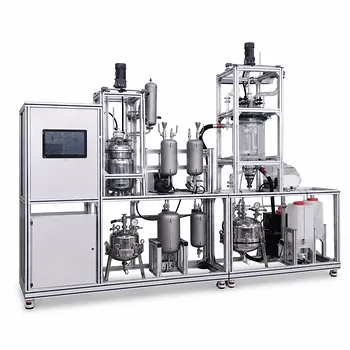
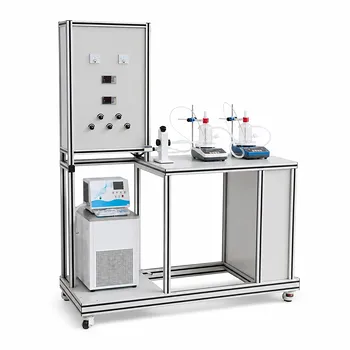
Fundamentally, separating adjacent lanthanides hinges on fractional liquid-liquid extraction that amplifies tiny chemical differences across dozens of equilibrium stages.
To demonstrate this in a university laboratory, a pilot plant is configured as a multi-stage counter-current extraction unit using either mixer-settlers or energy-input columns, with precise control of flow rates, aqueous phase pH, and temperature.
The system allows students and researchers to track stage-by-stage concentration profiles, measure mass transfer coefficients, and optimize extractant performance—transforming a chemically “impossible” separation into a tangible engineering lesson.
Lanthanide separation demands 10–20+ theoretical stages and the right equipment to handle low interfacial tension and small density differences. The core insight is that a pilot plant must mirror the counter-current contact pattern and provide clear visibility of both chemical selectivity and the physical dynamics of phase separation—backmixing, droplet coalescence, and residence time distribution—so that the invisible thermodynamics become a visible engineering exercise.
Why Lanthanide Separation Demands a Multi-Stage Approach
The Chemical Challenge: Near-Identical Behavior
Lanthanides share an almost identical ionic radius and the same trivalent oxidation state.
Their physical and chemical properties vary so subtly that a single extraction step produces negligible enrichment.
Achieving high‑purity rare earth oxides therefore requires a cascade of contacting stages.
Fractional Extraction: Exploiting Subtle Coordination Differences
The trick is to use an organic extractant—typically an organophosphorus acid like D2EHPA or PC88A—that forms slightly more stable complexes with heavier lanthanides.
Even though the selectivity per stage is small (a separation factor often below 2), a counter-current flow multiplies this effect exponentially.
In an educational pilot plant, students can literally see how a mixed aqueous feed becomes progressively enriched in one element while the raffinate is depleted.
Choosing the Right Extraction Equipment for Your Pilot Plant
Matching Equipment to Theoretical Stages
Lanthanide separations routinely need 10 to 20 theoretical stages.
For <3 stages, simple spray or packed columns suffice, but that is far below what a realistic rare‑earth demonstration requires.
For 4–10 stages, sieve plate columns or pulsed columns become practical.
For the 10–20 stage window typical of lanthanide fractionation, the most educationally valuable choices are mixer‑settler batteries, rotating disc contactors, or reciprocating plate columns.
Dealing with Low Interfacial Tension and Small Density Differences
The aqueous and organic phases used in rare‑earth extraction often have very low interfacial tension and only a small density difference.
Under gravity alone, phase separation becomes frustratingly slow, and the system is prone to emulsions and axial mixing.
Energy‑input devices—such as centrifugal extractors, mixer‑settlers, or agitated columns—provide the additional force needed to coalesce droplets and maintain a sharp interface, making the pilot plant reliable and instructive.
Mixer‑Settlers vs. Columns: An Educational Perspective
Mixer‑settlers offer a clear, stage‑by‑stage layout that makes the counter‑current principle visually intuitive.
Each unit can be sampled easily, letting students construct a true concentration profile and calculate a distribution coefficient for every stage.
Columns, like a pulsed disc‑and‑doughnut column, are more compact and better for demonstrating continuous, differential contacting and the impact of backmixing—a key scale‑up concern.
Critical Process Parameters to Monitor and Control
Flow Rates and the Solvent‑to‑Feed Ratio
The aqueous flow rate, organic flow rate, and their ratio determine the operating line and the number of stages required to hit a purity target.
Accurate peristaltic or piston pumps with a precise turndown ratio are essential so that students can map separation performance as a function of phase ratio.
Even small fluctuations blur the stage‑wise data and obscure the subtle chemistry.
pH and Temperature: The Drivers of Selectivity
Organophosphorus acid extractants function by cation exchange; their deprotonation and thus complexation strength are exquisitely sensitive to pH.
Online pH probes at key stages, along with temperature-regulated jackets, show how a shift of <0.1 pH units or a few degrees Celsius can alter the extraction order.
This transforms a purely chemical phenomenon into an engineering control‑loop demonstration.
Phase Separation Dynamics: Watching Coalescence in Action
In real rare‑earth streams, the interfacial tension is low and the viscosity can change with metal loading, so students should measure coalescence time and observe the dispersion band.
A pilot plant with transparent settlers or sight glasses makes these phenomena visible.
They learn firsthand why emulsification and entrainment are not just nuisances but major equipment‑sizing parameters.
Understanding the Trade‑offs in an Educational Setting
A university‑scale lanthanide pilot plant cannot—and should not—be a perfect model of an industrial plant.
Using a real multi‑element leach liquor from a monazite or bastnäsite source introduces radionuclide and toxicity concerns that are often unacceptable.
Instead, many labs use simulated feeds with two or three lanthanides (e.g., Nd/Pr or Sm/Eu) to keep hazards manageable while preserving the chemical challenge.
The organic phase itself—kerosene‑diluted acidic extractants—requires careful handling and waste management.
Cleaning and equilibration cycles can take days, limiting the number of student‑run experiments per semester.
Moreover, achieving a true steady‑state counter‑current flow demands startup times that can conflict with a three‑hour laboratory period.
Finally, the small selectivity means that even a 20‑stage rig will only produce a partial enrichment, not a 4N‑purity oxide.
The educational value lies not in the final purity but in observing the separation cascade, measuring mass transfer coefficients, and linking solvent chemistry to equipment design.
Transparency about these limitations builds trust and teaches the iterative nature of process development.
Making the Right Choice for Your Goal
- If your primary focus is teaching unit operations fundamentals: Choose a 10‑ to 15‑stage mixer‑settler battery with clear sight glasses. The stage‑wise visibility makes distribution coefficients and extraction isotherms tangible, and students can manually take samples at every port.
- If your primary focus is research into extraction chemistry and process optimization: Incorporate high‑precision pH monitors and jacketed vessels. This configuration lets researchers quantify how small pH and temperature changes alter separation factors and mass transfer kinetics, generating publishable data.
- If your primary focus is demonstrating industrial scale‑up issues: Select a pulsing disc column or a rotating disc contactor. It will vividly illustrate axial mixing, continuous phase holdup, and flooding—the same non‑idealities that dominate production‑scale design.
- If your primary focus is a safe, low‑maintenance teaching tool: Use a two‑lanthanide simulated feed (e.g., Nd/Pr) with D2EHPA in a kerosene diluent. Design the skid with secondary containment, easy‑drain ports, and a simple HMI, so the plant remains operable by a teaching assistant.
A well‑designed lanthanide extraction pilot plant turns a famously difficult separation into a masterclass in counter‑current contacting, phase behavior, and process control—exactly the skills that bridge the gap between the wetted‑bench beaker and the engineering‑scale column.
Summary Table:
| Equipment Type | Primary Focus / Goal | Key Educational & Practical Value |
|---|---|---|
| Mixer-Settler Battery | Teaching Unit Operations | Visual stage-wise counter-current flow; easy manual sampling per stage. |
| Pulsed/Agitated Column | Industrial Scale-up | Demonstrates continuous contacting, backmixing, holdup, and flooding. |
| Jacketed Units (pH Probes) | Research & Optimization | Quantifies how precise pH and temperature shifts alter separation factors. |
Bring Industrial-Scale Chemistry to Your Laboratory
Setting up complex separation processes like lanthanide fractionation requires precision engineering. LABPARK provides state-of-the-art Educational and Vocational Unit Operations Pilot Plants in chemical engineering, bioprocess & biotech, and environmental & water treatment. Designed specifically for universities, research institutes, and enterprises, our customizable pilot skids feature transparent stage visibility, precise control systems, and robust safety containment to turn complex thermodynamics into practical, hands-on learning.
Ready to upgrade your lab? Contact our engineering experts today to discuss your custom pilot plant configuration!
Related Products
- Educational Rotary Disc Liquid-Liquid Extraction Pilot Plant
- Gallium and Indium Selective Extraction Educational Pilot Plant
- Comprehensive Liquid-Liquid Extraction Pilot Plant for Engineering Education
- Ternary Liquid-Liquid Equilibrium Educational Pilot Plant
- Liquid-Liquid Mass Transfer Coefficient Determination Educational Pilot Plant
People Also Ask
- How do density and IFT affect liquid-liquid extraction pilot plants? Optimize Column Performance
- How to Estimate KD for Liquid-Liquid Extraction Pilot Plants Using Henry's Law when Lab Data is Limited
- How are ternary phase diagrams and LLE data applied in extraction experiments? Optimize Pilot Plant Scale-up
- How to resolve emulsion in liquid-liquid extraction? 5 ways to ensure efficient phase separation
- Why is the plait point a critical limit in liquid-liquid extraction pilot plants? Safe LLE Operation