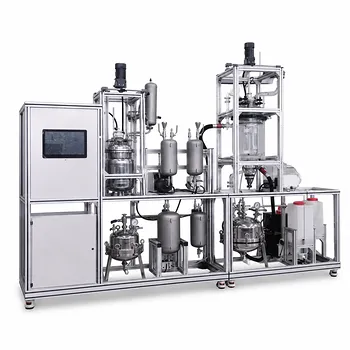
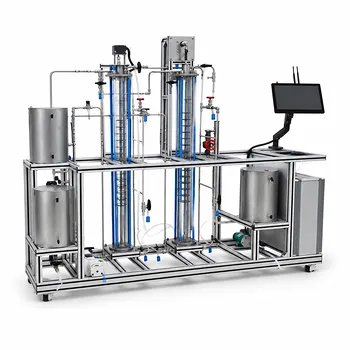
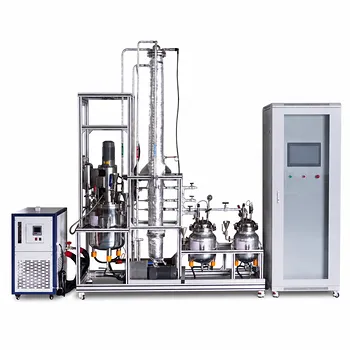
Pilot plants allow chemical engineers to safely replicate the hazardous, SO₂-laden off-gas from a roasting furnace and systematically test removal technologies before full-scale implementation.
By using a combination of gas absorption columns and catalytic reactor stages in a unit operations pilot plant, researchers and students can directly study the mass transfer, reaction kinetics, and chemical absorbent performance that govern SO₂ capture. This approach transforms textbook principles into measurable, controllable processes, making it possible to optimize operating conditions—such as liquid-to-gas ratio, temperature, and absorbent concentration—to achieve industrial-grade removal efficiencies.
The true power of the pilot plant lies in its ability to isolate the deep engineering challenge: moving from a theoretical understanding of SO₂ chemistry to a validated, scalable design. It bridges the gap between a single beaker experiment and a full-scale emission control system, allowing safe, data-driven optimization that directly addresses the environmental impact of lead and zinc metallurgy.
The Role of Wet Scrubbing Pilot Plants in SO₂ Control
Wet scrubbing forms the bedrock of most industrial flue gas desulfurization, and the pilot plant is where its fundamental behavior is mastered.
Packed and Plate Columns for Gas‑Liquid Mass Transfer
A pilot-scale absorption column—either packed with structured material or fitted with plates—provides the controlled environment needed to measure how SO₂ moves from the gas phase into a liquid absorbent. Students can vary gas and liquid flow rates independently, then track the resulting concentration profiles along the column height.
This hands-on operation reveals the relationship between pressure drop, flooding limits, and the overall mass transfer coefficient (K_G a). By calculating the height of a transfer unit (HTU) and number of transfer units (NTU) from experimental data, the pilot plant turns an abstract design parameter into a tangible, scalable number.
Chemical Absorbents and Neutralization Pathways
The choice of absorbent dictates the chemistry, waste product, and cost of the system. The pilot plant allows a direct comparison of sodium hydroxide, limestone slurry (CaCO₃), and calcium hydroxide (Ca(OH)₂) under identical flue‑gas conditions.
- An alkaline solution like sodium hydroxide rapidly absorbs SO₂ through a simple acid‑base reaction, offering very high efficiencies even at low liquid rates.
- Limestone and lime slurries, however, introduce a reaction‑crystallization step, forming calcium sulfite/sulfate sludge that must be managed.
Researchers use the pilot plant to measure how absorbent pH, particle size, and stoichiometric ratio influence both removal efficiency and the settling characteristics of the resulting solids. This direct measurement of neutralization efficiency is exactly what the primary reference emphasizes as a core learning objective.
Process Variables and Optimization
Beyond chemistry, the pilot plant makes it possible to deconstruct the influence of every operating lever. By systematically adjusting liquid‑to‑gas ratio, inlet SO₂ concentration, and temperature, the user generates performance curves that define the “sweet spot” for a given column.
Modern pilot plants are fitted with in‑line gas analyzers and thermocouples, capturing real‑time data that feeds directly into process simulators. The result is a robust empirical model that can predict how the system will behave when the ore grade changes or the roaster throughput increases—a capability that direct scale‑up from lab batches cannot provide.
Exploring Dry Desulfurization for Niche Applications
Not every emission control scenario relies on liquid slurries. A unit operations pilot plant can also demonstrate dry adsorption systems, which become valuable when water usage or wet waste handling presents a problem.
Fixed‑Bed Adsorption Columns
The same pilot plant frame can be reconfigured with a fixed bed of active carbon or sulfonated coal. As the simulated roasting gas passes through the bed, SO₂ molecules physically adsorb onto the porous surface.
Students collect breakthrough curves—the outlet concentration as a function of time—which directly yield the dynamic adsorption capacity of the material under realistic gas velocities.
These experiments highlight the trade‑offs between bed length, pressure drop, and the frequency of regeneration. By comparing the performance of different adsorbents, researchers can identify materials that offer a longer service life before requiring thermal or vacuum regeneration.
Catalytic Conversion: Turning a Pollutant into a Product
While wet scrubbing treats SO₂ as a waste to be neutralized, a unit operations pilot plant can also model a resource recovery pathway by converting SO₂ directly into sulfuric acid—a valuable industrial chemical.
Multi‑Bed Reactors with Interstage Cooling
The oxidation of SO₂ to SO₃ is a reversible, highly exothermic reaction. Low temperatures favor a high equilibrium conversion, but the kinetics are far too slow. Industrial practice therefore operates around 680–715 K, where the catalyst (typically vanadium pentoxide) is active.
A single catalyst bed, however, experiences an adiabatic temperature rise that caps conversion at only 60–70%. The pilot plant brings this limitation to life by using multiple fixed‑bed reactor stages with intermediate cooling (via heat exchangers or cold air quenching) between each bed.
By dropping the gas temperature after each stage, the reaction is brought back into a thermodynamically favorable region, allowing the next bed to push overall conversion to 98–99%.
According to reactor design principles, exothermic reactions carry risks of thermal runaway, making such pilot‑scale kinetic studies essential. Researchers safely collect real‑time temperature, pressure, and concentration data across each bed, then fit reaction rate equations and determine rate constants. This empirical data is what ultimately validates the kinetic models used to design industrial relief systems and optimize catalyst loading—all without risking a full‑scale incident.
Linking Pilot Plant Data to Full‑Scale Design
The true value of any unit operations pilot plant is not the numbers it produces in isolation, but the design rules it validates.
- Scale‑up correlations: Mass transfer data from a 10‑cm column feeds directly into correlations that predict the performance of a 5‑meter industrial scrubber.
- Kinetic parameter fitting: The conversion profiles from a multi‑bed reactor allow engineers to extract activation energies and pre‑exponential factors that are independent of reactor size.
- Process integration: Students learn that the scrubber effluent (calcium sulfite sludge) or the SO₃ product stream must be handed off to downstream filtration, neutralization, or absorption towers—exactly the kind of sequence that a modular pilot plant can demonstrate.
Understanding the Trade‑offs
No single technology is universally superior. The pilot plant is the arena where these conflicts become measurable.
- Wet scrubbing vs. waste management: A limestone slurry achieves high removal at a low chemical cost, but generates a calcium sulfite/sulfate sludge that requires dewatering and disposal. The pilot plant quantifies the volume and handling properties of that sludge.
- Dry adsorption vs. capacity: Active carbon beds avoid a liquid effluent, yet they must be regenerated or replaced once saturated. Pilot‑scale breakthrough data reveal whether the cycle time is commercially viable for the specific SO₂ load.
- Catalytic oxidation vs. energy intensity: The high conversion of the contact process comes at the price of preheating the gas to over 700 K and managing interstage cooling. The pilot plant’s energy balance data make this cost transparent.
- Simulation fidelity: A pilot plant uses simulated or bottled SO₂, not the full spectrum of dust, heavy metals, and moisture from a real roaster. Any scale‑up must account for the catalyst deactivation or column fouling hidden in the simplified feed.
Making the Right Choice for Your Pilot Plant Study
The configuration of your pilot plant should directly mirror the ultimate goal of your research or teaching module.
- If your primary focus is fundamental absorption kinetics and liquid‑side mass transfer resistance: Start with a packed or plate wet‑scrubbing column. Instrument it to measure axial concentration profiles and pressure drop, and systematically compare absorbents like NaOH and limestone slurry.
- If your primary focus is developing novel adsorbents or evaluating dry, water‑free processes: Configure the pilot plant with a fixed‑bed adsorption column. Run breakthrough tests with active carbon and alternative sorbents, and correlate the results with bed depth service time models.
- If your primary focus is resource recovery and linking emission control to a sulfuric acid value chain: Invest in a multi‑bed catalytic reactor with precise interstage cooling control. Use the kinetic data to validate the rate equations and study catalyst durability under cyclic operation.
A well‑designed unit operations pilot plant does more than scrub SO₂—it teaches the engineering discipline of balancing chemistry, thermodynamics, and economics under one roof.
Summary Table:
| Technology | Process Mechanism | Key Advantages | Main Challenges |
|---|---|---|---|
| Wet Scrubbing | Gas-liquid mass transfer (absorption via NaOH/lime slurries) | High removal efficiency; predictable scale-up correlations | Generates waste sludge; high water consumption |
| Dry Adsorption | Physical adsorption onto solid beds (activated carbon/coal) | No liquid waste; ideal for water-scarce applications | Sorbent saturation; requires periodic thermal regeneration |
| Catalytic Conversion | Multi-bed exothermic catalytic oxidation of SO2 to SO3 | Resource recovery (converts waste to sulfuric acid) | High energy input; complex interstage cooling management |
Bring Industrial-Scale SO2 Control into Your Lab
Are you looking to bridge the gap between theoretical chemistry and scalable environmental technology? LABPARK provides state-of-the-art Educational and Vocational Unit Operations Pilot Plants in chemical engineering, bioprocess & biotech, and environmental & water treatment for universities, research institutes, and enterprises.
By partnering with us, you can:
- Replicate complex industrial emission scenarios safely in a controlled lab environment.
- Gather high-fidelity mass transfer and catalytic kinetic data for reliable scale-up.
- Train students and researchers on industry-standard scrubbing and adsorption technologies.
Ready to elevate your research and teaching capabilities? Contact LABPARK today to customize your pilot plant system!
Related Products
- Gallium and Indium Selective Extraction Educational Pilot Plant
- Natural Product Extraction Unit Operations Training Pilot Plant
- Comprehensive Liquid-Liquid Extraction Pilot Plant for Engineering Education
- Continuous Batch Extractive Distillation Educational Pilot Plant
- Multi-Functional Special Distillation Educational Pilot Plant
People Also Ask
- How do pilot plants differentiate physical vs chemical extraction? Enhance Chemical Engineering Training
- What is the significance of the isopycnic line in liquid-liquid extraction? Avoid Column Flooding
- How do droplet motion states affect kD in extraction pilot plants? Optimize Mass Transfer
- Why is predicting multicomponent LLE from binary data more challenging than VLE? Master your pilot plant design.
- How are ternary phase diagrams and LLE data applied in extraction experiments? Optimize Pilot Plant Scale-up