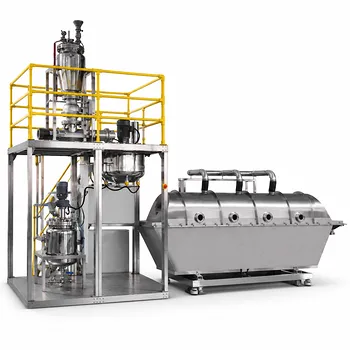
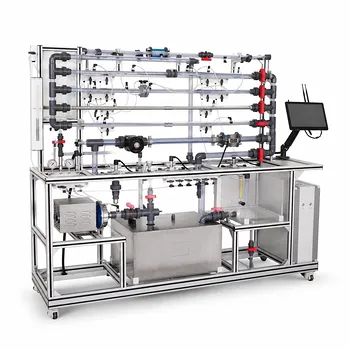
You can stop treating thermodynamics like an abstract puzzle. Chemical engineering students verify endothermic heat requirements by directly measuring the enthalpy of all inlet and outlet streams on a pilot plant and then applying the energy accumulation equation (Accumulated = In - Out). When the calculation reveals a negative accumulation—meaning energy is leaving the system faster than it enters—it physically proves the process is endothermic and quantifies the exact external heat load that must be supplied through a heat exchanger or heating jacket.
The core insight is this: A unit operations pilot plant transforms the theoretical energy balance from an algebraic exercise into a tangible engineering skill. By measuring real temperatures, flows, and compositions, you move from assuming perfect conditions to confronting actual heat losses, sensor drift, and side reactions—exactly the challenges you will face in industry.
Why the Textbook Equation Alone Isn’t Enough
The energy balance is deceptively simple on paper. Reality, however, is messier, and that messiness is precisely what you need to master.
The Flawless Equation, the Imperfect System
In a textbook, you assume adiabatic walls and 100% conversion. A pilot plant shatters those assumptions. Hot pipes radiate heat to the room, thermocouples have lag, and the reaction you drew on the whiteboard competes with others you didn’t anticipate. Verifying a heat requirement here means accounting for these discrepancies rather than ignoring them, forcing you to diagnose where the extra energy is going.
Why Your Endothermic Reaction Might Starve
If you simply trust a desktop calculation for an endothermic process like styrene production from ethylbenzene, you will under-size the furnace. The reaction pulls heat from its surroundings constantly to sustain itself. In a pilot plant, you can watch the reactor temperature plummet unless a calibrated flow of hot oil or steam actively replenishes that energy. This visible, physical “starvation” is what cements the principle: the reaction’s enthalpy change is not a number on a flashcard, but a real, quantifiable drain on the system.
The Pilot Plant as Your Measurement Toolkit
A well-instrumented pilot plant gives you everything you need to move from speculation to calculation. The key is knowing what to measure and how to set your boundaries.
Defining Your System Boundaries First
Your energy balance equation changes depending on your reactor type. For a closed batch reactor at constant volume, the heat transferred equals the change in internal energy (Q = ΔU). For an open, continuous-flow system at constant pressure, such as a tubular reactor or a distillation column, the heat transferred equals the change in enthalpy (Q = ΔH). Misidentifying this boundary will lead you to calculate the wrong energy quantity and defeat the entire verification.
The Critical Data Streams
Verification rests on three pillars of live data. You must capture the mass flow rate, temperature, and composition of every stream entering and leaving your defined system. In a jacketed reactor, you also need the coolant or heating fluid’s flow rate and its inlet/outlet temperature. With these, and using reference data for heat capacity (Cp), you can determine the enthalpy flow (ṁ * ∫Cp dT) of each stream and close the balance.
A Step-by-Step Verification of an Endothermic Heat Load
Let’s walk through how these measurements translate into a proven energy requirement for a reaction that absorbs heat.
Collecting Inlet and Outlet Enthalpy Data
Begin by bringing the pilot plant to a steady state. For a continuous dehydrogenation reactor, you would measure the mass flow rates and temperatures of the preheated ethylbenzene feed and the reactor effluent. Using the known Cp values, you calculate the sensible enthalpy of the feed (H_in) and the total enthalpy of the product mixture (H_out), which now contains styrene, hydrogen, and benzene byproducts.
Calculating the Energy Accumulation Gap
Apply the open-system energy accumulation equation. ΔE_accumulated = H_in - H_out - Q_removed. In an endothermic process where you are adding heat to maintain temperature, the term Q_added appears on the input side. If H_out is greater than H_in despite the stream being at a similar temperature, it indicates energy was absorbed by the chemical transformation. The negative accumulation gap (H_out > H_in) calculates the exact rate at which you must supply external heat to keep the process isothermal.
Interpreting Negative Accumulation: The Call for Heat
A negative accumulation is not an error; it is the signature of an endothermic reaction. In a jacketed batch reactor, you will see the reaction mixture’s temperature drop the moment you stop actively heating it. This real-time observation is the ultimate verification. You can cross-check the measured heat duty of your hot oil system against the theoretical enthalpy of reaction (from Hess’s Law) and, in doing so, see the principle validated within the error bars of your sensors.
The Inescapable Realities: Pitfalls to Account For
Your first data set will likely reveal a mismatch between the theoretical heat requirement and the measured one. This is not a failure; it’s the most advanced part of the verification.
The Unseen Heat Leak
Pilot-scale equipment has a high surface-area-to-volume ratio. Ambient heat loss to the surroundings is often the single largest source of error. You can verify this by running a non-reactive hot fluid through the system and measuring the temperature drop. Subtracting this baseline heat leak from your endothermic experiment is what forges a true process engineer’s understanding of insulation and energy efficiency.
When Reaction Stoichiometry Gets Messy
Textbook calculations assume a single reaction path. In an ethylbenzene dehydrogenation pilot plant, side reactions produce benzene and toluene. These side reactions have their own enthalpies, skewing the net heat balance. Verifying energy principles thus becomes a combined mass-and-energy balance exercise: you must use a gas chromatograph to identify all products, determine selectivity, and allocate the total heat effect among the competing pathways to truly close the balance.
How to Apply This to Your Laboratory Learning
The exact approach you take should match the specific skill you are aiming to build. Use the following goal-oriented strategies to guide your pilot plant experiment.
- If your primary focus is proving an endothermic heat requirement: Operate a continuous stirred tank reactor (CSTR) with an exothermic reaction first to see a temperature rise, then switch to an endothermic one. Measure the heating jacket’s duty required just to keep the reactor isothermal; the positive duty you supply is the direct verification.
- If your primary focus is mastering the energy balance equation itself: Start with a simple shell-and-tube heat exchanger, not a reactor. Measure the hot and cold stream temperatures and flows to verify
Q_lost = Q_gained. Once the balance closes here, add the complexity of a chemical reaction. - If your primary focus is confronting real-world industrial losses: Deliberately run an endothermic batch without changing the jacket setpoint. Plot the dropping temperature curve, then calculate the heat loss rate from the cooling ramp. This quantifies the environmental penalty you must budget for in a real plant design.
- If your primary focus is linking thermodynamics to kinetics: Use a pilot plant to run the same endothermic reaction at different steady-state temperatures. Measure the equilibrium product concentrations and use the van’t Hoff equation to calculate the reaction enthalpy (
ΔH°), then compare this kinetically derived value to your direct calorimetric measurement.
The power of a pilot plant is not that it gives you better equations, but that it teaches you what the equations left out. By verifying your energy balance on real hardware, you leave the classroom with the ability to commission, troubleshoot, and optimize a process, not just solve for Q.
Summary Table:
| Parameter | Measurement Method | Purpose in Energy Balance |
|---|---|---|
| Mass Flow Rate | Flow meters (inlet/outlet) | Determines mass flow rate for energy throughput calculations |
| Temperature | Thermocouples / RTD sensors | Calculates enthalpy changes (Cp * dT) of process streams |
| Composition | Gas Chromatography / Analysers | Accounts for reaction conversion and side reaction heat effects |
| Heat Loss | Baseline non-reactive hot run | Quantifies and corrects for ambient thermal radiation losses |
Bring Thermodynamics to Life in Your Lab
Bridge the gap between textbook equations and real-world industrial scale-up. LABPARK provides high-quality Educational and Vocational Unit Operations Pilot Plants in chemical engineering, bioprocess & biotech, and environmental & water treatment. Specially designed for universities, research institutes, and enterprises, our plants empower students and researchers to master energy balances, heat transfer, and process kinetics with hands-on precision.
Ready to elevate your laboratory training and research capabilities? Contact LABPARK today to find the perfect pilot plant solution for your institution!
Related Products
- General Purpose Cosmetics Production Unit Operations Training Pilot Plant
- Multi Pump Fluid Transport Process Piping Unit Operations Training Pilot Plant
- Multi-Functional Drying Educational Unit Operations Pilot Plant
- Fixed-Bed Chemical Reaction and Gas Dust Tar Removal Unit Operations Pilot Plant
- 100L Continuous Loop Hydrogenation Educational Unit Operations Pilot Plant
People Also Ask
- How do deviations in estimating latent heat impact pilot plant thermal systems? Avoid hardware mis-sizing.
- Why is the chemical plant startup schedule crucial? De-risk scale-up with pilot plants.
- When to transition from PID to adaptive control in pilot plants? Key process indicators.
- Why Compare Predicted and Experimental Excess Enthalpy? Key to Accurate Pilot Plant Scale-up
- How to study gasification in pilot plants? Compare exit gas composition & efficiency