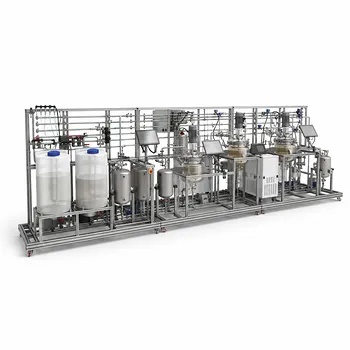
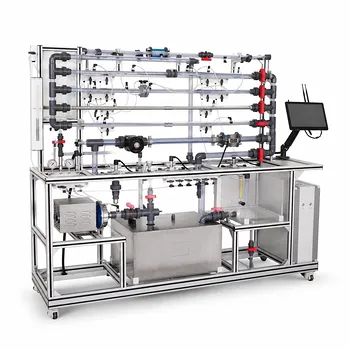
For any chemical engineering student operating a pilot plant, understanding how a real gas deviates from ideality is not an academic exercise—it’s a practical necessity.
When working with gas-phase streams at elevated pressures in unit operations pilot plants, you use equations of state (EOS) and the compressibility factor ($Z = PV/RT$) to correct ideal-gas assumptions. By collecting actual pressure, volume, and temperature (PVT) data from the plant and fitting them to EOS like the Virial or cubic equations, you obtain accurate $Z$ values that directly feed into equipment sizing, flow-rate corrections, and compressor work calculations—turning textbook thermodynamics into a reliable engineering tool.
In a pilot plant, the compressibility factor is the critical bridge between ideal-gas simplicity and real-gas complexity. Students who learn to measure $Z$ from experimental PVT data and select the appropriate equation of state can design safer, more efficient gas-phase processes while validating the predictive models they will carry into full-scale industry.
The Fundamental Role of the Compressibility Factor and Equations of State
Why Ideal Gas Assumptions Fall Short in Pilot Plants
Pilot-scale distillation columns, reactors, and absorption towers frequently handle gases at pressures where molecular interactions and finite molecular volume can no longer be ignored. Assuming $Z=1$ under these conditions leads to significant errors in mass balances, energy balances, and equipment specifications. The compressibility factor quantifies the deviation, and an equation of state gives it a mathematical form you can trust.
Turning Raw Data into Design Numbers
Your primary task as a student operator is to measure steady-state pressures, temperatures, and volumetric flow rates. With that PVT data, you calculate the experimental compressibility factor $Z = PV/RT$. Then, by selecting an appropriate EOS—such as the Virial equation ($Z = 1 + B/V + C/V^2 + \dots$) or a cubic form like Soave-Redlich-Kwong—you can extrapolate that information to conditions you haven’t directly tested, building a robust thermodynamic model of the entire gas-handling section of the plant.
Applying EOS and $Z$ to Core Pilot-Plant Calculations
Accurate Flow-Rate Corrections for Gas Streams
Rotameters, orifice plates, and mass-flow controllers often give readings that assume an ideal gas or a specific calibration condition. When the process gas is non-ideal, you must compute the true molar or mass flow using the measured $Z$ factor. This correction prevents cumulative mass-balance errors around reactors and separation units, which is essential for any kinetic or yield study.
Sizing Gas-Handling Equipment
The diameter of a pipe, the cross-sectional area of a packed bed, and the size of a knockout drum all depend on volumetric gas flow. Real-gas volumes at operating pressure and temperature shrink or expand relative to the ideal prediction by a factor of $Z$. Plugging the EOS-derived $Z$ into the design equations ensures that downstream equipment is neither flooded nor oversized, directly linking your bench-top thermodynamic analysis to the physical plant layout.
Determining Compressor Work and Utility Loads
Compression is a major energy consumer in pilot plants. The enthalpy change of the gas—and thus the work required—depends on departure functions that are calculated from the chosen EOS and the $Z$ profile across the compressor stages. By integrating $Z$ data (or derivative properties like residual enthalpy) from an EOS, you can predict shaft power, cooling-water duties, and outlet temperatures with far greater precision than any ideal-gas shortcut.
Extending the EOS: Vapor–Liquid Equilibrium and Safety
Even when the main concern is a gas-phase process, separators and reflux drums involve condensation. A single, self-consistent EOS—applied through the concept of fugacity—lets you predict whether the stream will remain single-phase vapor, start to condense, or form a problematic liquid slug. Performing these calculations with measured pilot-plant $PVT$ inputs allows you to set safety interlocks and operating windows that avoid unexpected phase separation.
Coupling EOS with Thermodynamic Databanks for Reactive Gas Processes
If your pilot plant hosts a gas-phase reactor, the EOS does more than describe the fluid volume. It becomes a partner to the thermodynamic databanks that store enthalpy, entropy, and heat-capacity data for each species. Once you calculate the equilibrium constant $K$ at the actual reaction temperature—using the real-gas heat capacities and standard-state data—you can predict conversion, heat release, and quenching requirements. The EOS ensures that the pressure and volume inputs into those equilibrium calculations reflect the true, non-ideal state of the reacting mixture.
Understanding the Trade-offs
Model Accuracy Versus Computational Complexity
The Virial equation truncated at the second coefficient is elegant and easy to fit from pilot plant $PVT$ data, but it is reliable only at moderate pressures. Cubic equations (like Peng-Robinson) are more robust at high pressures and handle phase equilibrium well, yet they demand iterative solution methods and careful parameter selection. Students must recognize that a “perfect” EOS does not exist; each choice represents a deliberate trade-off between simplicity and domain accuracy.
The Danger of Untuned Parameters
Semi-empirical EOS rely on pure-component constants and binary interaction parameters that are often estimated from generic databanks. Applying these uncalibrated models to a specific pilot-plant mixture can introduce significant bias. The most impactful action a student can take is to use the plant’s own steady-state stream data to regress and correct those parameters, closing the gap between theory and the real process fluid.
Non-ideal Behaviors That Common EOS Miss
Strongly polar gases, associating fluids, or mixtures with hydrogen bonding can exhibit compressibility trends that simple cubic EOS cannot capture. In such cases, specialized activity-coefficient models coupled with a vapor-phase EOS, or advanced forms like the Benedict-Webb-Rubin modification, are required. Recognizing when the standard toolbox falls short is a key learning objective in pilot-plant education, preventing a false sense of security from a model that appears to fit but is physically inappropriate.
How to Apply These Tools to Your Pilot Plant Operations
Start by defining your primary engineering goal, then choose the EOS and compressibility-factor strategy that serves it best.
- If your primary focus is designing and sizing gas-handling equipment: Prioritize measuring accurate $PVT$ points across the plant’s pressure range, fit a cubic EOS to obtain $Z$, and apply that $Z$ directly in volumetric flow-rate and pressure-drop calculations.
- If your primary focus is predicting compressor work and energy loads: Use departure functions derived from your chosen EOS, validated against at least a few measured compressor outlet temperatures, to calculate real-gas enthalpy changes and utility requirements.
- If your primary focus is validating a thermodynamic model for scale-up: Collect steady-state stream compositions and $PVT$ data from multiple operating points, then regress binary interaction parameters from the pilot-plant data itself, reducing the uncertainty that would otherwise propagate into the full-scale design.
- If your primary focus is safe operation and phase-stability analysis: Apply a consistent EOS to calculate component fugacities, confirm that the gas-phase stream remains single-phase under all expected disturbance conditions, and set alarms based on those real-gas equilibrium predictions.
By grounding every pilot-plant decision in measured compressibility factors and a consciously chosen equation of state, you transform abstract thermodynamics into a practical, repeatable skill that will define your competence as a process engineer.
Summary Table:
| Application | Key Input / Parameter | Engineering Benefit |
|---|---|---|
| Flow-Rate Correction | Measured PVT & Z | Prevents cumulative mass-balance errors |
| Equipment Sizing | EOS-derived Z factor | Sizes pipes, packed beds, & drums accurately |
| Compressor Work | Departure functions & Z | Predicts utility loads & outlet temperatures |
| VLE & Safety | Component fugacities | Avoids liquid slugging & sets operating windows |
Bring Thermodynamics to Life in Your Lab
Looking to bridge the gap between textbook theory and practical process engineering? LABPARK provides state-of-the-art Educational and Vocational Unit Operations Pilot Plants in chemical engineering, bioprocess & biotech, and environmental & water treatment. Specially designed for universities, research institutes, and enterprises, our pilot plants enable students and researchers to gain hands-on mastery of real-gas behaviors, equations of state, and advanced process control.
Ready to elevate your training or research capabilities? Contact LABPARK today to find the perfect pilot plant solution for your facility!
Related Products
- General Purpose Cosmetics Production Unit Operations Training Pilot Plant
- Multi Pump Fluid Transport Process Piping Unit Operations Training Pilot Plant
- Multi-Functional Drying Educational Unit Operations Pilot Plant
- Fixed-Bed Chemical Reaction and Gas Dust Tar Removal Unit Operations Pilot Plant
- 100L Continuous Loop Hydrogenation Educational Unit Operations Pilot Plant
People Also Ask
- How do deviations in estimating latent heat impact pilot plant thermal systems? Avoid hardware mis-sizing.
- Why is the chemical plant startup schedule crucial? De-risk scale-up with pilot plants.
- When to transition from PID to adaptive control in pilot plants? Key process indicators.
- Why Compare Predicted and Experimental Excess Enthalpy? Key to Accurate Pilot Plant Scale-up
- How to study gasification in pilot plants? Compare exit gas composition & efficiency