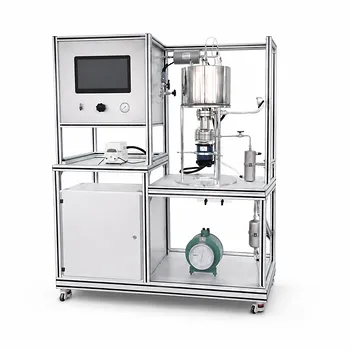
The most direct path to understanding selectivity in parallel reactions is through a temperature profiling experiment on a pilot-scale reactor. Chemical engineering students can investigate this effect by using reactor pilot plants equipped with programmable temperature control and real-time sensors. By strategically varying the temperature over time—starting low to favor the desired product when its activation energy is lower than the side reaction’s—and then gradually raising it to boost conversion, students can directly observe the trade-off between selectivity and reaction rate. This hands-on approach bridges the gap between Arrhenius kinetics and industrial practice.
When the desired reaction has a lower activation energy, low temperatures favor selectivity but slow the rate. A time-varying temperature profile—starting low, then increasing—lets students experimentally balance selectivity and yield in a pilot plant, directly linking theory to scalable operation.
The Kinetic Roots of Temperature-Dependent Selectivity
In a parallel reaction system, a reactant can transform into a desired product or an undesired byproduct. The pathway taken depends on temperature because each reaction has its own activation energy.
Why Activation Energy Dictates Selectivity
The reaction rate constant (k) follows the Arrhenius equation. A reaction with a lower activation energy ((E_A)) has a weaker temperature dependence—its rate increases less dramatically with heat. A reaction with a higher activation energy is more sensitive to temperature changes.
When the desired reaction has (E_{A1}) lower than the side reaction’s (E_{A2}), low temperatures naturally suppress the high-(E_A) side reaction more. This gives you higher selectivity, but the overall rate is slow. Conversely, if the desired reaction has the higher activation energy, high temperatures make it dominant.
The Two Core Scenarios
- (E_{desired} < E_{side}): Cold start favors the desired product, but conversion is sluggish. The winning strategy is a temperature ramp—begin low, then raise the heat.
- (E_{desired} > E_{side}): High temperature favors the desired product, but safety or degradation limits may apply. Here, you might operate at the highest permissible temperature from the start.
Your pilot plant investigation can explore either scenario, but the most instructive and common student experiment focuses on the first case where a temperature profile is essential.
From Theory to Practice: The Pilot Plant as a Kinetic Sandbox
A unit-operations pilot plant is not just a scaled-down industrial reactor. It’s a kinetic sandbox that lets you impose precise thermal histories and measure their consequences.
Essential Instrumentation
Modern pilot plants come with PID-controlled heating/cooling jackets, high-precision thermocouples, and programmable logic controllers (PLCs). You can define a temperature setpoint trajectory—a linear ramp, a step change, or a custom curve—and the system will follow it automatically. Multi-point temperature sensors map axial and radial profiles, ensuring you catch any hot spots that could distort selectivity.
Implementing a Temperature Profile
For a batch or plug-flow reactor, the classic experiment works like this:
- Start the reaction at a low temperature (point of high selectivity).
- Monitor concentration in real time using online analyzers or periodic sampling.
- As the reactant concentration drops and the selectivity benefit from low temperature diminishes, ramp the temperature upward at a controlled rate.
The pilot plant’s automation executes this while you record kinetic data. This lets you compare a constant-temperature baseline against the profiled run and quantify the improvement in overall yield.
Designing a Student Investigation
A successful experiment depends on choosing the right system, collecting meaningful data, and linking results back to kinetic theory.
Choosing Your Reaction System
Select a liquid-phase or gas-phase parallel reaction with known activation energies. Classic examples include the nitration of aromatics, certain esterifications, or oxidation reactions where the desired partial oxidation product competes with full combustion. If the kinetics are well-documented, you can pre-calculate the expected optimal temperature profile and then verify it experimentally.
Data Collection and Real-Time Analysis
Use the pilot plant’s sensor array to record temperature, pressure, and flow rates. Couple this with concentration measurements—GC, HPLC, or spectroscopy—to calculate instantaneous selectivity and conversion. Plot these against time and temperature to see whether the selectivity holds up as the heat rises.
Validating Arrhenius Models
Determine the rate constants for each reaction by running separate calibration experiments at constant temperatures. Then, using the Arrhenius parameters, simulate the expected concentration profiles for your temperature ramp. Overlaying the model predictions with pilot plant data confirms or refines your kinetic assumptions. Any deviation points to mass transfer limitations or catalyst effects that theory alone wouldn’t catch.
Understanding the Trade-offs
Temperature profiling is powerful, but it isn’t free. A transparent investigation acknowledges the limitations you’ll encounter.
- Selectivity vs. Conversion: Raising the temperature later in the run inevitably accelerates the side reaction. You gain conversion at the cost of some selectivity. The art is finding the ramp rate and final temperature that maximize overall yield of the desired product.
- Thermal Mass and Response Lag: Even with advanced PID control, the reactor’s jacket and metal mass create a time lag. A profile that looks perfect on paper may overshoot or undershoot in practice, distorting selectivity. You must characterize the thermal dynamics of your pilot plant before drawing conclusions.
- Equipment Limits: Heating and cooling capacities, sensor placement, and mixing efficiency all impose bounds. A poorly mixed reactor can develop local hot spots that ruin selectivity even if the average temperature seems acceptable.
- Safety and Scalability: A profile that works in a small pilot plant may not translate directly to a production-scale reactor, where heat removal is more challenging. Students learn that temperature profiles are a scale-up variable, not just a laboratory curiosity.
Making the Right Choice for Your Investigation
How you structure your experiment depends on what you want to learn most.
- If your primary focus is demonstrating the selectivity-rate trade-off: Run a constant low-temperature experiment, a constant high-temperature experiment, and one temperature-profiled run. Compare the yield of the three.
- If your primary focus is generating data to validate an Arrhenius model: First measure rate constants at several steady temperatures, then test the model’s predictive power by executing a novel temperature ramp it hasn’t “seen.”
- If your primary focus is learning industrial temperature control strategies: Use the pilot plant’s cascade loops to simulate a temperature-to-flow control scenario—adjusting coolant or steam flow to follow a setpoint trajectory—and quantify how control performance affects selectivity.
- If your primary focus is exploring the opposite activation energy case (E_desired > E_side): Investigate the impact of operating at the highest safe temperature from the start, and see if a cooldown period at high conversion offers any selectivity benefits.
Ultimately, a reactor pilot plant transforms the abstract mathematics of parallel reactions into a clear, visual cause-and-effect lesson—cementing the principle that temperature is the reaction engineer’s most versatile selectivity lever.
Summary Table:
| Scenario | Activation Energy Relationship | Recommended Temperature Strategy | Impact on Selectivity & Rate |
|---|---|---|---|
| Favor Desired (Low $E_A$) | $E_{desired} < E_{side}$ | Temperature Ramp: Start low, then gradually increase | Maximizes initial selectivity; ramp boosts final conversion |
| Favor Desired (High $E_A$) | $E_{desired} > E_{side}$ | Constant High: Operate at highest safe temperature | Favors desired product throughout; watch safety limits |
Bring advanced chemical kinetics to life in your laboratory. LABPARK provides state-of-the-art Educational and Vocational Unit Operations Pilot Plants in chemical engineering, bioprocess & biotech, and environmental & water treatment. Tailored for universities, research institutes, and enterprises, our pilot plants feature industry-grade automation and real-time monitoring to bridge the gap between classroom theory and industrial practice.
Ready to elevate your engineering curriculum? Contact us today to find the perfect pilot plant solution for your institution!
Related Products
- Fixed-Bed Chemical Reaction and Gas Dust Tar Removal Unit Operations Pilot Plant
- Multi-Reactor Educational Pilot Plant for Reaction Engineering Unit Operations
- 100L Continuous Loop Hydrogenation Educational Unit Operations Pilot Plant
- Fixed Bed Gas Solid Catalytic Reaction Educational Pilot Plant
- Internal Circulation Gradient Free Catalytic Reaction Educational Pilot Plant
People Also Ask
- When to transition from PID to adaptive control in pilot plants? Key process indicators.
- How do deviations in estimating latent heat impact pilot plant thermal systems? Avoid hardware mis-sizing.
- Why Compare Predicted and Experimental Excess Enthalpy? Key to Accurate Pilot Plant Scale-up
- How to study gasification in pilot plants? Compare exit gas composition & efficiency
- Why Use PTFE & Hastelloy in Chemical Pilot Plants? Prevent Corrosion & Ensure Safety