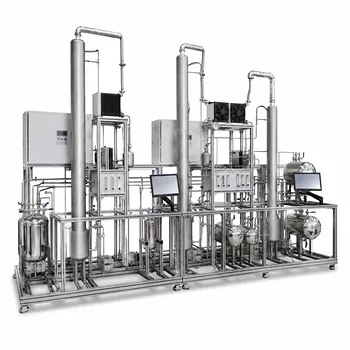
“Equilibrium is the bottleneck—continuous water removal is the breakthrough.”
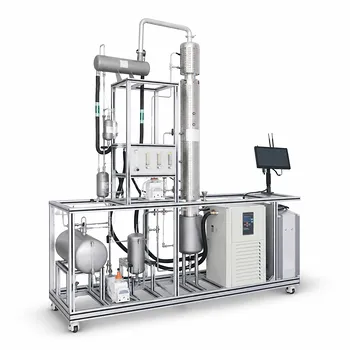
In a chemical engineering pilot plant, you can shatter the conversion ceiling of a reversible esterification by coupling the reactor to an integrated azeotropic distillation and decantation system. An added organic entrainer forms a low-boiling ternary azeotrope with water and alcohol; the vapor is condensed, the two liquid phases are separated in a decanter, the water-rich phase is continuously withdrawn, and the organic phase is refluxed. This relentless extraction of water drives the reaction to near-total conversion.
Reversible esterifications stall at an equilibrium-imposed limit of roughly 60–70% conversion. To push beyond, water must be removed as it forms. The most robust pilot-plant configuration marries a heated reactor, a distillation column, an overhead condenser, and a phase separator. Using an entrainer like cyclohexane creates a low-boiling water–entrainer–alcohol azeotrope; after condensation and phase splitting, the organic layer returns to the column while water is drawn off, shifting the equilibrium sharply toward the ester product.
Why Equilibrium Walls Off Conversion
The Thermodynamic Ceiling
A reversible esterification (RCOOH + R′OH ⇌ RCOOR′ + H₂O) reaches a state where the forward and reverse rates are equal.
Without intervention, the equilibrium constant dictates a maximum conversion—often well below 90%—regardless of how long you wait.
Standard batch reactors simply hit this thermodynamic wall.
Le Chatelier’s Lever
Le Chatelier’s principle shows that removing a product pushes the equilibrium to the right.
Water is the easiest product to selectively eliminate because it boils lower than most esters and acids.
Continuous water removal transforms a yield-limited reaction into a kinetically driven, nearly complete conversion.
The Core Pilot Plant Configuration: Azeotropic Distillation with Decantation
The Entrainer’s Role
Adding an organic solvent such as benzene, toluene, or cyclohexane forms a ternary azeotrope with water and alcohol.
This azeotrope boils at a temperature lower than any of the pure components, allowing water to be stripped out of the reactor at mild conditions.
The vapor phase is rich in water but also carries entrainer and a small amount of alcohol.
Key Hardware Components
A pilot plant built for water-removal esterification needs four tightly integrated units.
- Reactor: A glass‑lined or stainless steel stirred vessel where the acid, alcohol, and catalyst are charged.
- Distillation Column: A packed or tray column mounted above the reactor to fractionate the vapor.
- Overhead Condenser: Cools the azeotropic vapor to a liquid that separates into two immiscible phases.
- Decanter (Phase Separator): Allows the organic layer to overflow back to the column as reflux, while the water layer is continuously drained.
The Operating Cycle Step by Step
Reaction mixture is heated, and the low‑boiling azeotrope vapor travels up the column.
After condensation, the liquid enters the decanter, where the entrainer‑rich upper phase returns to the column for renewed water pickup.
The lower, water‑rich phase is discharged, permanently removing water from the system and relentlessly pulling the equilibrium forward.
Wiring the Plant for Maximum Conversion
Temperature and Pressure Profiling
Column temperature must be tuned so the azeotrope composition remains stable and water departure is maximized.
Slight vacuum operation can lower boiling points, protect heat‑sensitive reagents, and improve water fraction in the overhead vapor.
Decanter Dynamics and Reflux Ratio
Efficient phase separation inside the decanter is critical; any entrainer lost in the water draw reduces the driving force for water removal.
The reflux ratio of the organic phase controls the column’s ability to concentrate water at the top—too low and water slips back into the reactor, too high and energy costs soar.
Residence Time and Mixing Strategy
For fast esterifications, prolonged contact between product and water can allow the reverse hydrolysis to creep back.
A pilot plant can adopt a continuous flow setup—a static mixer followed by a centrifugal liquid‑liquid separator—to keep residence times under three minutes.
This rapid, inline water removal slashes the 10–20% yield loss often seen during batch scale‑up due to back‑reaction.
Understanding the Trade‑offs
Entrainer Selection and Environmental Footprint
Cyclohexane is safer than benzene but still requires a dedicated closed‑loop recovery system.
Pilot plants must integrate extraction and distillation steps to recycle the entrainer and treat wastewater containing any dissolved acid‑salts or organics.
Energy Cost of Distillation
Azeotropic distillation demands high heat input to vaporize the azeotrope continuously, especially if reflux ratios are generous.
The reboiler duty is the dominant operating expense, so optimizing column internals and insulation is vital even at pilot scale.
Side Reactions and Product Purity
Acid‑catalyzed dehydration of alcohols can form unwanted ethers under the thermal load of the column.
Careful temperature control and choice of catalyst help maintain high ester selectivity while water is being stripped.
Complexity vs. Reliability
A decanter‑column‑reactor loop introduces more control loops, sensors, and potential for fouling or emulsion.
Pilot‑plant operators must balance the gain in conversion against the added mechanical complexity and maintenance.
A Glimpse into Reactive Distillation
When the Product Itself Co‑Distills
For esterifications where the ester, water, and alcohol form a low‑boiling azeotrope, reactive distillation merges reaction and separation in a single column.
Volatile products are continuously stripped from the reaction zone; no external entrainer is needed.
This is especially effective for systems like acetic acid + ethanol, where the ethyl acetate–water–ethanol azeotrope is removed overhead.
Integration Benefits and Limits
Reactive distillation recuperates reaction heat for distillation, improving energy efficiency.
However, the column design must accommodate simultaneous reaction and fractionation, demanding precise stage holdups, catalyst placement, and real‑time temperature profiling that stretch pilot‑plant complexity.
Making the Right Choice for Your Pilot Plant Goal
Your configuration must match the specific conversion target, feedstocks, and operational constraints.
- If your primary focus is maximizing conversion with a proven, hardware‑friendly setup: Install a stirred reactor connected to a packed column, overhead condenser, and decanter using cyclohexane as entrainer. This classic azeotropic configuration achieves near‑complete conversion with straightforward operation.
- If your primary focus is process intensification and eliminating auxiliary solvents: Build a reactive distillation column that continuously removes the ester‑water‑alcohol azeotrope. It integrates reaction heat and separation, reducing the number of unit operations.
- If your primary focus is studying fast esterification kinetics and preventing back‑reaction during scale‑up: Shift from batch to a continuous flow reactor with a static mixer and centrifugal separator. Minimizing water contact time below a few minutes can dramatically improve yield and purity.
Choose the water‑removal architecture that aligns with your conversion targets, energy budget, and safety profile, and you will transform a reversible bottleneck into a high‑yield demonstration that mirrors industrial best practice.
Summary Table:
| Configuration Type | Key Hardware Components | Best Used For | Main Advantage |
|---|---|---|---|
| Azeotropic Distillation | Reactor, packed column, condenser, decanter, entrainer | Standard high-yield batch operations | Proven setup, near-complete conversion |
| Reactive Distillation | Single column integrating reaction & separation | Systems where products co-distill | High energy efficiency, no auxiliary solvents |
| Continuous Flow | Static mixer, centrifugal liquid-liquid separator | Fast kinetics, minimizing back-reaction | Residence times < 3 min, prevents yield loss |
Optimize Your Process Scale-Up with LABPARK
Transitioning chemical processes from lab to production requires reliable, high-performance equipment. LABPARK provides premium Educational and Vocational Unit Operations Pilot Plants in chemical engineering, bioprocess & biotech, and environmental & water treatment. Tailored for universities, research institutes, and enterprises, our systems ensure precise process control, reliable scale-up data, and long-term durability.
Ready to design or upgrade your pilot plant? Contact LABPARK today to get a custom solution tailored to your research and training needs!
Related Products
- Ethyl Acetate Synthesis Unit Operations Pilot Plant for Practical Training
- Continuous Batch Extractive Distillation Educational Pilot Plant
- Multi-Functional Special Distillation Educational Pilot Plant
- Continuous Sieve-Plate Distillation Pilot Plant for Unit Operations Laboratory Education
- Green Anhydrous Ethanol Refining Practical Training Pilot Plant
People Also Ask
- How do pilot plants demonstrate esterification? Visualizing Chemical Engineering Equilibrium
- When to transition from PID to adaptive control in pilot plants? Key process indicators.
- Why is the chemical plant startup schedule crucial? De-risk scale-up with pilot plants.
- Why Use PTFE & Hastelloy in Chemical Pilot Plants? Prevent Corrosion & Ensure Safety
- How do deviations in estimating latent heat impact pilot plant thermal systems? Avoid hardware mis-sizing.