Distillation is both an art and a science. In chemical engineering education, the most effective curricula don’t just teach shortcut formulas or rigorous simulations in isolation — they integrate them into a single, tangible learning loop. Students first apply shortcut methods (like Fenske‑Underwood‑Gilliland) to set baseline design targets, then use rigorous iteration methods (such as Naphtali‑Sandholm) to resolve stage‑by‑stage behavior, and finally operate a pilot plant to collect real‑time data and close the gap between calculation and physical reality.
The core insight: Shortcut methods provide the scaffolding to quickly define theoretical boundaries, rigorous methods illuminate the complex physics that shortcuts ignore, and the pilot plant transforms both into measurable, observable truths. Together they create an unshakeable understanding of distillation that neither theory nor simulation alone can deliver.
Why Distillation Curricula Must Bridge the Gap
Distillation remains the workhorse of separation processes, yet textbook theory often feels disconnected from a column’s actual behavior. Students can easily solve algebraic equations for a minimum reflux ratio, but without experiencing how non‑idealities, tray hydraulics, and control loops affect that number, their knowledge remains fragile.
A well‑designed lab curriculum uses the pilot plant as the physical integrator between shortcut design and rigorous simulation. This creates a three‑step pedagogical chain that moves from simplified prediction → detailed modeling → empirical validation. Each step reinforces the others and deepens the student’s ability to reason about separations.
Step 1: Establish Theoretical Baselines with Shortcut Methods
Shortcut techniques give students a rapid, intuitive grasp of the separation’s fundamental constraints. They require minimal computational effort and immediately link key design variables.
The Fenske‑Underwood‑Gilliland (FUG) Method
The classic FUG suite answers the three essential design questions in minutes. The Fenske equation calculates the minimum number of theoretical stages under total reflux. The Underwood equations determine the minimum reflux ratio for a given separation. The Gilliland correlation then relates the actual reflux ratio to the actual number of stages, bridging the two extremes.
In a laboratory session, students apply FUG before they ever touch the pilot plant. This forces them to identify light key (LK) and heavy key (HK) components, fix product purities, and appreciate how relative volatility drives column size and energy demand.
Defining Light and Heavy Keys
For multicomponent feeds, the FUG method demands a clear choice of LK and HK. This decision‑making exercise is itself a powerful learning moment. Students see that a “minor” component can dictate column height if its volatility lies between the two keys, and they learn to distribute non‑key components using the same shortcut framework.
Limitations of Shortcut Assumptions
Shortcut methods assume constant relative volatility and ideal vapor‑liquid equilibrium. They ignore heat effects per stage, pressure drop, and composition‑dependent K‑values. Recognizing these limits is the trigger that naturally propels students toward the next step: rigorous iteration.
Step 2: Dive into the Details with Rigorous Iteration Methods
Once the baseline is set, rigorous methods reveal what shortcuts hide. This is where students encounter the true physical complexity of a distillation column — and where they begin to appreciate the power of modern process simulators.
Solving the Full MESH Equations
A single equilibrium stage is defined by four sets of equations: Material balances, Equilibrium relationships, Summation constraints, and Heat balances. For a column with dozens of stages, this becomes a large, tightly coupled system that cannot be solved by hand. Rigorous methods attack the MESH system directly, solving for compositions, temperatures, and flows on every tray simultaneously.
The Naphtali‑Sandholm Global Iteration Approach
The Naphtali‑Sandholm method linearizes the MESH equations for all stages at once and iterates on the full set of variables. This global approach is faster and more robust than sequential stage‑by‑stage methods, especially for high‑purity separations. In the curriculum, students can implement a simplified version or use a commercial simulator to see how Newton‑Raphson convergence behaves when they tighten product specs.
Handling Non‑Idealities and Convergence
The true educational value of rigorous methods emerges with non‑ideal liquid mixtures. Here, activity coefficient models (like Wilson or NRTL) replace simple K‑values, and azeotropes may appear. Students learn that convergence is not guaranteed — they must supply good initial guesses, often derived from the same shortcut methods they just mastered. This feedback loop between shortcut and rigorous is exactly the mental model practicing engineers use daily.
Step 3: Close the Loop on a Pilot Plant
Neither shortcut nor rigorous calculations produce a physical column. The pilot plant turns numbers into sound, sight, and smell, cementing the theories through direct experience.
From Simulation to Physical Reality
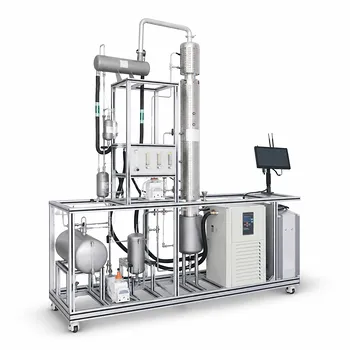
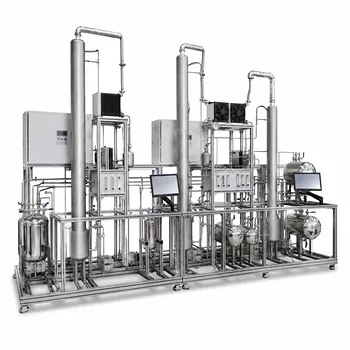
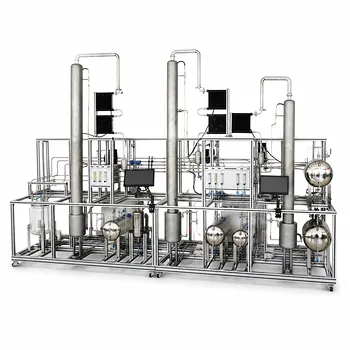
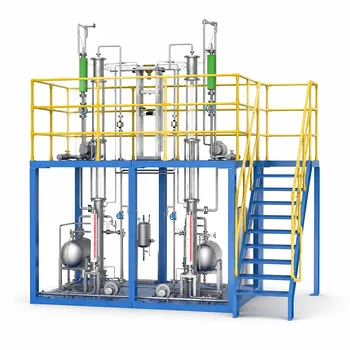
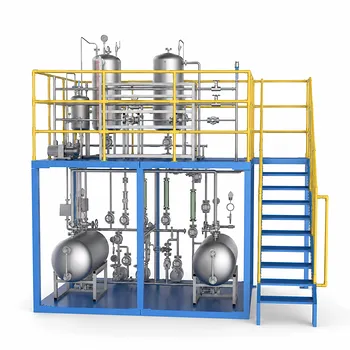
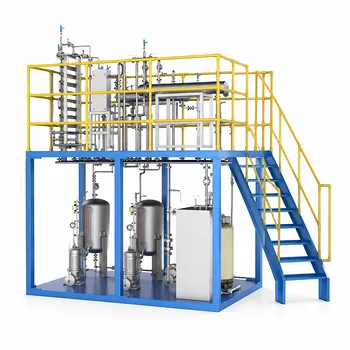
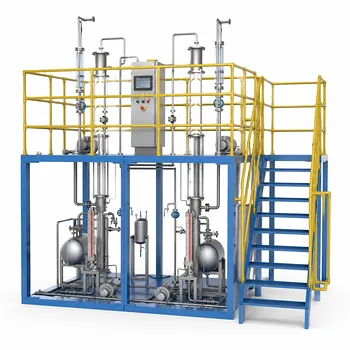
Educational pilot plants are typically modular and generously instrumented. Students can alter the feed thermal condition, change the reflux ratio, or move the feed point to a different tray. Every adjustment ripples through the column’s temperature profile, top and bottom compositions, and pressure drop — all of which appear in real time on a control panel or historian.
Data Collection and Comparison
Armed with their shortcut‑predicted minimum stages and their rigorous simulator outputs, students now record actual plant data. They sample products, measure flow rates, and log tray temperatures. The immediate task is to compare the theoretical stage count from simulation with the actual physical trays and compute the overall column efficiency. That efficiency number anchors months of theory in a single, unforgettable measurement.
Understanding Tray Efficiency and Real‑World Behavior
The pilot plant reveals phenomena that calculations cannot fully capture — foaming, weeping, entrainment, and downcomer backup. Students observe that the real column needs more stages than the FUG prediction, not because thermodynamics are wrong, but because hydraulic limits prevent ideal contact. This is the moment where they internalize the difference between “theoretical stages” and “actual trays.”
Understanding the Trade‑offs and Common Pitfalls
A curriculum that only celebrates success does a disservice. Honest learning requires confronting the inherent trade‑offs of each method.
- Shortcut speed vs. accuracy: Shortcut methods are fast and intuitive, but they can mislead for highly non‑ideal or azeotropic systems. Students must know when to stop trusting the constant‑volatility assumption.
- Rigorous complexity vs. physical insight: A converged Naphtali‑Sandholm solution can feel like a black box. Without an understanding of the underlying MESH structure, students may blindly accept unrealistic results caused by poor initialization or incorrect thermodynamic models.
- Simulation vs. plant reality: Even the most rigorous simulator cannot predict tray weeping or control valve hysteresis. The pilot plant teaches that operability constraints often override purely thermodynamic optima.
Common pitfalls include designating incorrect key components, ignoring pressure drop in vacuum columns, and applying the Gilliland correlation well outside its original data range. By walking students through these mistakes on a functioning column, educators turn errors into lasting lessons.
How to Apply This to Your Curriculum Goals
The optimal blend of shortcut, rigorous, and pilot‑plant activities depends on the learning outcomes you prioritize. Use the following guide to tailor your lab experience.
- If your primary focus is teaching conceptual design: Lead with extensive FUG calculations. Let students explore the design space by varying reflux ratio and feed condition on paper before they ever see the column. Use the pilot plant only to verify the final design — this reinforces the shortcut-to-physical link.
- If your primary focus is computational process simulation: Have students first hand‑code a simple stage‑by‑stage model, then compare it with a commercial simulator using the same thermodynamic package. The pilot plant data then becomes the arbiter of model fidelity, sparking deep discussions about property method selection.
- If your primary focus is hands‑on unit operations: Start at the plant. Have students operate the column, identify a stable operating point, and then work backward to see how well the FUG method would have predicted that point. This reverse‑engineering approach grounds theory in immediate sensory experience.
- If your primary focus is industrial scale‑up awareness: Use the pilot plant to demonstrate vacuum distillation, azeotropic separation, or batch‑to‑continuous switching. Connect each experiment back to the shortcut and rigorous predictions, emphasizing how fluid dynamics and heat transfer become dominant at larger scales.
The most effective curricula weave all three threads together. When students leave the lab having used a shortcut to set a target, a rigorous simulation to refine it, and a physical column to prove it, they carry a mental framework that will serve them from the benchtop to the control room.
Summary Table:
| Method / Step | Core Focus | Key Equations & Tools | Educational Value |
|---|---|---|---|
| Shortcut Methods | Baseline design boundaries | FUG (Fenske-Underwood-Gilliland) | Fast, intuitive grasp of constraints |
| Rigorous Iteration | Detailed stage-by-stage behavior | MESH equations, Naphtali-Sandholm | Understands non-idealities & convergence |
| Pilot Plant Operation | Physical validation & reality | Real-time data, tray efficiency | Bridges theory with operability limits |
Elevate Your Chemical Engineering Curriculum with LABPARK
Bridge the gap between theoretical calculations and physical reality in your laboratory. LABPARK provides state-of-the-art Educational and Vocational Unit Operations Pilot Plants in chemical engineering, bioprocess & biotech, and environmental & water treatment.
Tailored for universities, research institutes, and enterprises, our highly instrumented pilot plants empower students and researchers to validate shortcut designs and rigorous simulations with real-world empirical data.
Ready to upgrade your laboratory training equipment and boost learning outcomes? Contact us today to discuss your curriculum goals!
Related Products
- Continuous Sieve-Plate Distillation Pilot Plant for Unit Operations Laboratory Education
- Multi-Modal Distillation Unit Operations Training Pilot Plant
- Green Anhydrous Ethanol Purification Extractive Distillation Unit Operations Training Pilot Plant
- Dual-Mode Rectification Pilot Plant for Practical Training Unit Operations
- Ethyl Acetate Synthesis Unit Operations Pilot Plant for Practical Training
People Also Ask
- Why is vacuum operation capability an essential feature for a distillation unit operations pilot plant? Unlock Efficiency
- How does catalyst water concentration affect distillation pilot plant design? Key separation train choices.
- What are the primary reflux ratio control strategies? Master Distillation Unit Operations
- How can real-time carbon number prediction improve distillation pilot plants? Optimize control.
- How to select the right activity coefficient model (Wilson, NRTL, UNIQUAC) for distillation pilot plants?