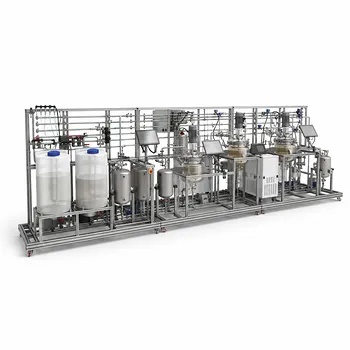
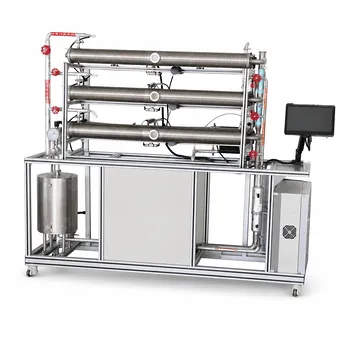
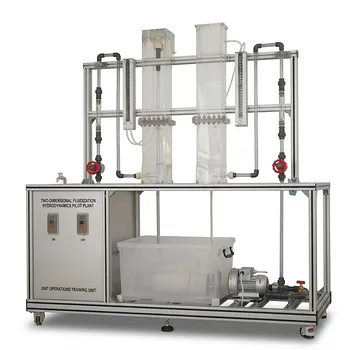
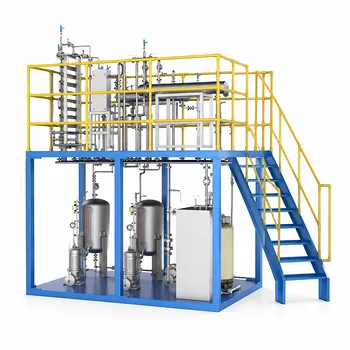
Validating process models for nonideal mixtures is not a one-click software task—it’s a meticulous, physical confrontation with reality.
Chemical engineering laboratories and research facilities achieve this by operating unit operations pilot plants under controlled conditions to generate experimental phase equilibrium and process data. This data is then directly compared against thermodynamic model calculations (such as NRTL, UNIQUAC, or UNIFAC) to identify discrepancies and optimize binary interaction parameters. The goal is to replace estimated model parameters with measured truth, bridging the gap between simulation and actual plant behavior.
Before a single industrial gallon is processed, the reliability of a thermodynamic model for a nonideal mixture rests on empirical validation at the pilot scale. Simulation predictions are cost-effective starting points, but they are only as good as the data used to calibrate them. Unit operations pilot plants provide that essential data, transforming theoretical correlations into trustworthy tools for scale-up.
The Core Challenge: Why Nonideal Models Fail
Simulators offer a library of thermodynamic models, but for nonideal mixtures—where molecular interactions deviate significantly from ideality—these models can exhibit erratic behavior even within their published applicable ranges. Relying on default or estimated binary interaction parameters introduces process uncertainty.
The Pitfall of Estimated Parameters
Built-in model parameters are often regressed from limited or generalized datasets. For unique chemical mixtures, these estimates can predict separation efficiencies and stream compositions that do not reflect reality. This is why verification is non-negotiable.
The Cost of Blind Trust
Failing to validate a model can lead to columns that cannot meet purity specs, reactors with runaway exotherms, or equipment sizing that floods during agitation. The paper-based design looks perfect, but the physical world punishes assumptions.
The Validation Workflow in a Research Setting
A successful validation strategy in a laboratory or research facility follows a disciplined cycle. It turns the pilot plant into an analytical instrument that interrogates the model, not just a miniature factory.
Step 1: Run a Controlled Physical Experiment
Researchers operate a unit operations pilot plant—typically a distillation, absorption, or extraction column—under steady-state conditions with the target nonideal mixture. The operating conditions (temperature, pressure, flow rates) are held constant to ensure data integrity.
Step 2: Generate Empirical Phase Equilibria Data
Key stream samples are taken and analyzed. The results deliver real-world vapor-liquid or liquid-liquid equilibrium compositions, mass balances, and energy balances. This is the “ground truth” that no software can argue with.
Step 3: Cross-Check Against Simulation and Reference Databases
The experimental results are compared side-by-side with the outputs of the process model. If discrepancies appear, the researcher first consults verified physical property databases (like DIPPR or DECHEMA) to rule out simple data entry errors in pure-component properties.
Step 4: Regress and Optimize Model Parameters
When the deviation is confirmed to be a model deficiency, the empirical pilot-plant data is fed back into the system. The binary interaction parameters for the NRTL or UNIQUAC model are regressed to minimize the error between predicted and actual phase behavior. This directly bridges the gap between theoretical simulation and observed performance.
The Role of Unit Operations Pilot Plants: The Empirical Bridge
A unit operations pilot plant is the central tool in this verification process. It is not merely a scaled-down version of a factory; its purpose is pure data generation under safe, visible, and controllable conditions.
A Platform for Controlled Process Upsets
Pilot plants allow researchers to safely introduce deliberate process upsets and test multivariate designs. This experimental freedom is crucial for assessing process limitations and identifying failure modes that a static model cannot predict.
Validation Beyond Phase Equilibria
While phase equilibrium validation is critical for separation units, pilot plants validate other model assumptions simultaneously. They provide empirical data on heat transfer coefficients, reaction kinetics, residence time distribution (RTD), and non-ideal flow patterns. For example, a reactor pilot plant tracer experiment can calculate the Peclet number, quantifying how much backmixing—a factor often oversimplified in a simulator—deviates from an ideal plug-flow assumption.
Proving Equipment Sizing Calculations
Simulator-generated material balances dictate vessel volumes and pipe diameters. Pilot plant runs reveal if those calculations hold up under real operational events like precipitation and agitation, verifying that vessels are large enough to prevent overfilling while maintaining minimum operating volumes.
Understanding the Trade-offs: When is a Pilot Plant Non-Negotiable?
The decision to run a pilot plant validation campaign involves weighing predictability against the cost of a mistake. Not every process demands the same level of physical testing.
Processes That Almost Always Require Pilot Plants
According to established chemical engineering rules of thumb, some operations hide scale-up complexity that models routinely fail to capture. These include reactors, extraction units, and dryers/solids handling systems. For these, skipping pilot-plant validation is a high-risk gamble.
Processes That May Not Require Pilot Plants
Standard distillation of well-characterized mixtures and single-phase fluid flow are often predictable enough to design with validated models alone. A pilot plant becomes essential here only when specific complications exist, such as foaming in the distillation column or complex two-phase flow dynamics. The key is to know when the underlying physics outruns the model's inherent assumptions.
Making the Right Choice for Your Validation Goal
Your specific research objective will determine how you integrate pilot-plant validation into your workflow. Use this decision logic to guide your next steps.
- If your primary focus is generating high-accuracy thermodynamic parameters for a novel, nonideal mixture: Operate a distillation or extraction pilot plant under steady-state, sample rigorously, and use the resulting phase equilibrium data to regress binary interaction parameters, superseding simulator defaults.
- If your primary focus is validating a full process model before a risky scale-up: Run the pilot plant across its intended operating envelope, including deliberate upsets. Compare reaction yields, separation purities, and dynamic responses against your simulation to identify model breakdowns.
- If your primary focus is building an educational curriculum: Use pilot plants with RTD capabilities. Have students measure dimensionless variance to calculate tanks-in-series model parameters, then compare predicted conversion to experimental data, making the concept of non-ideal flow tangible.
- If your primary focus is a standard distillation with no foaming or known complications: Lean on robust simulation predictions cross-checked with DECHEMA or DIPPR data, but remain prepared to pilot if initial lab-bench tests show unexpected azeotropes or phase splitting.
A validated model is a hard-won asset, forged from the deliberate comparison of prediction against the physical reality that can only be found in a well-instrumented unit operations pilot plant.
Summary Table:
| Process Type | Pilot Plant Necessity | Primary Validation Goal |
|---|---|---|
| Reactors & Extraction | High (Critical) | Validate reaction kinetics, residence time distribution (RTD), and mass transfer. |
| Complex Distillation | High (Critical) | Regress binary interaction parameters and detect physical complications like foaming. |
| Standard Distillation | Low (Optional) | Cross-check simulation predictions using databases like DECHEMA or DIPPR. |
Bridge the Gap Between Simulation and Reality with LABPARK
Are you looking to validate complex thermodynamic models or enhance engineering education? LABPARK provides state-of-the-art Educational and Vocational Unit Operations Pilot Plants in chemical engineering, bioprocess & biotech, and environmental & water treatment.
We empower universities, research institutes, and enterprises to:
- Generate High-Precision Data: Safely measure phase equilibria, kinetics, and RTD to calibrate process models.
- Ensure Safe Scale-Up: Test design limits and process dynamics before industrial-scale execution.
- Enhance Engineering Education: Provide students and researchers with hands-on, industry-grade experimental setups.
Ready to elevate your research and laboratory capabilities? Contact LABPARK today to discuss your custom pilot plant configuration!
Related Products
- Multi-Functional Drying Educational Unit Operations Pilot Plant
- General Purpose Cosmetics Production Unit Operations Training Pilot Plant
- Dual-Mode Rectification Pilot Plant for Practical Training Unit Operations
- Multi-Reactor Educational Pilot Plant for Reaction Engineering Unit Operations
- Multimodal Absorption and Desorption Pilot Plant for Unit Operations Training
People Also Ask
- Why Use PTFE & Hastelloy in Chemical Pilot Plants? Prevent Corrosion & Ensure Safety
- How do deviations in estimating latent heat impact pilot plant thermal systems? Avoid hardware mis-sizing.
- Why is the chemical plant startup schedule crucial? De-risk scale-up with pilot plants.
- How to study gasification in pilot plants? Compare exit gas composition & efficiency
- When to transition from PID to adaptive control in pilot plants? Key process indicators.