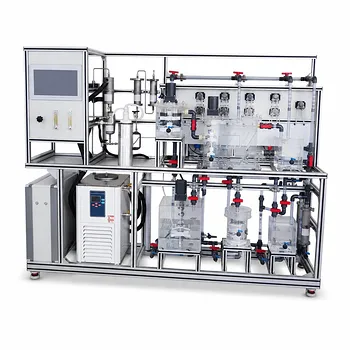
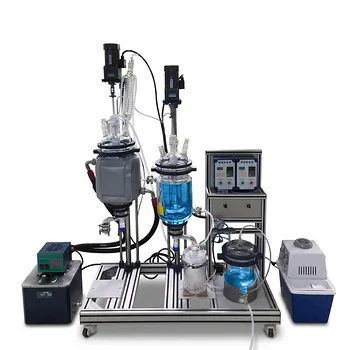
The crucial insight is that extractive distillation, despite its multi-feed, non-ideal nature, can be reduced to a simple graphical calculation. By assuming the solvent’s concentration is essentially constant across the column and treating the two key components as a pseudo-binary system, you can directly apply the McCabe-Thiele method to determine the required theoretical stages. This approach satisfies both preliminary engineering design and hands-on learning on a pilot plant.
For systems where the solvent boils much higher than the feed components and the key pair has similar chemical behavior, extractive distillation effectively becomes a pseudo-binary separation. The constant-solvent and constant-relative-volatility assumptions unlock the visual power of the McCabe-Thiele diagram, giving engineers and students a rapid, intuitive way to estimate theoretical stages and connect theory to a physical pilot column.
The Simplifying Assumptions That Make It Feasible
The core challenge of extractive distillation is the presence of a third component – the solvent – which alters the liquid-phase non-idealities. The simplification rests on two carefully validated conditions.
Why the Solvent Concentration Stays Nearly Constant
The solvent is chosen to have a high boiling point and low volatility.
Virtually all of it travels downward in the liquid phase, while the lighter key components partition into the vapor. Because the solvent’s thermal state and concentration change very little from tray to tray, its concentration in both the rectifying and stripping sections can be treated as constant. This removes the need to solve the full ternary material and energy balances simultaneously.
Transforming a Ternary into a Pseudo-Binary
With the solvent concentration fixed, the separation can be modeled as a pseudo-binary system of the two key components.
Their vapor-liquid equilibrium (VLE) is defined at the prevailing solvent concentration, yielding a new, modified relative volatility (α₁₂/ₛ) that remains nearly constant. You can plot this as a familiar VLE curve and then use the standard McCabe-Thiele construction.
Applying McCabe-Thiele to a Pseudo-Binary System
Once the system is reduced to a pseudo-binary, the calculation of theoretical stages follows the classic graphical routine. This is the practical heart of the simplification.
Drawing the Operating Lines
Use the same equations you would for a binary column.
For the rectifying section, the operating line is: [ y_{n+1} = \frac{R}{R+1}x_n + \frac{x_D}{R+1} ] For the stripping section, it becomes: [ y'_{m+1} = \frac{L'}{L'-W}x'_m - \frac{W}{L'-W}x_W ] The feed condition (q-line) is determined from the thermal state of the pseudo-binary feed, still accounting for the solvent’s presence in a lumped manner.
Stepping Off the Stages
Start at the distillate composition (xᴅ, xᴅ) on the 45-degree line. Draw rectangular steps between the operating lines and the modified equilibrium curve until you pass the bottoms composition (xᴡ, xᴡ).
Each step represents a theoretical stage. In a pilot plant, you would typically count the reboiler as a stage; if using trays, you often subtract one for the reboiler itself. This gives you a direct comparison to the physical bubble‑cap or sieve trays in the column.
Verifying the Simplified Model on a Pilot Plant
The real power of this approach emerges when you test it against a physical unit operations pilot plant. This bridges the gap between the simplified math and complex hydrodynamics.
Using Temperature and Concentration Profiles
A distillation pilot plant lets you take liquid samples from actual tray locations under steady‑state operation. Monitoring the temperature at each stage and analyzing the concentrations of the key components gives you an experimental concentration profile.
By overlaying this profile onto your McCabe-Thiele diagram, you can calculate the Murphree tray efficiency for each stage. The comparison reveals how real‑world mixing, entrainment, and weeping cause deviations from the theoretical prediction.
A Direct Link Between Graph and Glass
For educational settings, this visual link is invaluable. Students first compute the number of theoretical stages under the simplified assumptions, then run the pilot column and see that the actual number of physical trays is higher due to less-than‑ideal efficiency.
This exercise transforms a complex extractive distillation design into a teachable moment about mass transfer fundamentals – all while staying grounded in data from the pilot plant.
Understanding the Trade-offs
No simplification is free. Applying the pseudo-binary McCabe-Thiele method requires careful judgment about when the assumptions hold.
When the Simplification Breaks Down
The constant‑solvent assumption becomes risky if the solvent flow rate varies drastically – for instance, when the feed contains a large amount of solvent or when extreme temperature profiles change the liquid hold‑up.
Similarly, the constant‑relative‑volatility assumption fails if the key components have very different chemical properties that interact strongly with the solvent at varying concentrations. In such cases, the modified equilibrium curve is no longer reliable, and you must return to rigorous ternary simulations.
The Cost of Simplicity
Using the short‑cut method gives you a rapid estimate, but it may under‑ or over‑predict the real stage requirement by 10–20% for borderline systems. That margin is often acceptable for feasibility studies or when designing a pilot plant for educational purposes, where the physical column already has a fixed number of trays.
Still, never skip the pilot‑plant validation. The measured stage efficiencies allow you to back‑correct the theoretical calculation and refine your future designs.
Making the Right Choice for Your Goal
How you use these simplified calculations depends entirely on what you need to achieve.
- If your primary focus is rapid preliminary design: Apply the pseudo-binary McCabe-Thiele method with the constant‑solvent assumption. It yields a defensible first estimate of theoretical stages and solvent‑to‑feed ratio in minutes.
- If your primary focus is rigorous process design for scale‑up: Treat the pseudo‑binary approach as a sanity check only. Use it to guide detailed multi‑component simulations, then validate with pilot‑plant data to confirm actual stage efficiencies.
- If your primary focus is teaching extractive distillation: This simplification is a pedagogical goldmine. It lets students see the direct lineage from simple binary McCabe-Thiele to a complex ternary operation, making the abstract concept tangible through a real pilot column.
By internalizing this pair of judicious assumptions, you turn an intimidating multi-feed problem into a clear, graphical design tool that serves both the engineer and the student.
Summary Table:
| Parameter / Assumption | Description | Practical Impact / Limitation |
|---|---|---|
| Constant Solvent Concentration | Solvent concentration remains virtually fixed on all trays. | Eliminates complex ternary material/energy balances. |
| Pseudo-Binary VLE | Modified relative volatility is treated as constant. | Enables standard McCabe-Thiele graphical method. |
| Pilot Plant Validation | Compare experimental tray profiles with theoretical steps. | Ideal for calculating Murphree tray efficiency. |
| Method Limitations | Avoid if solvent flow varies widely or key pairs interact strongly. | May introduce 10-20% error margin; requires validation. |
Bring Theory to Life with LABPARK Pilot Plants
Are you looking to bridge the gap between complex distillation theory and hands-on engineering practice? LABPARK designs and manufactures premium Educational and Vocational Unit Operations Pilot Plants in chemical engineering, bioprocess & biotech, and environmental & water treatment.
Whether you are a university looking to enhance student lab work, a research institute validating scale-up models, or an enterprise optimizing chemical processes, our pilot columns provide the physical data you need to verify theoretical stage calculations and tray efficiencies.
Contact LABPARK today to discuss your laboratory's training or research requirements and request a custom pilot plant proposal!
Related Products
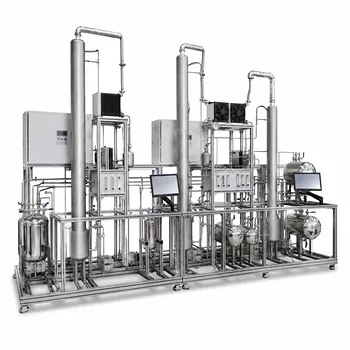
- Green Anhydrous Ethanol Purification Extractive Distillation Unit Operations Training Pilot Plant
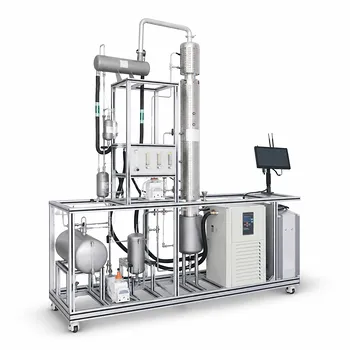
- Continuous Batch Extractive Distillation Educational Pilot Plant
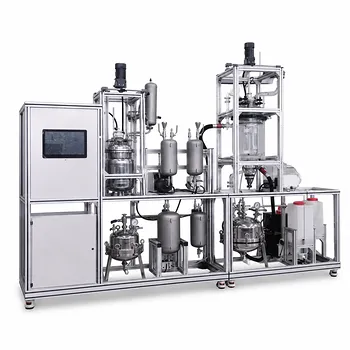
- Multi-Functional Special Distillation Educational Pilot Plant
- Green Anhydrous Ethanol Refining Practical Training Pilot Plant
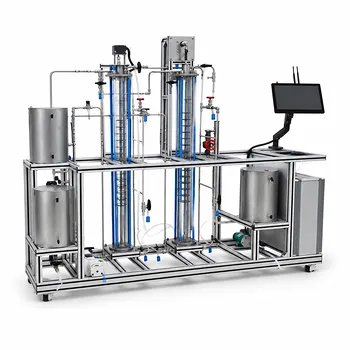
- Continuous Sieve-Plate Distillation Pilot Plant for Unit Operations Laboratory Education
People Also Ask
- How can energy balance equations for condensers & reboilers be validated experimentally? Guide
- Fugacity vs Activity Coefficient: How to Choose VLE Models for Distillation Pilot Plants
- How can real-time carbon number prediction improve distillation pilot plants? Optimize control.
- How Reflux Ratio Affects Distillation Pilot Plant Separation Efficiency & Limits
- Why run shortcut fractionation before rigorous distillation calculations? Optimize your pilot plant.