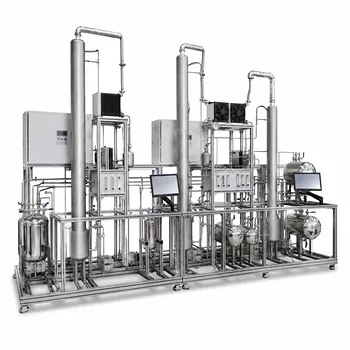
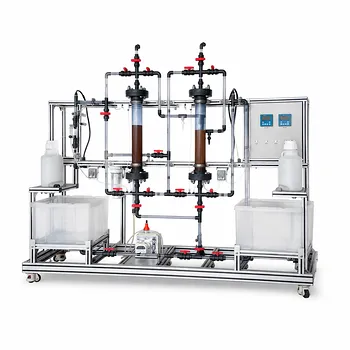
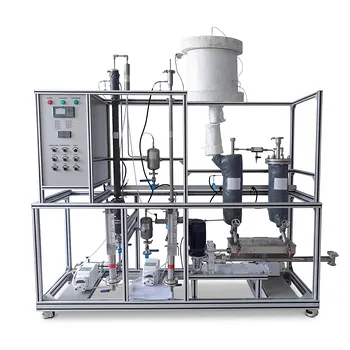
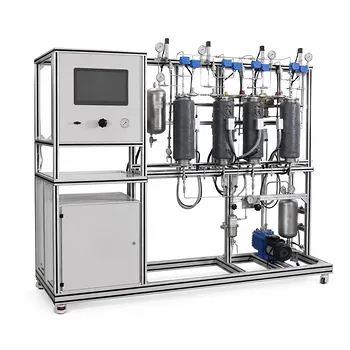
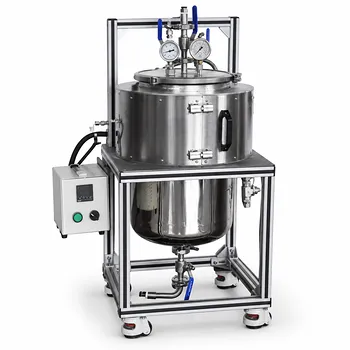
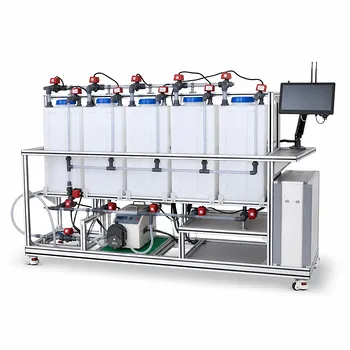
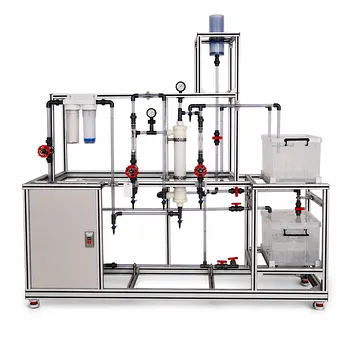
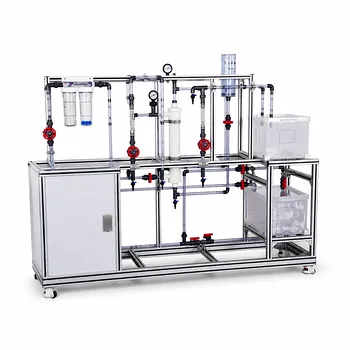
Here’s exactly what a dedicated unit operations pilot plant can demonstrate. It physically replicates the complete brine purification chain—primary precipitation and filtration to remove hardness ions, followed by ion‑exchange polishing—and shows how the treated brine feeds the membrane cell, how depleted brine is dechlorinated and recycled, and how caustic concentration is managed. The system makes visible every step that prevents irreversible damage to the expensive membrane.
The core takeaway: In a chlor‑alkali membrane cell, the membrane will fail quickly if exposed to hardness ions like calcium and magnesium. A pilot plant that models the full purification loop—precipitation, filtration, polishing, dechlorination, and recirculation—teaches that brine purity is not a one‑time step; it is an integrated, circular discipline that sustains cell performance and membrane life.
Why Brine Purification Is Non‑Negotiable for Membrane Cells
The membrane in a modern chlor‑alkali cell is a thin, selective polymer film.
It tolerates sodium ions and water, but hardness ions like Ca²⁺ and Mg²⁺ form precipitates inside the membrane structure.
These precipitates create local hot spots.
They block ion channels, increase voltage, and physically destroy the membrane within days.
The pilot plant makes this vulnerability tangible by showing that the purification steps are the gatekeepers of the entire electrochemical process.
The Pilot Plant as a Living Blueprint of the Industrial Brine Loop
A well‑designed unit operations pilot plant does not just purify brine in isolation.
It connects the purification train to a small electrolysis cell, forming a closed loop that mirrors industrial reality.
This setup demonstrates how saturated, purified brine is continuously prepared and fed to the anode compartment.
Simultaneously, it shows how depleted brine exits the cell, is dechlorinated to remove dissolved chlorine, re‑saturated with solid salt, and re‑circulated back through the purification units.
The pilot plant thus transforms a textbook flowchart into a hands‑on, process‑control challenge.
Step‑by‑Step Demonstration of Critical Purification Stages
Primary Precipitation and Filtration: Removing the Bulk of Hardness
The first stage of the pilot plant mirrors the industrial brine treatment.
Raw brine or re‑saturated depleted brine is dosed with chemical reagents—typically sodium carbonate and sodium hydroxide.
These reagents selectively precipitate calcium as calcium carbonate and magnesium as magnesium hydroxide.
A settling tank and a filter module then remove the solid precipitates, taking the hardness from tens or hundreds of ppm down to a few ppm.
Students and researchers can operate the pilot plant to observe how pH, temperature, and dosing rate affect precipitation efficiency.
They can sample the filtrate and measure residual hardness, directly linking chemical variables to separation performance.
Fine Purification via Ion Exchange: Achieving Parts‑per‑Billion Purity
Even after primary treatment, the brine still contains trace hardness that will poison the membrane.
The pilot plant therefore incorporates an ion‑exchange column—often filled with a chelating resin that selectively binds Ca²⁺ and Mg²⁺.
By passing the filtered brine through this column, the pilot plant demonstrates how hardness levels drop to less than 20 ppb.
The system can show breakthrough curves when the resin capacity is exhausted, a concept that is abstract until seen in real time.
The ion‑exchange step also illustrates the regeneration cycle.
Students switch the column to acid and caustic regenerants, balance waste streams, and bring the resin back to service, gaining practical insight into chemical management.
Depleted Brine Dechlorination and Recirculation: Closing the Loop
The depleted brine that leaves the anode compartment is saturated with dissolved chlorine.
Sending it directly back to purification would corrode equipment and interfere with precipitation chemistry.
The pilot plant integrates a dechlorination step, often using acidification and air stripping or a chemical reducing agent.
This station demonstrates how chlorine is safely removed before the brine is re‑saturated with solid salt and returned to the purification train.
By tracing the recycle line, learners see that brine purification is inherently circular.
The plant makes it clear that every litre of depleted brine must be treated as a valuable resource, not a waste.
Managing Caustic Concentration at the Cathode
While the focus is on brine, the pilot cell also demonstrates what happens on the other side of the membrane.
Water is reduced at the cathode, producing hydrogen gas and a sodium hydroxide solution.
The plant shows how the caustic concentration is controlled by managing the water balance and cell flow rates.
This reinforces the membrane’s role as a separator that must remain clean to maintain product quality and current efficiency.
Understanding the Trade‑offs and Realities
No pilot plant perfectly mimics an industrial chlor‑alkali facility.
Operations at small scale bring specific compromises that must be acknowledged.
Residence times and mixing differ from full‑scale vessels.
What works in a pilot‑scale precipitation tank may require significant re‑engineering for a 100,000‑litre industrial unit.
Ion‑exchange resin life is often longer in a clean pilot environment.
Students may miss the cumulative fouling challenges that dominate real plant economics, unless the pilot intentionally introduces upset conditions.
Safety systems must be exceptionally robust in an educational setting.
Chlorine gas generation, hydrogen handling, and strong caustic demand gas absorption systems, explosion‑proof fittings, and rigorous ventilation—adding cost and complexity that the pilot plant must explicitly demonstrate as a design principle.
Sampling frequency and online monitoring can be enhanced on a pilot scale.
This is a trade‑off that becomes an advantage: a well‑instrumented pilot plant trains operators in real‑time purity analysis and process analytics that are increasingly expected in industry.
Making the Right Choice for Your Goal
Use the pilot plant’s design and operation to match your specific objective.
- If your primary focus is teaching fundamental unit operations: Configure the plant to show each purification stage in isolation, with clear sampling points and simple analytical methods such as hardness titration.
- If your primary focus is membrane‑cell process research: Integrate the full loop and emphasize the cause‑and‑effect relationship between brine hardness, ion‑exchange breakthrough, and the membrane’s voltage rise.
- If your primary focus is process safety and scale‑up training: Build in the dechlorination and caustic concentration modules as mandatory elements, and task teams with writing standard operating procedures that mirror industrial hazard management.
- If your primary focus is demonstrating circular economy principles: Highlight the depleted brine recirculation path, measure the waste generation from resin regeneration, and explore strategies to minimize chemical consumption.
Mastering brine purification on a unit operations pilot plant turns an abstract chemistry lesson into an unforgettable design principle—because you only need to see one membrane fail from hardness to understand exactly why those purification steps come first.
Summary Table:
| Stage | Key Mechanism / Process | Educational & Process Value |
|---|---|---|
| Primary Precipitation | Chemical reagent dosing & filtration | Removes bulk hardness (Ca²⁺/Mg²⁺) to ppm level; teaches pH/mixing controls. |
| Ion-Exchange Polishing | Chelating resin column | Achieves sub-20 ppb purity; demonstrates resin breakthrough and regeneration. |
| Brine Dechlorination | Acidification & stripping/reduction | Safely removes dissolved chlorine; enables circular brine recirculation. |
| Caustic Concentration | Cathode water balance management | Explains current efficiency and membrane boundary separation dynamics. |
Bring Industrial Process Reality to Your Lab with LABPARK
Are you looking to bridge the gap between textbook theory and industrial chemical engineering? LABPARK provides state-of-the-art Educational and Vocational Unit Operations Pilot Plants in chemical engineering, bioprocess & biotech, and environmental & water treatment.
Designed specifically for universities, research institutes, and enterprises, our robust systems empower learners and researchers to master complex chemical loops, safety protocols, and circular process design.
Ready to elevate your engineering training and research capabilities? Contact LABPARK today to customize your pilot plant solution!
Related Products
- Electrolyte Distillation Purification and Formulation Educational Pilot Plant
- Green Anhydrous Ethanol Purification Extractive Distillation Unit Operations Training Pilot Plant
- Ion Exchange Water Purification Educational Pilot Plant for Engineering Unit Operations
- Fixed-Bed Chemical Reaction and Gas Dust Tar Removal Unit Operations Pilot Plant
- Steam Methane Reforming Hydrogen Production and Purification Educational Pilot Plant
People Also Ask
- Why does simple distillation yield higher efficiency than flash distillation? Key thermodynamic differences.
- How to Integrate Spectroscopy in Distillation Pilot Plants for Advanced Process Control
- Why is the acentric factor important in pilot plants? Fluid property prediction.
- How to Estimate Distillation Pilot Plant Tray Efficiency? O'Connell's Correlation Guide
- How does double temperature difference control improve distillation pilot plants? Stabilize purity.