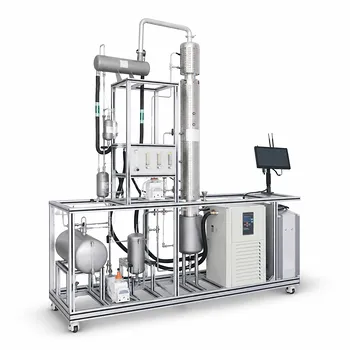
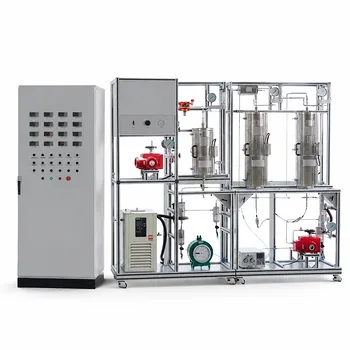
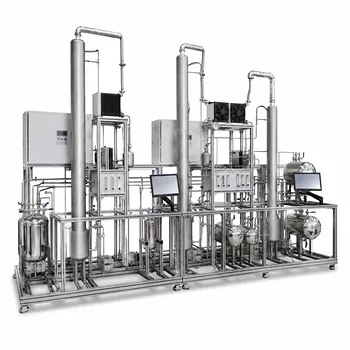
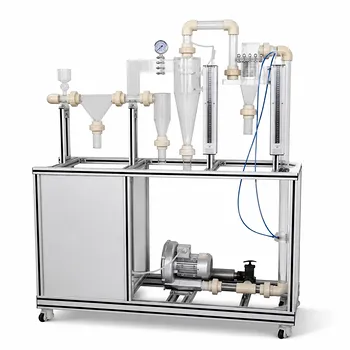
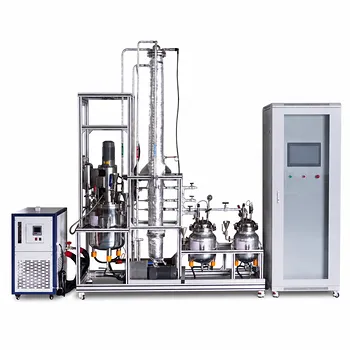
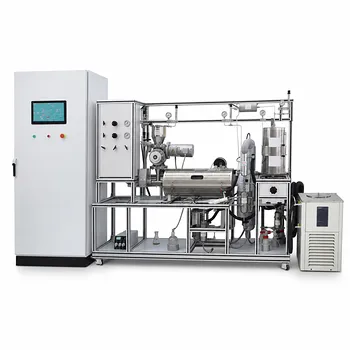
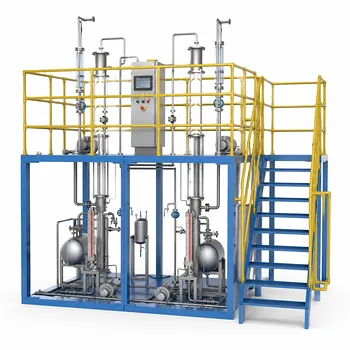
The answer is a carefully choreographed modular design. A unit operations pilot plant that integrates multi-stage reaction, phase separation, and vacuum distillation is built around a series of connected reactors, a gravity decanter, a vaporizer, and a vacuum-rated fractionating column—all equipped with comprehensive sensors and transparent glass sections. This configuration lets you physically observe the reaction kinetics, control phase boundaries, and perform the thermal separation under reduced pressure in one continuous loop.
A truly integrated pilot plant couples multi-stage chemical conversion with downstream physical separations. The core insight is that the design must prioritize flexibility, visibility, and robust data acquisition, so that every interface—from reactor to decanter to vacuum column—can be operated, monitored, and understood as part of a single unified process.
Designing the Multi-Stage Reaction Section
The foundation of the pilot plant is a reaction section that mimics industrial multi-stage conversion, not just a single vessel.
Series-Connected Reactor Vessels
Link multiple stirred tank or tubular reactors in series. Each stage functions as an independent reaction zone, enabling stepwise conversion and temperature control.
Circulation pumps between stages ensure uniform mixing and precise temperature profiling. This arrangement lets you study how intermediate species build up and how conversion shifts across the cascade.
Modular Heat Management
Use external inter-stage heat exchangers or internal cooling coils. In educational setups, clear jacketed reactors make the heat exchange visible while temperature sensors log the profile at each stage.
This modularity lets you compare different thermal strategies—like adiabatic operation with inter-bed cooling versus internal quench gas injection—using the same base hardware.
Enabling Reliable Phase Separation
After the final reactor stage, the crude product mixture often contains immiscible organic and aqueous phases. A dedicated separation step is essential before distillation.
Gravity Settlers and Decanters
Integrate a transparent gravity settler or decanter immediately downstream. The pilot plant’s glass construction makes the liquid-liquid interface directly visible, which is invaluable for teaching and troubleshooting.
Design the settler with adjustable weirs and overflow lines to handle varying phase ratios. This flexibility allows you to separate the reaction products cleanly, sending the organic phase forward to the vaporizer and the aqueous phase to waste or further treatment.
Handling Complex Phase Behavior
For azeotropic or multi-component separations later, you can add a secondary decanter after the distillation column to recycle entrainer-rich phases. The pilot plant’s modular piping makes this reconfiguration straightforward without major re-plumbing.
Transitioning to Vacuum Distillation
The organic phase must be vaporized before entering the distillation train. A controlled vaporization step ensures thermal stability, especially when working under vacuum.
The Vaporizer as a Bridge
Install a jacketed or electrically heated vaporizer between the decanter and the column. This unit brings the liquid to its bubble point while preventing thermal degradation—critical when you later pull a vacuum to lower boiling points.
Use pressure and temperature sensors at the vaporizer outlet to confirm that the feed enters the column as a saturated vapor, which is the ideal condition for fractionation.
Integrating the Vacuum System
Couple the distillation column to a vacuum pump, vacuum-rated seals, and pressure transducers. The entire column must be able to hold a stable sub-atmospheric pressure to demonstrate separation of heat-sensitive materials.
With glass column sections, students and researchers can watch the vapor-liquid contact dynamics change as the vacuum is adjusted, directly linking pressure, boiling points, and tray efficiency.
The Distillation Train: Fractionation Under Vacuum
The heart of the integrated pilot plant is a fractionating column designed for multi-component separation under vacuum.
Column Configuration and Operating Modes
Use a packed or tray column with multiple feed points at various heights. This modularity lets you switch between batch and continuous distillation by simply moving the feed line.
For a crude oil or olefin purification demonstration, preheat the feed, inject it at the appropriate stage, and draw product cuts from side streams and the top. The operating sequence—atmospheric pre-flash followed by vacuum fractionation—mirrors industrial practice and prevents thermal cracking.
Real-Time Data and Visualization
Populate the column with temperature sensors at every theoretical stage and pressure taps above and below the packing. Combined with glass sections, this turns the column into a “living McCabe-Thiele diagram” where you can observe flooding, weeping, and reflux dynamics while the software logs mass and energy balances.
Understanding the Trade-offs and Common Pitfalls
Integrating these unit operations introduces specific design challenges that you must address upfront.
Balancing Flexibility with Holdup
Modular connections (flanges, flexible hoses, adjustable feed points) are essential, but each extra valve and joint adds liquid holdup. High holdup distorts residence time distribution and can mask reaction kinetics. Minimize dead legs and use small-bore tubing where possible.
Pressure Cascade Management
The reactor may operate at slightly elevated pressure, the decanter at atmospheric, and the column under vacuum. You need careful placement of back-pressure regulators and control valves to maintain smooth flow without starving the vaporizer or pulling liquid backwards. Always include a vacuum break and inert gas purge capability.
Glass vs. Metal
Glass gives unmatched visibility but limits the pressure and temperature envelope. If your demonstration involves aggressive solvents or high vacuum, compromised joints can leak. A hybrid approach—glass for the decanter and column sections, stainless steel for the reactors and vaporizer—often strikes the right balance between safety and visual learning.
Making the Right Choice for Your Goal
Here’s how to align the pilot plant design with different educational or research objectives.
- If your primary focus is teaching integrated process concepts: Prioritize glass construction, numerous sensor points, and manually adjustable feed locations. The visual clarity and hands-on control will help students physically see each stage of reaction, decantation, and vacuum fractionation.
- If your primary focus is process development and data fidelity: Select stainless steel reactors with precise thermal mass-flow control, automated sampling at each stage, and a tightly integrated vacuum control system. Emphasize low dead-volume connections to get kinetic data that scales up reliably.
- If your primary focus is flexibility for multiple chemistry demonstrations: Invest in a truly modular skid with interchangeable column packs, reactor types, and quick-connect fittings. This allows you to reconfigure from a simple distillation trainer to a full reaction-separation train in hours.
- If your primary focus is demonstrating industrial heat recovery: Include multiple inter-stage heat exchangers and a side-stream reboiler tied to the column. This lets you illustrate how energy integration between the reaction and separation sections can dramatically cut utility costs.
A well-designed integrated pilot plant does more than train operators—it illuminates the deep interdependence of chemical conversion and physical purification. By choosing the right level of visibility, modularity, and instrumentation, you create a platform that transforms abstract process flow diagrams into tangible, tunable reality.
Summary Table:
| Section | Key Components | Design Focus & Benefits |
|---|---|---|
| Multi-Stage Reaction | Series-connected reactors, inter-stage heat exchangers | Stepwise conversion, precise temperature profiling |
| Phase Separation | Transparent gravity decanters, adjustable weirs | Visual interface control, clean organic/aqueous split |
| Vaporization & Vacuum | Jacketed vaporizer, vacuum pump, pressure sensors | Thermal stability, sub-atmospheric fractionation |
| Distillation Train | Packed/tray column, multiple feed points | Simulates continuous/batch separation & reflux dynamics |
Accelerate Your Research & Education with LABPARK
Are you looking to design or upgrade your laboratory's process systems? LABPARK provides premium Educational and Vocational Unit Operations Pilot Plants in chemical engineering, bioprocess & biotech, and environmental & water treatment. Specifically built for universities, research institutes, and enterprises, our modular designs offer maximum flexibility, visual clarity, and high-fidelity data acquisition.
Take the next step in process innovation—contact LABPARK today to customize your integrated pilot plant solution!
Related Products
- Multi-Modal Distillation Unit Operations Training Pilot Plant
- Multi-Functional Special Distillation Educational Pilot Plant
- Multi-Reactor Educational Pilot Plant for Reaction Engineering Unit Operations
- Multi-Functional Membrane Separation Educational Pilot Plant for Unit Operations Lab
- Multi Functional Membrane Crystallization Educational Unit Operations Pilot Plant
People Also Ask
- How can energy balance equations for condensers & reboilers be validated experimentally? Guide
- How does catalyst water concentration affect distillation pilot plant design? Key separation train choices.
- Why is vacuum operation capability an essential feature for a distillation unit operations pilot plant? Unlock Efficiency
- How can real-time carbon number prediction improve distillation pilot plants? Optimize control.
- What are the primary reflux ratio control strategies? Master Distillation Unit Operations