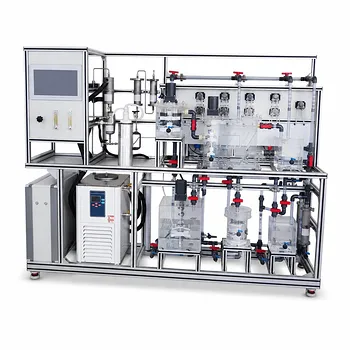
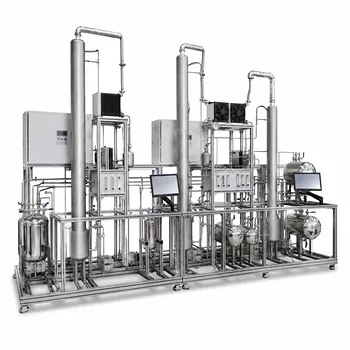
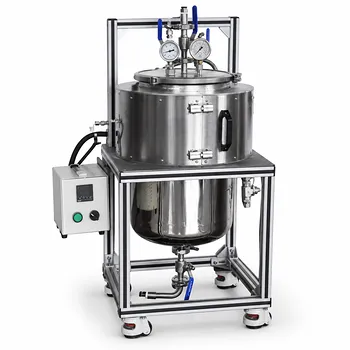
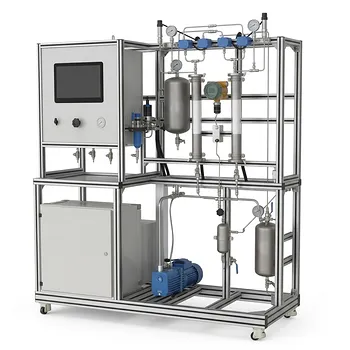
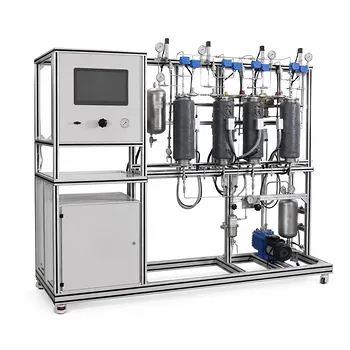
A pilot-scale FGD unit transforms the abstract theory of ammonia scrubbing into a tangible, hands-on laboratory experience. It lets students directly manipulate the same core process variables—liquid-to-gas ratio, pH, and temperature—that govern industrial desulfurization. By feeding a simulated flue gas spiked with a known concentration of SO₂ and then measuring the outlet concentration, they can instantly quantify removal efficiency and connect their operational choices to real-world performance outcomes.
The true educational power of a pilot-scale ammonia FGD unit lies not just in demonstrating >99% SO₂ removal, but in revealing the sensitive interplay of parameters that makes this efficiency possible. The most critical variable students discover is the counter-intuitive need to keep the pre-scrubber pH below 2 to prevent SO₂ stripping and unlock stable absorption, a lesson that bridges fundamental chemistry with practical process control.
The Essential Bridge from Classroom to Plant Floor
Chemical engineering education thrives when static equations become dynamic systems. A pilot-scale FGD unit serves as that bridge for the ammonia scrubbing process, compressing a full-scale industrial operation into a safe, observable, and controllable learning platform.
Why Scale Matters in Learning
Benchtop glassware cannot replicate the hydraulic behavior, column pressure drops, or recirculation dynamics of a real scrubber. A properly designed pilot unit introduces these real-world complexities without the overwhelming scale of a production plant.
Students see that absorption is not just a single equilibrium stage. It becomes a distributed mass-transfer process where solute concentrations, temperature profiles, and pH gradients evolve along the column height.
The Core Ammonia Scrubbing Chemistry in Action
The pilot unit circulates an ammonium sulfite/bisulfite solution that chemically captures SO₂. This is not a simple neutralization with ammonia gas; the scrubbing liquor itself is a reactive buffer that absorbs SO₂ and eventually leads to the formation of ammonium sulfate as a valuable byproduct.
The system demonstrates a complete process chain: absorption in the pre-scrubber, oxidation of the sulfite to sulfate, and finally, evaporation crystallization to harvest solid ammonium sulfate crystals approximately 300 μm in size. Students witness the full circular economy concept—turning a pollutant into a fertilizer.
Critical Parameters That Drive the Demonstration
The educational value of the unit is unlocked by systematically altering its operating conditions and observing the outcomes. Three parameters dominate the learning experience.
The Liquid-to-Gas Ratio (L/G)
The L/G ratio is the most fundamental lever in any wet scrubbing operation. Students vary the recirculation flow rate of the ammonium salt solution against a fixed simulated flue gas flow and immediately see the impact on SO₂ removal.
A higher L/G ratio generally improves mass transfer by providing more absorbent surface area and reducing gas-phase resistance. However, the pilot plant reveals the penalty: increased pumping energy and a risk of flooding. This trade-off between efficiency and cost is a core engineering lesson.
The Pivotal Role of pH Control
This is where the ammonia process reveals its unique character. Scrubbing SO₂ with an ammonium salt solution is highly sensitive to pH. Maintaining a pH below 2 in the pre-scrubber is a specific, non-intuitive requirement that the pilot unit brings to life.
Students learn that at a higher pH, dissolved SO₂ can be stripped back out of the solution, undermining absorption efficiency. By carefully metering acid (often sulfuric acid) to keep the pH in this low range, they ensure that SO₂ is captured and held in solution, ready for the subsequent oxidation step. This teaches precision in process chemistry control beyond simple neutralization.
Temperature Effects and Energy Integration
The pilot unit allows for controlled heating or cooling of the scrubbing solution. Raising the temperature reduces SO₂ solubility according to Henry’s Law, which can harm absorption. Yet, the downstream crystallization step requires elevated temperatures to evaporate water and precipitate the ammonium sulfate.
Students face a classic chemical engineering dilemma: optimize the absorption section for low temperature while providing enough heat to the crystallization section. The pilot plant’s instrumentation makes this heat integration challenge measurable and visual.
Quantifying Success: Demonstrating >99% Efficiency
The most compelling demonstration is a performance test. By introducing a simulated flue gas with an SO₂ concentration of, for example, 6100 μL/L and measuring the cleaned gas at the outlet, the unit can show desulfurization efficiencies exceeding 99%, with outlet concentrations falling below 61 μL/L.
This direct, numerical result transforms an equation from a textbook into a convincing proof of process viability. Students can then backtrack through their data logs—pH charts, flow meter readings, temperature profiles—to isolate which parameter adjustments created that performance peak.
Understanding the Trade-offs and Hidden Complexities
While the ammonia scrubbing pilot plant is an exceptional teaching tool, it does not hide its difficulties. Exposing these challenges is essential for building competent engineers.
- Corrosion at Low pH: Operating continuously below pH 2 demands materials of construction that resist acid attack. This teaches the critical link between process chemistry and materials selection, a lesson far more memorable than a textbook chapter.
- Ammonia Slip Management: The scrubbing solution can release trace ammonia gas, especially if pH control is lost. The pilot unit can demonstrate the need for a secondary washing stage or careful vapor-phase management, highlighting environmental compliance as a process constraint.
- Crystallization Control: Producing those 300 μm crystals on demand requires stable supersaturation. Students frequently encounter scaling on heat exchanger surfaces or poor crystal size distribution, learning firsthand how unit operations are intimately coupled.
Making the Right Choice for Your Educational Goal
The ammonia scrubbing FGD pilot plant is a flexible platform. The focus of your demonstration should align with your core learning objective.
- If your primary focus is process dynamics and control: Use the unit to run step-change experiments on pH and observe the delayed, oscillating response of the outlet SO₂ concentration. This vividly illustrates the need for tight feedback loops in unstable chemical systems.
- If your primary focus is mass transfer fundamentals: Isolate the absorption column and have students calculate the overall mass transfer coefficient (K_Ga) under varying L/G ratios, connecting packed-bed hydrodynamics to absorption kinetics.
- If your primary focus is industrial byproduct synthesis: Operate the full loop from absorption to crystallization, challenging students to optimize the crystal yield and purity by manipulating residence time, temperature, and oxidation air rate.
By moving beyond static theory and into a living, breathing chemical process, the pilot-scale ammonia FGD unit builds engineers who understand not just how desulfurization works, but how to make it work reliably.
Summary Table:
| Key Parameter / Stage | Operating Control / Target | Educational / Practical Takeaway |
|---|---|---|
| Liquid-to-Gas (L/G) Ratio | Varying recirculation flow | Balances mass transfer efficiency against pumping energy and flooding risks. |
| pH Control | Maintaining pH < 2 in pre-scrubber | Prevents SO₂ stripping; teaches precise buffer chemistry and corrosion management. |
| Temperature Integration | Heat/cool scrubbing solution | Demonstrates Henry's Law trade-offs between absorption and crystallization. |
| SO₂ Removal Efficiency | >99% efficiency (6100 to <61 μL/L) | Quantifies process viability through direct inlet vs. outlet concentration. |
| Crystallization Byproduct | ~300 μm ammonium sulfate crystals | Teaches circular economy concepts by converting pollutants into usable fertilizers. |
Bring Industrial Scale to Your Classroom with LABPARK
Ready to elevate your chemical engineering curriculum? LABPARK provides state-of-the-art Educational and Vocational Unit Operations Pilot Plants in chemical engineering, bioprocess & biotech, and environmental & water treatment. Designed specifically for universities, research institutes, and enterprises, our pilot plants—like the Ammonia FGD Unit—give students and researchers hands-on, real-world process experience.
Contact LABPARK today to request a quote or discuss custom configurations for your laboratory!
Related Products
- Two-Dimensional Fluidization Hydrodynamics Educational Pilot Plant for Unit Operations Training
- Fixed-Bed Chemical Reaction and Gas Dust Tar Removal Unit Operations Pilot Plant
- Fluidized Bed Gas Solid Catalytic Reaction Educational Pilot Plant
- Dual-Mode Gas Absorption and Desorption Unit Operations Training Pilot Plant
- Gas-Solid Heterogeneous Separation Demonstration Educational Unit Operations Pilot Plant
People Also Ask
- What pressure drop characteristics should students & researchers monitor in a fluidization pilot plant?
- How does active time pulsing mixing enhance fluid homogenization? Configuration Guide for Educational Pilot Plants
- How can acoustic chemometrics prevent reactor clogging in educational fluidized bed pilot plants?
- What is the operational significance of solids feed rate on emulsion phase dynamics in fluidized bed pilot plants?
- Why is UB/Ui critical in fluidized bed pilot plant modeling? Master Gas-Solid Contact