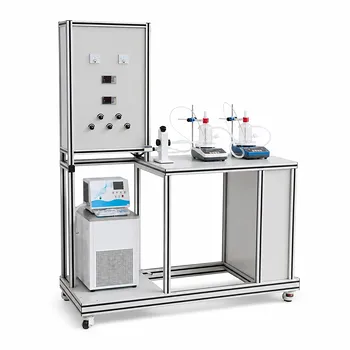
Azeotropic mixtures defy conventional distillation, but chemical engineering students can master their separation with hands-on tools.
A liquid-liquid extraction (LLE) pilot plant lets students directly demonstrate how a selective solvent extracts a target solute from an azeotropic feed, alters the remaining mixture so the azeotrope disappears, and then routes the separated components to distillation for final purification. By operating the pilot plant, students go beyond textbook theory to observe separation fundamentals, solvent selection, and the seamless integration of extraction with distillation – just as they would in industry.
Core takeaway: An LLE pilot plant enables chemical engineering education to physically break azeotropes by teaching the principle of solubility-based separation before distillation. Students can see, measure, and control the entire sequence – from solvent mixing and phase separation to downstream purification – embedding a practical understanding of why and how extraction solves what distillation alone cannot.
Why Azeotropes Demand a Different Approach
The Distillation Dead-End
When a liquid mixture reaches an azeotropic composition, the vapor and liquid phases become identical – the relative volatility is 1 – and conventional distillation cannot enrich one component further. Students see that in systems like ethanol-water, boiling at the azeotrope produces a vapor of the same composition as the liquid, halting any further purity increase no matter how many stages are used.
How Liquid-Liquid Extraction Bypasses the Azeotrope
LLE exploits solubility differences rather than boiling points. By introducing an immiscible solvent that selectively dissolves the target solute, the original azeotrope is chemically disrupted. Once extracted, the solute and solvent (or the raffinate) exhibit large boiling-point gaps and no longer form an azeotrope, making simple distillation a viable final step. This sequence teaches the core strategy behind countless industrial processes.
How a Pilot Plant Brings the Concept to Life
Hands-On Demonstration of Solvent Extraction
In a typical educational run, students prepare an azeotropic feed mixture and then mix it with a chosen solvent in a pilot-scale mixer-settler or extraction column. They immediately see the two immiscible phases form – one enriched in the solute, the other depleted. By sampling and analyzing the streams, they calculate extraction efficiency and partition coefficients, linking theory (like Nernst’s law) to measurable outcomes.
Visualizing Phase Separation and Mass Transfer
Modern LLE pilot plants frequently use transparent glass vessels or columns, so students can watch droplet coalescence, settling rates, and the sharp interface between phases. They quickly discover that physical properties such as density difference, interfacial tension, and viscosity control how fast phases separate – factors that are invisible in simulations but critical for equipment sizing and scale-up.
Integrating Extraction with Distillation for Complete Purification
After extraction, the solute-loaded solvent is routed to a distillation column for solvent recovery and pure product separation. Students can operate this integrated train directly, seeing how the LLE step eliminates the azeotrope and allows the downstream column to achieve target purities. This bridges unit operation theory and process integration in a tangible way.
Deepening the Learning: What Students Can Investigate
Solvent Selection and Partition Coefficients
Students rotate through different candidate solvents to compare their selectivity, distribution coefficients, and ease of recovery. This solvent screening exercise mirrors industrial R&D and demonstrates how the right choice can minimize the number of extraction stages and reduce downstream energy costs.
Effects of Physical Properties and Hydrodynamics
By measuring droplet size distributions and observing interface behavior, learners link fluid properties to axial mixing (backmixing) and mass transfer rates. They see how a small density difference can lead to emulsion formation and slow separation, prompting discussions on how to design internals or adjust agitation to optimize performance.
Real-Time Data Collection and Process Control
Pilot plants fitted with temperature, pressure, and level sensors allow students to collect dynamic data and calculate mass and energy balances on every stream. This teaches them to validate process models, detect steady-state conditions, and apply feedback control – all crucial skills for a modern plant engineer.
Understanding the Trade-offs and Common Pitfalls
An LLE pilot plant offers powerful learning, but it introduces real-world challenges that must be managed:
- Slow phase separation: When density differences are small, separation can take considerable time. Students learn that what works at lab scale may require coalescence plates, centrifuges, or longer residence times at pilot scale.
- Solvent loss and recovery costs: The solvent must be recovered and recycled, often by distillation, adding energy and capital. The overall process may only be economically viable if the azeotrope truly cannot be broken by pressure-swing or other methods.
- Emulsion and interfacial crud: Impurities or surface-active agents can stabilize emulsions, leading to poor separations. This teaches students to troubleshoot real feeds and understand pre-treatment requirements.
- Axial mixing impacts efficiency: Backmixing reduces the concentration driving force in extraction columns, so students must quantitatively assess how column height or packing influences mass transfer.
- Safety and solvent toxicity: Handling solvents like toluene or ethyl acetate in a pilot plant introduces health and fire risks, reinforcing HAZOP thinking and inherent safety design principles.
Making the Right Choice for Your Educational Goal
The way you use an LLE pilot plant depends on the learning outcome you prioritize.
-
If your primary focus is fundamental thermodynamics and phase equilibria: Have students map ternary phase diagrams, measure tie lines, and confirm that extraction shifts compositions away from the azeotrope. This anchors theory in direct observation.
-
If your primary focus is process integration: Structure the experiment to seamlessly connect the extraction stage to a downstream distillation column, letting students run the full train and compute overall recovery, purity, and solvent make-up rates.
-
If your primary focus is industrial troubleshooting and scale-up: Introduce deliberate challenges like varying viscosity or adding surfactants, then have students measure the impact on phase separation time and mass transfer efficiency, linking pilot data to screening criteria for industrial extraction equipment.
-
If your primary focus is data-driven engineering: Equip the pilot plant with SCADA or process historians so students can collect real-time trends, perform statistical analysis, and fit mass transfer parameters to dynamic models.
Hands-on liquid-liquid extraction training transforms azeotropic separation from an abstract impossibility into a clear, solvable engineering problem that students can physically execute from start to finish.
Summary Table:
| Learning Objective | Key Student Activity | Critical Engineering Skill Gained |
|---|---|---|
| Thermodynamics & Phase Equilibria | Map ternary phase diagrams & screen solvents | Select solvents based on selectivity & partition coefficients |
| Hydrodynamics & Separation | Observe droplet coalescence & physical interfaces | Size equipment and manage density & viscosity effects |
| Process Integration | Run integrated extraction & distillation loops | Calculate mass balances & optimize solvent recovery |
| Troubleshooting & Safety | Solve emulsion formation & manage solvent risks | Apply HAZOP principles & design for industrial scale-up |
Bring Industrial-Scale Learning to Your Laboratory
Equip your students and researchers with the tools they need to master complex chemical separation and process integration. LABPARK provides state-of-the-art Educational and Vocational Unit Operations Pilot Plants in chemical engineering, bioprocess & biotech, and environmental & water treatment designed specifically for universities, research institutes, and enterprises.
Ready to transform your curriculum or training program? Contact LABPARK today to explore our custom pilot plant solutions and request a technical catalog!
Related Products
- Educational Rotary Disc Liquid-Liquid Extraction Pilot Plant
- Comprehensive Liquid-Liquid Extraction Pilot Plant for Engineering Education
- Gallium and Indium Selective Extraction Educational Pilot Plant
- Ternary Liquid-Liquid Equilibrium Educational Pilot Plant
- Liquid-Liquid Mass Transfer Coefficient Determination Educational Pilot Plant
People Also Ask
- How do density and IFT affect liquid-liquid extraction pilot plants? Optimize Column Performance
- How to Estimate KD for Liquid-Liquid Extraction Pilot Plants Using Henry's Law when Lab Data is Limited
- How to Select a Liquid-Liquid Extraction Pilot Plant with Space Constraints: Key Factors
- In a liquid-liquid extraction pilot plant, how is a ternary-phase diagram utilized to determine solvent feed requirements?
- How to resolve emulsion in liquid-liquid extraction? 5 ways to ensure efficient phase separation