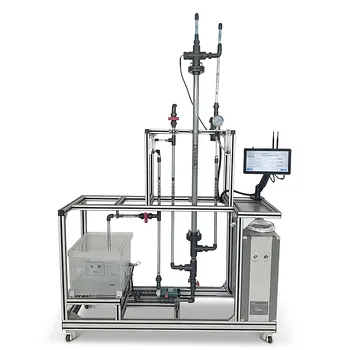
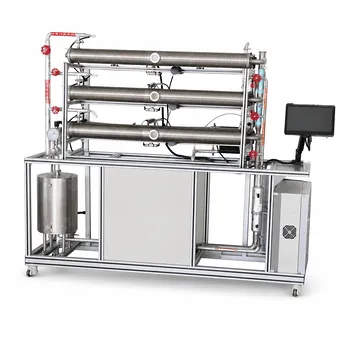
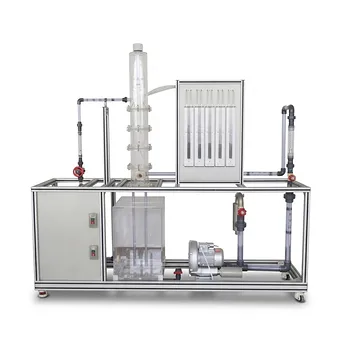
Creating a visible, measurable hydraulic jump in an educational flume starts by forcing flow from a supercritical state to a subcritical state—most commonly with an upstream sluice gate that accelerates water over the bed. Students then measure the rapid change in depth across the turbulent roller, capturing the conjugate depths ( y_1 ) and ( y_2 ). By verifying the conservation of momentum between these two cross‑sections, the experiment directly links textbook fluid mechanics to a critical unit operation in environmental engineering: the controlled dissipation of kinetic energy to protect waterways, mix chemicals, or aerate wastewater.
The core educational value lies not just in observing a dramatic hydraulic phenomenon, but in physically proving that the momentum equation governs the jump’s limits—a principle that underlies the design of spillways, stilling basins, and rapid‑mix chambers in water treatment plants.
How to Initiate the Hydraulic Jump
Generating Supercritical Flow with a Sluice Gate
A sharp‑edged sluice gate is the most reliable tool for generating supercritical (rapid) flow in a horizontal rectangular channel.
By lowering the gate close to the bed, you constrict the upstream flow, forcing a high‑velocity, shallow jet underneath.
This jet forms a M3 drawdown curve that begins at the gate and accelerates until the jump forms—exactly the condition needed to transition back to tranquil, subcritical flow.
Controlling the Jump’s Position
The location of the jump is extremely sensitive to the tailwater depth.
A downstream adjustable weir or gate controls the backwater level, allowing students to move the hydraulic jump upstream or downstream at will.
Raising the sluice gate increases the supercritical depth ( y_1 ), which tends to push the jump upstream; lowering it does the opposite.
When the tailwater is set too low, the jump will literally wash out of the downstream end of the flume; when it’s too high, the gate becomes submerged and the jump disappears entirely—a powerful demonstration of the conjugate depth threshold.
Alternative Triggers for the Demonstration
While a sluice gate is standard, the jump can also be triggered by other means available in most pilot plants.
- Channel slope change: Transitioning from a steep (supercritical) slope to a mild (subcritical) slope naturally produces a hydraulic jump at the break point, mimicking the base of a spillway.
- Overflow obstruction: A small weir or bump downstream can force a local transition, though this method is less stable for precise measurements.
Measuring the Jump and Verifying Theory
The Momentum Equation for a Rectangular Channel
For a horizontal rectangular channel with negligible side‑wall friction over the short jump length, the conservation of momentum simplifies to a relation between the conjugate depths ( y_1 ) and ( y_2 ) and the flow per unit width ( q = Q/b ):
[ \frac{q^2}{g} = \frac{y_1 y_2 (y_1 + y_2)}{2} ]
This equation is what students physically verify in the lab.
It says that for a given flow rate, there is always a unique pair of depths that satisfy momentum balance—one supercritical and one subcritical.
Step‑by‑Step Measurement Procedure
- Set a steady flow rate using the pump/control valve and record the discharge ( Q ) (volumetric method or in‑line flowmeter).
- Adjust the sluice gate to produce a stable, well‑defined jump in the visible test section.
- Measure ( y_1 ) just before the jump, where the flow is still smooth and parallel. A point gauge with a micrometer gives the needed accuracy.
- Measure ( y_2 ) after the roller has settled, typically a few channel widths downstream.
- Compute ( q = Q/b ) and plug both depths into the momentum equation to check if the left‑ and right‑hand sides match within experimental uncertainty.
- Repeat for multiple flow rates and gate settings to build a curve of observed conjugate depths against the theoretical prediction.
Critical Insights from the Data
Students quickly discover that the jump consumes an enormous amount of energy—the specific energy after the jump is always lower than before.
By comparing Froude numbers, they see that the upstream flow is truly supercritical (Fr > 1) and downstream flow subcritical (Fr < 1).
The experiment also reveals that the measured ( y_2 ) sometimes differs from theory because of air entrainment and turbulence; discussing these deviations forces a deeper understanding of real‑fluid effects.
Common Pitfalls and Trade‑offs in the Lab Setup
Gate Submergence and Jump Instability
The most frequent error is setting a tailwater depth that equals or exceeds the conjugate depth without the jump forming, causing the gate to become submerged.
When this happens, the flow simply returns to subcritical with no visible roller, and no useful measurement can be made.
The remedy is to drop the tailwater until a clean jump forms, then slowly raise it to reposition the jump without drowning the gate.
Obtaining Accurate Depth Measurements
Surface waves and air entrainment make the water surface appear higher than the time‑averaged depth.
Using a point gauge in a stilling well connected to the flow can dampen these oscillations, but even then, students must measure multiple times and average to reduce random errors.
The width ( b ) must be uniform; any warping of the channel walls introduces side‑friction effects that violate the simple momentum equation.
Simplifying Assumptions vs. Reality
The textbook equation neglects bed friction, air drag, and wall shear over the jump length.
For short jumps in smooth glass‑flumes, these assumptions hold reasonably well, but for larger jumps or longer runs, the measured ( y_2 ) will systematically deviate from theory.
Acknowledging this bridges the gap between idealized fluid mechanics and hydraulic engineering practice.
Practical Significance in Environmental Engineering Education
Energy Dissipation for Erosion Control
The hydraulic jump is nature’s most efficient way to destroy excess kinetic energy in a short distance.
In the field, spillway stilling basins, energy dissipators at culvert outlets, and drop structures all rely on a forced hydraulic jump to prevent downstream scour.
By measuring the energy lost in a flume, students directly connect a conservation law to the protection of rivers, bridges, and treatment plant outfalls.
Rapid Mixing and Aeration in Water Treatment
The violent turbulence of a hydraulic jump is not just destructive—it can be harnessed for process intensification.
In water and wastewater treatment plants, engineered hydraulic jumps serve as rapid‑mix units: the roller entrains air for aeration and provides instantaneous dispersion of coagulants or disinfectants.
Demonstrating this in a flume shows students that the same physics that dissipates energy also enhances mass transfer and reaction kinetics.
Linking Lab Principles to Real‑World Design
When students see the conjugate depth relationship hold in a tiny flume, they grasp why field engineers size stilling basins based on the same momentum equation.
The exercise also teaches the limits of control: if the tailwater rises too high during a flood, the jump will drown and the basin will function poorly—a failure mode that students can literally observe by over‑adjusting the downstream weir.
This hands‑on insight builds the judgment needed to design robust hydraulic structures in environmental water management.
Making the Most of This Experiment for Different Learning Goals
- If your primary focus is understanding momentum conservation: Drive the experiment by varying flow rate and measuring how the conjugate depth pair shifts, then calculate the momentum flux at each cross‑section to confirm it remains constant.
- If your primary focus is fluid mechanics visualization: Use dye injection upstream of the sluice gate to reveal the recirculating roller and the abrupt change in flow regime, turning an abstract equation into a vivid mental model.
- If your primary focus is environmental engineering design: Discuss the jump’s role in energy dissipation and rapid mixing, then challenge students to calculate the required basin length or chemical mixing time using their own measured depths and velocities.
A single flume experiment, correctly framed, transforms the hydraulic jump from a textbook abstraction into a tangible, measurable tool—one that sits at the core of both safe water infrastructure and effective treatment processes.
Summary Table:
| Stage | Key Method / Action | Educational & Practical Significance |
|---|---|---|
| Initiation | Use upstream sluice gate & tailwater weir | Generates supercritical flow & controls jump position |
| Measurement | Record depths ($y_1$, $y_2$) & flow rate ($Q$) | Verifies conservation of momentum & energy loss |
| Application | Analyze turbulence & energy dissipation | Connects to spillway design & wastewater aeration |
Elevate Your Engineering Lab with LABPARK
Bring fluid mechanics and environmental processes to life. LABPARK provides premium Educational and Vocational Unit Operations Pilot Plants across chemical engineering, bioprocess & biotech, and environmental & water treatment. Tailored for universities, research institutes, and enterprises, our equipment helps students bridge the gap between classroom theory and real-world engineering applications.
Ready to upgrade your laboratory? Contact our team today to find the perfect pilot plant solution for your curriculum!
Related Products
- Orifice and Venturi Flowmeter Calibration Educational Pilot Plant for Fluid Mechanics Laboratory
- Multi Pump Fluid Transport Process Piping Unit Operations Training Pilot Plant
- Fluid Transport and Piping Dynamics Practical Training Unit Operations Pilot Plant
- Ultrafiltration Membrane Separation Educational Pilot Plant
- Hollow Fiber Ultrafiltration Membrane Separation Educational Pilot Plant
People Also Ask
- What is the difference between static and stagnation pressure? Master Pilot Plant Flow Measurement
- How do pilot plants demonstrate siphon pressure variations? Visualizing Bernoulli's Energy Balance
- How do fluid mechanics training pilot plants facilitate the visualization and calculation of laminar and turbulent flows?
- How to update chemometric calibration models in pilot plants? Best practices for process engineers.
- Why are the laws of similitude critical in fluid flow pilot plants? Scale Up Safely