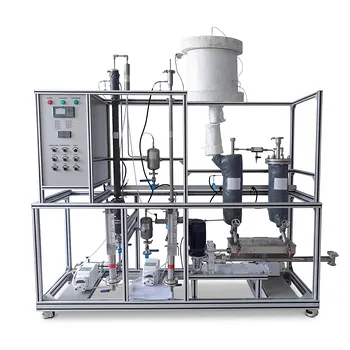
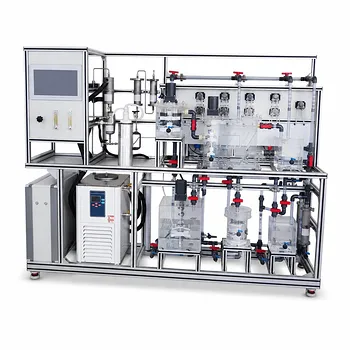
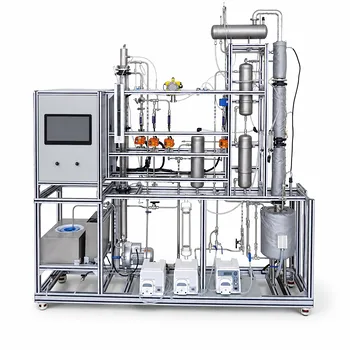
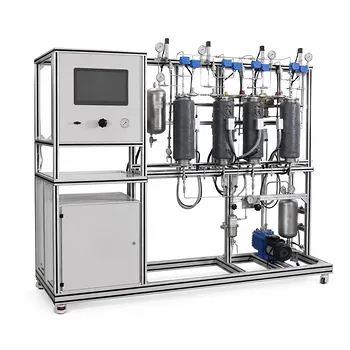
The most reliable pilot-plant configuration for high-efficiency organic vapor recovery couples absorption, membrane separation, and pressure swing adsorption (PSA) in a sequential train.
The gas stream first passes through a scrubber where a lean liquid solvent captures the bulk of the hydrocarbons. The remaining gas then enters a hydrocarbon-selective membrane module; vacuum on the permeate side yields a concentrated organic permeate and a lean retentate. Finally, the retentate is polished in a PSA unit, which uses the membrane’s operating pressure to drive adsorption and the vacuum to assist bed regeneration.
A hybrid absorption–membrane–PSA system is an educationally rich, industrially relevant design that achieves high recovery rates while demonstrating how each unit operation’s pressure and concentration footprint can be synergistically reused. The absorption stage cuts the organic load, the membrane concentrates the residual vapors for recovery, and the PSA provides the final emission-compliant polish.
The Core Configuration: Absorption, Membrane, PSA in Series
The Role of the Absorption Stage
The process opens with a gas-liquid absorption column (scrubber).
A cold, lean solvent – often a high-boiling hydrocarbon or glycol-based liquid – contacts the VOC-laden feed gas.
This unit removes the majority of the organic vapor mass, handling the fluctuating, high-concentration loads that are typical in tank venting or reactor off-gas scenarios.
Membrane Separation as the Concentration Engine
After bulk absorption, the partially clean gas flows to a hydrocarbon-selective membrane module.
The membrane’s thin rubbery permselective layer (usually PDMS or POMS) preferentially permeates organic vapors over air or inert gases.
A vacuum pump on the permeate side pulls a partial vacuum, creating a driving force that enriches the permeate stream with VOCs while leaving a lean retentate at near-feed pressure.
This enriched permeate can be condensed and recycled as liquid product or sent back to the absorption column inlet to boost recovery.
PSA for Final Polishing
The retentate, now containing only trace VOCs, enters a pressure swing adsorption (PSA) unit.
Adsorption beds packed with activated carbon or zeolites capture the residual hydrocarbons at the membrane’s discharge pressure.
Crucially, the same vacuum source that drives the membrane permeation can be staged to evacuate the PSA beds during regeneration, pulling desorbed VOCs back toward the membrane’s permeate stream for recovery.
This pressure‑vacuum integration avoids an extra vacuum pump and dramatically reduces the auxiliary energy demand.
Why This Sequence Maximizes High‑Efficiency Recovery
Matching Concentration to Technology
Absorption is most efficient when organic concentrations are moderate to high.
By placing the scrubber first, the system handles the bulk loading without overheating the membrane or overloading the PSA.
The membrane then thrives in the resulting lean‑to‑moderate concentration window, where its selectivity yields a concentrated permeate without excessive area.
Synergistic Pressure Use
The membrane retentate exits at nearly the feed compressor discharge pressure (if a compressor is used) or at system line pressure.
That pressure is directly usable in the PSA beds for adsorption – no extra booster blower needed.
During regeneration, the membrane’s vacuum system desorbs the PSA beds, and the released VOCs join the membrane permeate loop, avoiding an uncontrolled vent.
Load‑Shaving for Maximum PSA Life
Placing the membrane before the PSA shaves concentration peaks and selectively strips heavier organics.
This reduces the mass load and heat of adsorption on the PSA, extending bed life and maintaining the required emission standard even under fluctuating feed conditions.
Selecting the Right Membrane for Your Pilot Plant
PDMS for High‑Flux Standard Applications
Polydimethylsiloxane (PDMS) offers very high organic vapor permeance with acceptable selectivity.
It is the go‑to material when the pilot plant must handle large gas volumes and the target is rapid throughput demonstration.
The higher flux minimizes membrane area, making the module compact and cost‑effective for educational setups.
POMS for High‑Selectivity Research
Polyoctylmethylsiloxane (POMS) yields significantly higher hydrocarbon/air selectivity at the expense of lower permeability.
This choice shrinks the permeate flow, which in turn reduces the required vacuum pump size and operating cost.
Pilot plants that aim to study extreme emission limits or recovery of high‑value, low‑concentration compounds often prefer POMS to illustrate selectivity‑driven design trade‑offs.
Optimizing Vacuum and Recycle Streams
Permeate Recycle Loop
The enriched permeate stream is not just a waste to be flared – it is a concentrated product stream.
It can be sent to a small condenser and recovered as a liquid, or recycled back to the absorption column inlet.
A recycle loop raises the effective concentration entering the scrubber, pushing absorption efficiency above 99% overall recovery.
Vacuum Staging for Regeneration
By connecting the PSA desorption step to the membrane’s vacuum header, the system creates a closed‑loop vacuum network.
When the PSA bed needs regeneration, the vacuum valve opens, pulling the desorbed organics toward the membrane permeate side.
This avoids a separate vacuum train and keeps all recovered material within the process, demonstrating true industrial best practice in the pilot plant.
Understanding the Trade‑offs of Hybrid Systems
Increased Complexity and Control
A three‑technology train requires a more sophisticated control system.
Interlocks must manage solvent level, membrane pressure ratio, and PSA cycle timing simultaneously.
In an educational setting, this complexity is often a feature – students learn to balance cascading unit operations – but the design demands rigorous process automation and stable pressure control loops.
Solvent Loss and Regeneration Energy
Absorption solvents eventually become saturated and require thermal regeneration, typically by distillation.
The heat load for regeneration can be the largest energy consumer in the hybrid train.
Designers must evaluate whether the added recovery benefit justifies the steam or electricity input, especially when demonstrating economic viability.
Membrane Sensitivity to Heavy Hydrocarbons
Compounds like toluene or xylene can plasticize rubbery membranes, reducing selectivity over time.
The absorption stage must be robust enough to remove these aggressive species before they reach the membrane.
Regular solvent bleed‑and‑fresh‑makeup is needed to keep the lean solvent capable of protecting the membrane, adding operational cost.
Capital vs. Operating Cost Balance
While a hybrid system lowers the per‑unit VOC removal operating cost, the capital investment is higher than a single‑stage membrane or PSA unit.
For pilot plants that simulate high‑flow industrial scenarios, the long‑term savings in adsorbent replacement and solvent makeup often justify the upfront expense, but the economic case must be built on realistic utility and maintenance data.
Designing Your Pilot Plant for Maximum Impact
Based on the primary research goal, adjustments can be made to the base configuration while preserving the core sequence.
- If your primary focus is demonstrating maximum recovery (>99%): Keep the full absorption‑membrane‑PSA train and add a permeate‑to‑absorption recycle loop, using POMS membranes to minimize vacuum pump load while maximizing retentate cleanliness.
- If your primary focus is minimizing operating energy: Place a feed compressor only if necessary; consider using the membrane permeate vacuum for PSA regeneration and choose PDMS to reduce membrane stage pressure drop, lowering overall compression cost.
- If your primary focus is handling highly fluctuating feed concentrations: Install the membrane directly after the absorption stage to act as a load‑shaving buffer for the PSA, and add a surge vessel before the scrubber to dampen flow spikes.
- If your primary focus is recovering a high‑value compound (e.g., vinyl chloride monomer): Opt for POMS for higher selectivity, condense the permeate for direct reuse, and size the PSA only for the final safety margin, thereby preserving product purity.
- If your primary focus is educational demonstration of pressure integration: Design the control system to explicitly show how the membrane retentate pressure drives PSA adsorption and how the permeate vacuum assists desorption, using transparent vessel sections or pressure sensor data logging to visualise the pressure‑swing cycle.
A carefully configured absorption–membrane–PSA pilot plant transforms a batch of technical specifications into a living demonstration of sustainable vapor recovery – your students or stakeholders will walk away not just with data, but with the confidence to deploy these hybrid strategies in the real world.
Summary Table:
| Stage | Technology | Core Function | Key Advantage |
|---|---|---|---|
| 1. Bulk Removal | Absorption (Scrubber) | Captures the majority of organic vapor mass | Handles high/fluctuating loads & protects membrane |
| 2. Concentration | Membrane Separation | Concentrates residual VOCs in permeate | Generates lean retentate at pressure & rich recycle stream |
| 3. Polishing | Pressure Swing Adsorption (PSA) | Captures trace VOCs for final compliance | Reuses membrane pressure & vacuum for energy efficiency |
Bring Industrial-Scale Innovation to Your Lab with LABPARK
Looking to equip your facility with advanced, integrated systems for hands-on training and cutting-edge research? LABPARK provides premium Educational and Vocational Unit Operations Pilot Plants in chemical engineering, bioprocess & biotech, and environmental & water treatment.
Designed specifically for universities, research institutes, and enterprises, our custom pilot plants empower you to:
- Demonstrate Complex Hybrid Processes: Visually and operationally link multiple unit operations like absorption, membrane separation, and PSA.
- Expose Learners to Industry-Standard Control: Equip your teams with practical experience in process automation, vacuum integration, and system interlocks.
- Accelerate Environmental & Process Research: Obtain reliable, scalable data to optimize organic vapor recovery and emissions compliance.
Ready to elevate your educational curriculum or research capabilities? Contact LABPARK today to discuss your customized pilot plant requirements!
Related Products
- Natural Product Extraction Unit Operations Training Pilot Plant
- Supercritical High-Gravity Flash Evaporation Educational Unit Operations Pilot Plant
- Steam Methane Reforming Hydrogen Production and Purification Educational Pilot Plant
- Multi-Functional Special Distillation Educational Pilot Plant
- Dual-Mode Rectification Pilot Plant for Practical Training Unit Operations
People Also Ask
- How to Demo Solubility Sensitivity in SFE Pilot Plants? Practical Thermodynamics
- How do pilot plants differentiate physical vs chemical extraction? Enhance Chemical Engineering Training
- How are HTU and NTU applied to determine extraction column height? Guide to Pilot Plant Scaling
- How do fluid transport principles apply to pilot plant configuration? Optimize your unit operations.
- How can Hotelling's T² & Q statistics detect pilot plant abnormalities? Optimize Safety