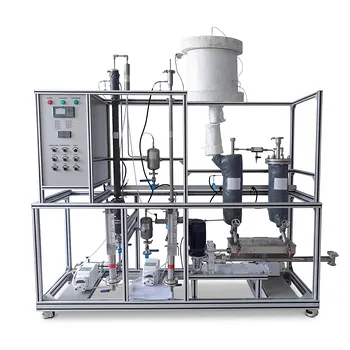
A pilot plant serves as the ultimate comparative laboratory, allowing you to physically produce, condition, and measure fuels to move beyond textbook theory. To demonstrate the differences, the plant must be configured to run the two distinct chemistries—transesterification for biodiesel and hydrodeoxygenation (HDO) for green diesel—and house the analytical instruments to quantify oxygen content, energy density, and ignition quality.
The fundamental demonstration is that green diesel is not just a "better" biodiesel; it is a chemically distinct hydrocarbon. A pilot plant proves this by showing that HDO strips all oxygen atoms from the feed, yielding a pure paraffinic fuel with 0 wt% oxygen, a 16% higher heating value (44 MJ/kg vs 38 MJ/kg), and a drastically superior cetane number (70–90 vs 50–65), explaining its classification as a true drop-in replacement for petroleum diesel.
The Chemical Foundation: Why the Difference Exists
The divergence in fuel properties originates entirely in the reactor vessel. A pilot plant configured with modular reaction stages makes this invisible chemistry visible through the resulting products.
The Transesterification Pathway
In a heated stirred-tank reactor operating at 320–350 K, the plant demonstrates that transesterification is a molecular restructuring, not a purification. The triglyceride backbone is cleaved, but the oxygen atoms in the ester bonds remain chemically locked within the Fatty Acid Methyl Ester (FAME) molecule.
This is immediately apparent in the subsequent separation units. The phase separation decanter reveals a dense glycerol layer, a direct visual cue of the oxygen-rich byproduct. The need for washing columns physically demonstrates a key molecular flaw: residual oxygen-containing contaminants require removal, highlighting the fuel's inherent polarity and hygroscopic nature.
The Catalytic Hydrodeoxygenation (HDO) Pathway
By switching the pilot plant's reactor to a high-pressure catalytic bed, you demonstrate a fundamentally different transformation. HDO is a removal process—a hydrotreating step where hydrogen gas strips oxygen atoms away as water and carbon oxides.
The measured product stream exiting the separator is a clear, water-white paraffinic hydrocarbon. There is no glycerol phase and no washing requirement, because the oxygen has been chemically eliminated, not rearranged. This direct observation explains the source of the 0 wt% oxygen content and the "good" storage stability, as the fuel lacks the polar, reactive sites that cause biodiesel to oxidize.
Mapping Unit Operations to Measurable Properties
A well-instrumented pilot plant translates the abstract property tables from the references into tangible operational measurements.
Measuring Energy Density and Ignition
The heating value gap (38 MJ/kg vs 44 MJ/kg) is not just a number; it is a consequence of oxygen content. You can connect these dots in the pilot plant by using a bomb calorimeter to directly measure the energy density of both products. The drier, deoxygenated liquid from the HDO unit will consistently produce a higher temperature rise, making the performance penalty of oxygenated fuels concrete.
The cetane number difference (50–65 vs 70–90) requires linking fuel structure to performance. The pilot plant can use an Ignition Quality Tester (IQT) to measure ignition delay. Researchers will observe that the linear paraffins generated by HDO ignite almost instantly, whereas the branched ester molecules of biodiesel exhibit a longer delay.
Assessing Long-Term Stability
The property of storage stability—rated "poor" for biodiesel vs. "good" for green diesel—is demonstrated through accelerated aging tests. A sample of washed FAME held at elevated temperature in the pilot plant’s glassware will rapidly form gums and sediment as unsaturated esters oxidize.
The green diesel sample, comprised of saturated hydrocarbons, remains clear and sediment-free. This simple visual comparison powerfully illustrates why a drop-in fuel must be oxygen-free to meet refinery pipeline specifications and avoid filter plugging.
Understanding the Trade-offs
Objectivity demands a clear look at the operational costs that a pilot plant reveals. These are the engineering constraints that shape real-world fuel choices.
The Hydrogen Cost of Perfection
While the HDO unit produces a superior fuel, it consumes enormous volumes of hydrogen. The pilot plant’s gas flow meters provide the critical counterbalance to the fuel quality data. Researchers can calculate the cost and energy input required to produce the 0 wt% oxygen fuel, quantifying the hydrogen demand that is entirely absent in the transesterification unit.
Catalyst Complexity vs. Ease of Operation
The transesterification route relies on a simple alkali catalyst at low pressure, but it generates a waste salt stream from the neutralization of free fatty acids. The pilot plant quantifies this through the neutralization vessel’s effluent mass. Conversely, the HDO route eliminates liquid base waste but requires high-pressure hydrogen, a robust metal sulfide catalyst bed, and significant capital cost for reactor construction—a trade-off vividly clear when operating both modules side-by-side.
Making the Right Choice for Your Research Goal
Your pilot plant configuration should be dictated by the specific engineering lesson you intend to teach or the data you need to gather.
- If your primary focus is demonstrating a true "drop-in" fuel: Operate the HDO reactor and analyze the liquid product. Focus on the cetane number, cloud point, and the complete absence of oxygen to show why this fuel can be processed in a standard petroleum refinery.
- If your primary focus is exploring process simplicity and renewable carbon efficiency: Run the transesterification unit and map the mass balance. Highlight how the ester product retains the original glyceride oxygen, avoiding the capital and operational cost of high-pressure hydrogen.
- If your primary focus is a rigorous economic-energy analysis: Run both systems simultaneously. Meter the electrical heating for biodiesel against the hydrogen consumption for green diesel to create a full comparative life-cycle inventory.
The power of the pilot plant lies in this simultaneous visibility; it transforms a list of fuel properties into a direct sensory experience of chemical engineering trade-offs.
Summary Table:
| Fuel Property / Parameter | Biodiesel (Transesterification) | Green Diesel (HDO) |
|---|---|---|
| Oxygen Content | Oxygen retained (ester bonds) | 0 wt% (oxygen stripped) |
| Heating Value | ~38 MJ/kg | ~44 MJ/kg |
| Cetane Number | 50–65 | 70–90 |
| Storage Stability | Poor (prone to oxidation/gumming) | Good (saturated hydrocarbons) |
| Byproducts | Glycerol and waste salt | Water and carbon oxides |
| Key Inputs | Triglycerides, alcohol, catalyst | Triglycerides, hydrogen, catalyst |
Advance Your Biofuel Research with LABPARK
Enhance your research and teaching capabilities with LABPARK. We provide cutting-edge Educational and Vocational Unit Operations Pilot Plants in chemical engineering, bioprocess & biotech, and environmental & water treatment for universities, research institutes, and enterprises. Our modular systems allow you to seamlessly compare transesterification and HDO pathways, bringing abstract fuel chemistry to life.
Contact LABPARK today to find the perfect pilot plant solution for your lab!
Related Products
- Bio-fermentation Ethanol Production Practical Training Unit Operations Pilot Plant
- Ethyl Acetate Synthesis Unit Operations Pilot Plant for Practical Training
- Dual-Mode Rectification Pilot Plant for Practical Training Unit Operations
- Multi-Functional Special Distillation Educational Pilot Plant
- Green Anhydrous Ethanol Refining Practical Training Pilot Plant
People Also Ask
- Why Use PTFE & Hastelloy in Chemical Pilot Plants? Prevent Corrosion & Ensure Safety
- Why Compare Predicted and Experimental Excess Enthalpy? Key to Accurate Pilot Plant Scale-up
- Why is the chemical plant startup schedule crucial? De-risk scale-up with pilot plants.
- When to transition from PID to adaptive control in pilot plants? Key process indicators.
- Why must batch and fed-batch fermentation pilot plants be designed to accommodate changing rheological conditions?