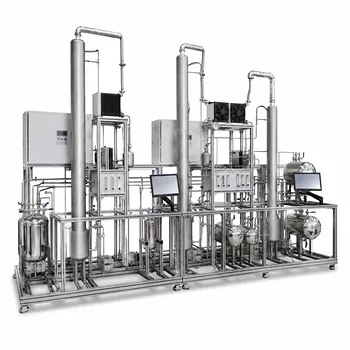
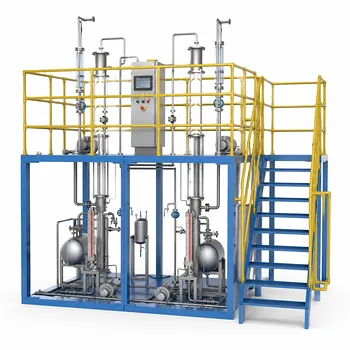
Bubble-point and dew-point calculations are your primary thermodynamic guideposts when starting and controlling a distillation pilot plant. They answer two immediate, operational questions: at what temperature will the liquid in the reboiler first begin to boil, and at what temperature will the overhead vapor first begin to condense? By nailing these two numbers, you set precise heater and cooler duties that establish a stable column pressure, prevent catastrophic flooding, and ensure you have both the rising vapor and descending reflux needed for separation.
The bubble point gives you the floor of the column’s temperature profile—the reboiler boiling point. The dew point gives you the ceiling—the condenser condensation point. Using these two thermodynamic anchors at startup and throughout the run allows you to bootstrap the column into a safe operating window and maintain the thermal equilibrium required for product purity.
Setting the Stage: Startup with Bubble‑Point Calculations
At startup, the pilot plant is cold and empty of the proper two‑phase flow. Bubble‑point calculations transform theoretical equilibrium into a heating schedule.
Finding the Reboiler’s First Bubble
The bubble‑point temperature of the bottom product mixture is the exact temperature at which the liquid begins to vaporize under the column’s operating pressure.
That value tells you when to throttle the reboiler heat input.
Start the reboiler heating gradually until the sump temperature climbs to the calculated bubble point—then hold. This ensures you generate initial vapor without overshooting into a thermal runaway that could lift the column pressure dangerously high.
Pre‑heater Control and Feed Flash
In a pilot column with a pre‑heater, you use the bubble point of the feed at the column’s pressure to set the pre‑heater exit temperature.
If the feed enters the column exactly at its bubble point, it flashes into a well‑defined vapor‑liquid split, which flash calculations can predict.
This gives you immediate two‑phase loading on the trays or packing and avoids thermally shocking the column with a subcooled slug that would collapse the vapor traffic.
Avoiding Overheating and Energy Waste
Pushing the reboiler far above the bubble point dumps excess sensible heat into the liquid that does not contribute to vaporization.
That excess energy increases the vapor boil‑up rate beyond design, risking flooding, and wastes utility steam or electricity.
The bubble point gives you a hard lower‑bound setpoint that maximizes vapor generation per unit of energy while staying within a controllable range.
Holding the Line: Dew‑Point Control of the Overhead Section
The overhead condenser must fully condense the vapour rising from the top of the column to create reflux. The dew‑point temperature of the overhead vapor dictates the minimum condenser exit temperature necessary to start condensation.
Condenser Setpoint: The Dew‑Point Target
Set the condenser coolant temperature so that the vapour leaving the top tray reaches its dew point—the temperature at which the first drop of liquid forms.
Operating the condenser exit within the dew‑point region guarantees two things: the vapor is fully convertible to liquid, and the produced liquid is saturated, ideal for reflux.
If the condenser exit temperature is too high, you get incomplete condensation, losing product out the vent and dropping reflux ratio.
Subcooling to Protect Pumps
If you need to pump the condensate to a downstream unit instead of using a costly compressor, you must cool it below its bubble point and keep it subcooled.
The required subcooling duty is calculated from the temperature drop, the mixture’s liquid specific heat capacity, and the mass flow rate.
Without this step, any pressure drop in the pump suction can trigger cavitation as the liquid flashes back to vapor, destroying the pump.
Preventing Incomplete Condensation
Monitoring the overhead temperature against the calculated dew point acts as an early warning.
A rising overhead temperature that approaches the dew point at constant pressure means you are losing condensation capacity—perhaps due to fouling or insufficient coolant flow.
By correcting it before the temperature crosses the dew point, you keep the reflux flow stable and avoid product loss.
Steering the Column: Thermodynamic Boundaries for Operation
Once the column is running, bubble‑point and dew‑point values define the entire temperature profile and limit how you adjust heat duties.
Mapping the Phase Envelope
For a multi‑component mixture at a fixed pressure, the bubble point and dew point mark the two ends of the two‑phase region (the phase envelope).
Inside this envelope, temperature lines run nearly horizontally—meaning that at constant pressure you can change temperature without drastically altering the vapor fraction.
Outside the envelope, temperature lines are near‑vertical; enthalpy changes become large for small temperature shifts. Operating within the two‑phase region keeps the column’s separation power, while straying outside it destroys the vapor‑liquid contact.
The Bubble‑Point Method in Simulation
Many pilot‑plant simulation tools use the Bubble‑Point (BP) method to solve the column’s material and equilibrium equations.
This algorithm is particularly stable for narrow‑boiling mixtures where stage temperatures are sensitive to composition shifts.
By iteratively solving the bubble‑point relation (∑ K_i x_i = 1) for each stage’s temperature, it provides a reliable internal model you can use to test proposed control setpoints before applying them to the physical pilot plant.
Tying Heat Duties to the Phase Boundaries
Condenser duty is computed as the enthalpy difference between the overhead vapour’s dew point and the condensate’s bubble point.
Similarly, reboiler duty is linked to the enthalpy required to raise the bottom liquid from the tray that feeds it to the bubble point of the bottoms product.
Any change in operating pressure shifts both bubble‑point and dew‑point curves, altering the required duties. Therefore, controlling column pressure at a constant value keeps these thermodynamic anchors fixed and prevents duty‑driven instability.
Understanding the Limits and Pitfalls
These calculations are only as reliable as the underlying thermodynamics and the assumptions you make.
Equation‑of‑State Sensitivity
The K‑values (y_i / x_i) that drive bubble‑point and dew‑point calculations depend on the equation of state chosen.
In a pilot plant handling polar or associating components, an ideal‑gas K‑value correlation can mispredict the boiling point by tens of degrees.
This leads to startup temperatures that are too low (no vapor) or too high (excessive flashing), risking safety and data integrity.
Assumptions of Equilibrium and Ideal Stages
Bubble‑point and dew‑point calculations assume thermodynamic equilibrium on each stage, but real pilot‑scale columns rarely achieve perfect equilibrium.
Startup transients, weeping, or entrainment can cause local compositions to deviate, so the calculated setpoints serve as a starting guide, not a rigid law.
Always verify the actual column temperature profile with in‑situ thermocouples and adjust the duty setpoints gradually.
When the Bubble‑Point Method Fails
The standard BP algorithm is robust for narrow‑boiling feeds, but it can struggle with wide‑boiling mixtures where a single enthalpy balance assumption breaks down.
In such cases, the bubble‑point temperature of the bottom product may be so far from the dew point of the feed that startup sequencing becomes non‑trivial; you may need to switch to a sum‑rates method or use dynamic simulation to avoid convergence failures.
Making the Right Choice for Your Pilot Plant
Every pilot plant has different priorities. Use the thermodynamic anchors as a decision framework.
- If your primary focus is safe, fast startup: Calculate the rebuilder bubble point and the overhead dew point before you apply heat. Set your initial heater and cooler setpoints 3–5°C below those thresholds, then step up slowly while watching column pressure and liquid levels. This minimizes thermal shock and prevents uncontrolled boiling.
- If your primary focus is consistent product purity: Lock the column pressure at a constant value using the phase envelope as your guide. Operate the reboiler temperature strictly near the bottoms bubble point and the condenser exit near the overhead dew point—this stabilizes the internal vapor and liquid traffic that delivers steady separation.
- If your primary focus is energy efficiency: Compute the condenser subcooling required to just avoid pump cavitation, and no more. Run the reboiler at the bubble point without excess superheat. Any energy beyond that is wasted utility cost without additional separation benefit.
- If your primary focus is simulation and education: Use the BP method for narrow‑boiling pilot mixtures to teach how composition influences stage temperatures. Validate the software predictions against the actual column’s temperature profile; the deviations reveal real‑world non‑idealities that textbooks alone miss.
Understand the bubble point and the dew point, and you understand the heartbeat of your distillation pilot plant. Set them right at startup, use them to bound every control decision, and the column will reward you with safe operation and meaningful data.
Summary Table:
| Operational Phase | Thermodynamic Metric | Key Action / Purpose |
|---|---|---|
| Startup | Reboiler Bubble Point | Set initial heating limits to prevent thermal runaway |
| Feed Control | Feed Bubble Point | Guide pre-heater temperature for stable flash vaporization |
| Overhead Condensation | Overhead Dew Point | Set coolant temperature to ensure complete condensation |
| Pumping | Condensate Bubble Point | Implement subcooling to prevent pump cavitation |
Elevate Your Chemical Engineering Lab with LABPARK
Ready to bring thermodynamic theory to life? LABPARK provides state-of-the-art Educational and Vocational Unit Operations Pilot Plants in chemical engineering, bioprocess & biotech, and environmental & water treatment. Designed specifically for universities, research institutes, and enterprises, our systems offer hands-on experience with precise distillation control.
Contact us today to discuss your laboratory requirements and discover how our solutions can enhance your teaching and research capabilities!
Related Products
- Continuous Sieve-Plate Distillation Pilot Plant for Unit Operations Laboratory Education
- Multi-Modal Distillation Unit Operations Training Pilot Plant
- Green Anhydrous Ethanol Purification Extractive Distillation Unit Operations Training Pilot Plant
- Dual-Mode Rectification Pilot Plant for Practical Training Unit Operations
- Ethyl Acetate Synthesis Unit Operations Pilot Plant for Practical Training
People Also Ask
- How can real-time carbon number prediction improve distillation pilot plants? Optimize control.
- How to select the right activity coefficient model (Wilson, NRTL, UNIQUAC) for distillation pilot plants?
- Why is vacuum operation capability an essential feature for a distillation unit operations pilot plant? Unlock Efficiency
- What are the primary reflux ratio control strategies? Master Distillation Unit Operations
- How does catalyst water concentration affect distillation pilot plant design? Key separation train choices.