The Moment the Solvent Vanishes
There is a specific moment in a supercritical fluid extraction (SFE) pilot plant that feels like a magic trick—though engineers prefer to call it a phase transition. You have a stream of fluid carrying precious cargo: the delicate essence of a plant, a bioactive compound, a flavor. Then, you drop the pressure.
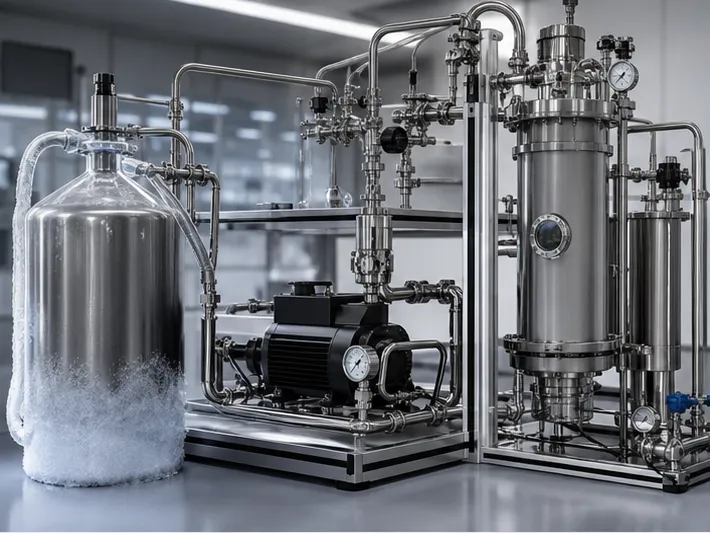
In an instant, the solvent literally disappears into a harmless gas, and the cargo falls out, pristine and untouched by heat. No toxic residue, no energy-intensive distillation. Just a pure extract and a gas ready to be used again.
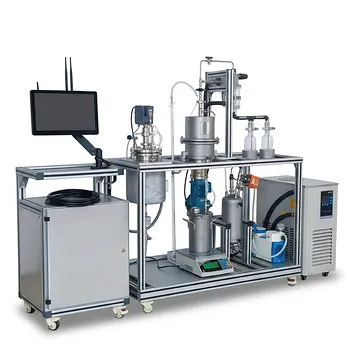
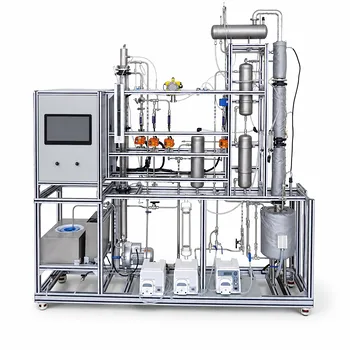
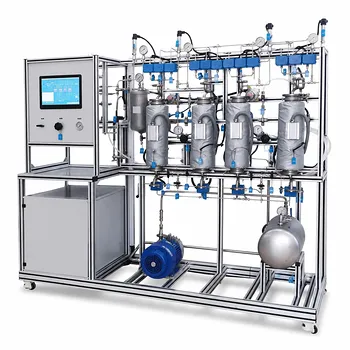
This vanishing act is the reason SFE units, like those developed by LABPARK, are redefining educational training for chemical engineers. It turns a complex closed-loop circulation system into an elegant, tangible lesson in green chemistry.
Why We Still Struggle to Separate Things
To understand the genius of the SFE loop, one must first appreciate the historical headache of separation chemistry.
For centuries, we’ve used a brute-force approach: soak things in a harsh liquid, then boil the liquid away. In the laboratory, this looks like a rotary evaporator working overtime. In industry, it looks like massive distillation columns consuming energy.
The psychology of this traditional method is simple—add, then remove. But this leaves a trail of problems:
- Thermal Degradation: Delicate molecules can’t survive the boiling process.
- Solvent Residue: Toxic traces of hexane or ethanol remain in the final product.
- Environmental Waste: Solvent vapors are vented or incinerated.
The supercritical CO2 pilot plant proposes a different logic: Turn the solvent into something that ceases to exist as a liquid the moment you stop wanting it to be one.
Mapping the Invisible Highway
Managing a substance that morphs between gas and liquid right inside steel pipes sounds complicated. But an SFE pilot plant isn't a mystery box; it’s a beautifully simple sequence of four unit operations. It’s a pressure-volume-temperature (PVT) playground.
Step 1: The Liquefaction and The Push
Gases are terrible to pump. They compress, they cavitate, they resist. So the journey begins with cold, dense liquid CO₂. It’s the only state predictable enough for a high-pressure pump to push against. The system takes this chilled liquid and pressurizes it far above the critical point of 7.38 MPa. At this stage, it’s just a pressurized liquid, waiting for the thermal trigger.
Step 2: Crossing the Critical Threshold
After the pump comes a heater. This is the ignition switch. The fluid crosses 31 °C. It’s no longer a liquid, yet not entirely a gas. It enters the supercritical realm. Here, CO₂ develops a split personality: it has the density of a liquid to dissolve compounds, but the low viscosity and high diffusivity of a gas. It flows through a packed bed of raw material like a ghost—penetrating the plant matrix rapidly, seeking out the target molecules.
Step 3: The Precipitation Ambush
The loaded supercritical fluid now bears the valuable extract. But we need to get the cargo out. The solution isn’t boiling; it’s decompression. An expansion valve crashes the pressure down to around 5 MPa. The supercritical fluid can’t hold its identity anymore. It reverts to a gas. In doing so, its dissolving power vanishes. The extracted compounds—now insoluble—simply “rain out” of the gaseous stream. They collect at the bottom of the separator, free of any solvent. For a student watching this, the lesson is visceral: pressure is a state of matter, and it controls solubility absolutely.
Step 4: The Eternal Return
We don’t vent the gas. In a linear economy, this CO₂ might be lost to the atmosphere. But this system is a true cycle. The low-pressure gas flows into a condenser, surrenders its heat, and collapses back into a liquid. This liquid drips right back to the suction side of the high-pressure pump, ready to start the loop again. The solvent inventory is permanent. It is a perfect model of industrial symbiosis.
The Psychology of a “Clean” Machine
Why do engineers find this process so intellectually satisfying? It removes the guilt. Traditional extraction always involves a trade-off—purity versus toxicity, yield versus energy. SFE is a system where the fundamental laws of thermodynamics do the cleaning work for you.
The Low-Temperature Advantage
The critical point of CO₂ is 31 °C. That is barely skin temperature. Heat-sensitive compounds—antibiotics, omega-3 oils, natural flavors—have no idea they are being processed. They slip out of the raw material without ever witnessing a thermal assault. The science has an almost surgical precision; it extracts without damaging the tissue.
The “Gas-Like” Mass Transfer
A common cognitive error in the lab is assuming a dense fluid must be thick and slow. Supercritical CO₂ breaks this intuition. Its mass transfer rate is blazingly fast because its viscosity remains gas-like. In an educational pilot plant, this means you can run a full extraction cycle in a fraction of the time required by liquid ethanol. You get rapid feedback, which is the secret to deep learning.
Zero-Tolerance for Residue
There is a profound business and safety argument here. CO₂ is non-toxic, non-flammable, and inert. You do not need an ATEX-rated explosion-proof room. When the extraction ends, the product contains no solvent because the solvent has returned to its gaseous state. It satisfies the modern consumer’s demand for a “LABPARK-clean” ingredient, where the label doesn't need to explain which chemical was used to strip the plant.
The Struggle in the Separator: Honesty About Limits
A machine that teaches only success teaches nothing about engineering. The SFE pilot plant has a personality, and it has bad days. The separator is often where this reveals itself. Extracts can be sticky, waxy, or stubborn. They don’t always fall neatly out of the gas stream. Sometimes they coat the walls. Managing separator conditions isn't a recipe; it's a negotiation.
Furthermore, pure CO₂ is a non-polar solvent. It loves lipids and volatile oils but shuns polar compounds. To grab these, we often need a co-solvent—a splash of ethanol. This complicates the clean loop:
- Suddenly, the ethanol needs its own recovery system.
- The “solvent-free” claim becomes a “solvent-low” claim.
- The capital expenditure for high-pressure pumps and chillers makes the unit a significant asset, not a consumable trinket.
But in a well-designed pilot plant, these trade-offs aren't hidden. They are engineered to be visible. The pressure gauges, the flowmeters, the temperature controllers—they tell the honest story of the energy required to achieve this green miracle.
Building Training with Impact
For a university or research institute, equipment isn’t just a production tool; it is a narrative device. An SFE pilot plant offers three distinct training profiles depending on the story you are trying to tell.
For the Green Chemistry Narrative: Focus on the closed loop. Show that solvents don't have to be waste streams. Use the machine to calculate the exact reduction in carbon footprint compared to hexane extraction. Let the students see the reuse rate of one single batch of CO₂ over dozens of cycles.
For the Unit Operations Intensive: Disrupt the equilibrium. Make the students map the extraction curve by changing the pressure and watching the yield spike. Unit operations training is about connecting the dial on the heater to the composition of the vial in the separator. The SFE plant makes thermodynamics tangible.
For the Scale-Up Economist: Use the pilot plant to mock the future. Before committing to a 1,000-liter industrial vessel, you test the "pressure-temperature-core flow" envelope here. The lessons learned about energy integration at this scale will dominate the financial viability of the larger factory.
From Lab Curiosity to Industrial Clarity
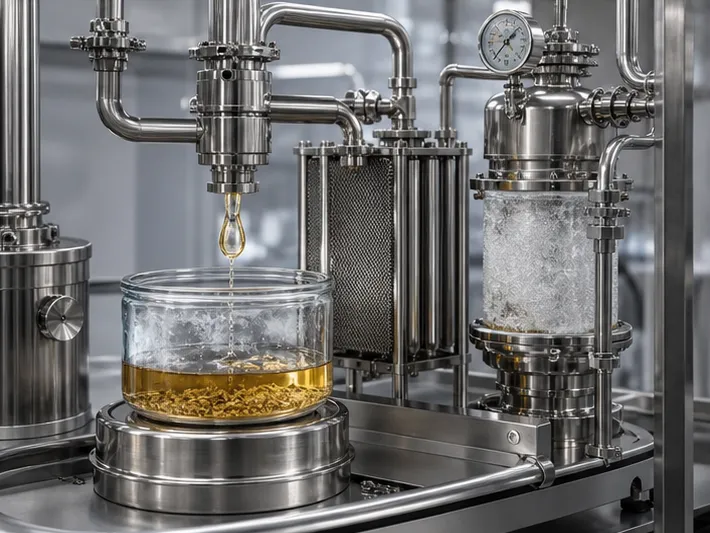
The table below summarizes the closed-loop state management in a way that is specific enough for a process engineer yet clear enough for a vocational student learning about separation technology for the first time.
| Step | CO₂ Phase Shift | Core Unit Operation | Purpose in the Loop |
|---|---|---|---|
| 1. Pressurize & Heat | Liquid ➔ Supercritical | High-Pressure Pump + Heater | Crossing the critical point to unlock the dual liquid/gas properties. |
| 2. Extraction | Supercritical (scCO₂) | Extractor Vessel | Selective solvation; the fluid penetrates and strips the target molecules. |
| 3. Depressurization | Supercritical ➔ Gas | Expansion Valve + Separator | The vanishing act; solubility drops to zero, precipitating pure extract. |
| 4. Condensation | Gas ➔ Liquid | Condenser | Thermal reset; liquefying the gas to restart the silent, zero-waste cycle. |
The supercritical CO2 cycle is a lesson in control. It proves that we don’t need to generate chemical waste to solve separation problems. We just need to manage pressure and temperature with precision. For any institution training the next generation of engineers, this machine is the bridge between the textbook and a sustainable future.
Ready to transform your lab’s teaching capabilities with hands-on fluid extraction and green chemistry engineering? Contact Our Experts
Related Products
- Supercritical High-Gravity Flash Evaporation Educational Unit Operations Pilot Plant
- Low Concentration Carbon Dioxide Capture Pressure Swing Adsorption Educational Pilot Plant
- Bench Scale Carbon Dioxide Capture Educational Unit Operations Pilot Plant
- Carbon Dioxide Adsorption and Capture Educational Unit Operations Pilot Plant
- Carbon Dioxide Absorption and Desorption Educational Pilot Plant for Carbon Capture Studies
Related Articles
- The Machine That Teaches Green Chemistry by Making Pressure Visible
- The Invisible Thread: How Supercritical CO₂ Weaves a Future Without Water
- The Physics of Safety: Why Supercritical CO2 Turns a Pilot Plant into a Classroom Without a Poison Cabinet
- The Solvent That Disappears: Supercritical CO₂ and the New Logic of Pilot Plant Operations
- The Bridge Between a Material's Promise and a Carbon Capture Plant's Reality